Clear Sky Science · en
High efficiency of antibacterial activity-based Zn-Co@BTC MOF against Bacillus bacterial cells
Why New Germ-Fighting Materials Matter
Food poisoning and hospital infections are everyday threats, made worse by germs that no longer respond to common antibiotics. This study explores a new type of man‑made porous solid, built from metals and organic building blocks, that can strongly slow down or even completely stop the growth of a troublesome food‑borne bacterium called Bacillus cereus. The work points toward future coatings, filters, or medical materials that could quietly kill germs without relying on traditional drugs.
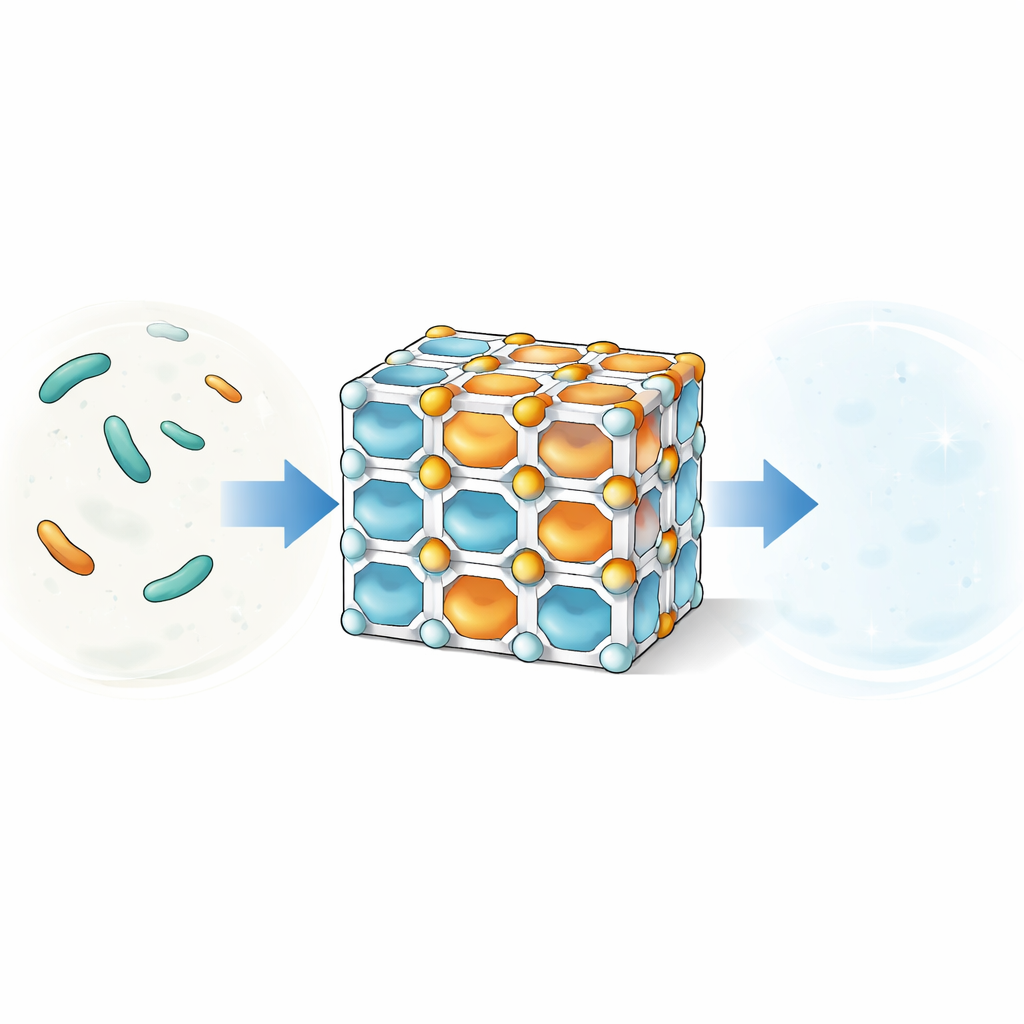
Building a Tiny Sponge to Fight Bacteria
The researchers created a material known as a metal–organic framework, or MOF, using zinc and cobalt atoms linked together by a small carbon‑based molecule. The result is a rigid, sponge‑like solid with an enormous internal surface area and many tiny pores. They chose a simple water‑based recipe and moderate heating, so the process is relatively economical and environmentally friendly. The final product, called Zn–Co@BTC, appears as pink particles made up of interlocking rods and plates when viewed under powerful microscopes.
Testing Strength, Stability, and Structure
Before turning this solid against bacteria, the team had to be sure it was well built. They used a suite of tools—light absorption measurements, infrared and Raman vibrations, X‑ray patterns, and surface‑area tests—to confirm that the framework had formed correctly and that both metals were evenly woven into the structure. These measurements showed that the material is highly porous, with many open channels for contact, and remains stable up to temperatures of roughly 500 °C. Chemical probes at the surface confirmed that zinc and cobalt sit in the expected chemical environment, strongly tied to the organic linkers but still capable of interacting with their surroundings.
Putting the New Material Up Against Germs
The scientists then challenged Bacillus cereus, a bacterium known for causing vomiting and diarrhea when it contaminates food. They grew the microbes in nutrient broth and on solid plates, adding different amounts of the Zn–Co@BTC powder. By tracking how cloudy the liquid became and how many colonies formed on plates, they could measure how well the bacteria were growing. At low doses, growth began to slow; at higher doses, it nearly stopped. At 600 milligrams of material per liter of liquid, bacterial growth was reduced by 99.9 percent. At 800 milligrams per liter and above, growth was completely halted, meaning the material was not just slowing down the microbes but effectively killing them.
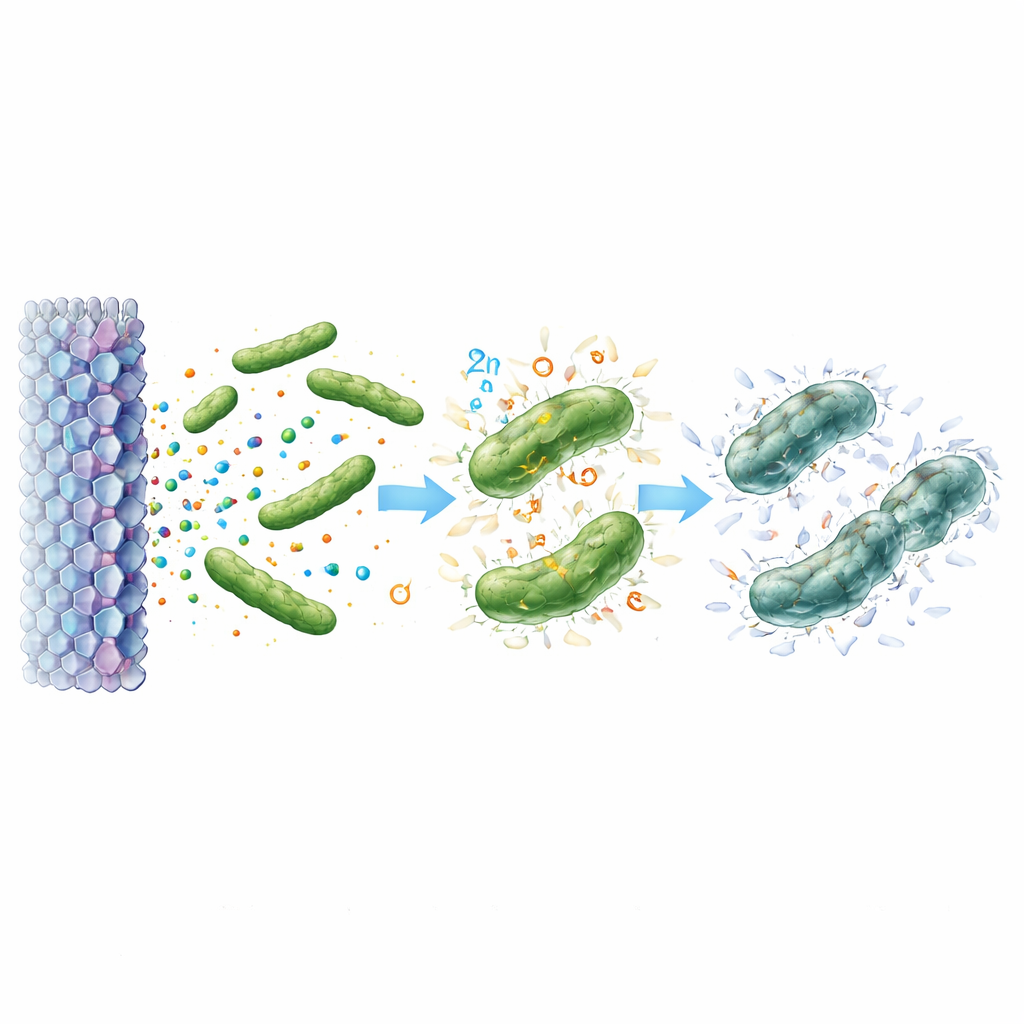
How the Material Damages Bacteria
The team proposes that the material attacks bacteria in several coordinated ways. First, the germs stick to the rough, high‑area surface, bringing them into close contact with the solid. Once there, small amounts of zinc and cobalt ions seep out of the framework and move into or onto the cells, upsetting the balance of metals that many enzymes need to function. At the same time, the surface chemistry helps generate reactive oxygen species—high‑energy forms of oxygen that can punch holes in cell membranes and damage proteins and DNA. As membranes are weakened, the contents of the cells leak out, essential enzymes are blocked, and the bacteria quickly lose their ability to survive and reproduce.
What This Could Mean for Everyday Life
Overall, the study shows that a carefully designed zinc‑ and cobalt‑based porous solid can act as a powerful, multi‑pronged killer of Bacillus cereus, fully wiping out the bacteria at sufficiently high doses. While other related materials may work at lower concentrations, Zn–Co@BTC combines strong germ‑killing power with good stability and a relatively simple, water‑based preparation. In the future, materials like this could be built into food‑processing surfaces, water filters, or medical devices to passively control harmful microbes, offering an extra layer of protection alongside traditional antibiotics.
Citation: Abdelnasser, E., El-Naggar, A.A., Lotfy, L.A. et al. High efficiency of antibacterial activity-based Zn-Co@BTC MOF against Bacillus bacterial cells. Sci Rep 16, 9731 (2026). https://doi.org/10.1038/s41598-026-42070-5
Keywords: antibacterial materials, metal organic frameworks, Bacillus cereus, zinc cobalt MOF, antibiotic resistance