Clear Sky Science · en
Kerogen-rich rocks influence growth and composition of an anaerobic microbial community
Rocks That Quietly Feed Hidden Life
Far beneath our feet, in dark, oxygen-free rocks, countless microbes survive on scraps of ancient carbon. This study asks a deceptively simple question with big implications: do different kinds of carbon-rich rocks make underground life thrive, struggle, or change its character—and what might that mean for life on other worlds?
Ancient Carbon Locked in Stone
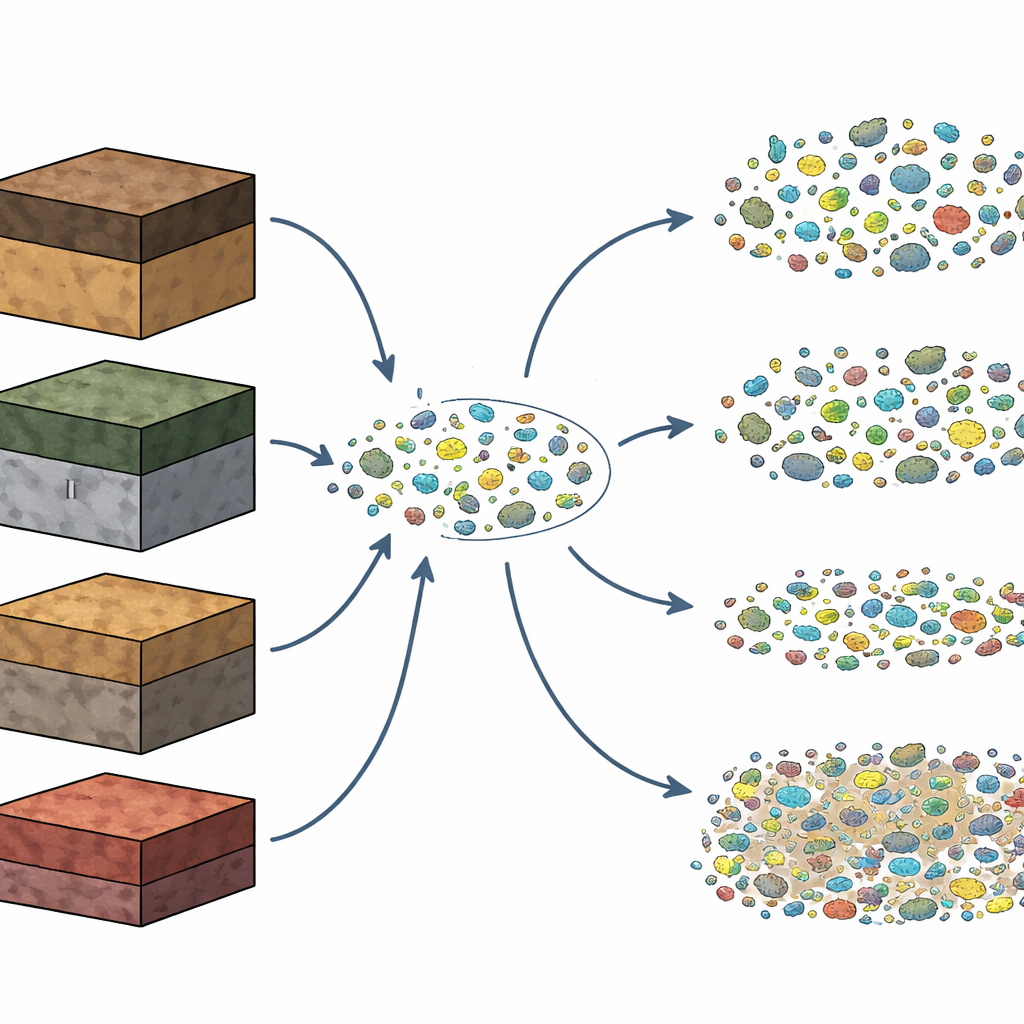
Most of Earth’s organic carbon is not in forests or oceans, but locked inside a tough material called kerogen, embedded in shales and coals. Kerogen forms from buried plants, algae, and other organic remains that are slowly cooked and compressed over millions of years. Geologists group it into four main types based on how it formed and how altered it is. Types I and II, found mainly in shales, are rich in long carbon chains and can generate oil and gas. Type III, common in coal, is more aromatic and chemically harsher. Type IV is the most altered and oxidized, a burnt, charcoal-like residue traditionally seen as poor fuel—and often ignored. Yet this type closely resembles the complex organic material found in meteorites and on planetary surfaces, making it a natural stand-in for extraterrestrial carbon.
A Controlled Underground World in a Bottle
To see how these rock types affect life, the researchers built miniature, oxygen-free "worlds" in glass bottles. Each microcosm contained a carefully prepared microbial community originally collected from a muddy pond bottom, then pre-adapted to grow on meteorite material rich in type IV–like organics. The team added powdered rocks rich in one of the four kerogen types—or no rock at all as a control—plus a basic nutrient medium with acetate so that simple starvation would not confuse the results. Over 11 days, they tracked how many microbes grew by counting colonies on plates, measured acidity (pH), analyzed gases such as carbon dioxide and hydrogen, sequenced microbial DNA to see which families took over, and used electron microscopes to inspect how cells interacted with rock surfaces.
Some Rocks Help, Some Harm, Some Just Watch
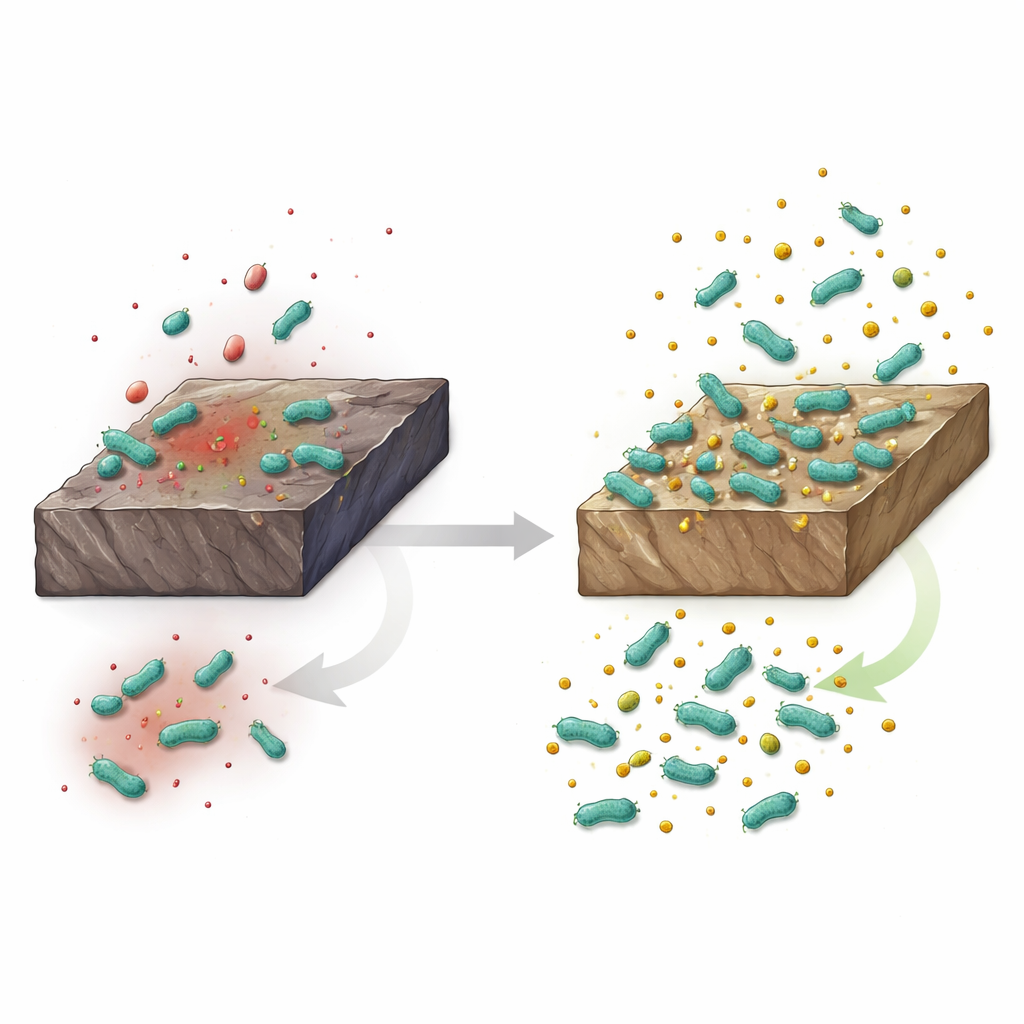
The four rock types had strikingly different effects on growth. Rocks rich in type I and II kerogen neither boosted nor strongly suppressed the total number of microbes compared with the acetate-only control, suggesting that their solid organic carbon remained tough to use under these conditions. Type III–rich coal did worse: it actually inhibited growth, likely because this kerogen contains abundant phenolic compounds, which are known to be toxic and hard to break down. In contrast, type IV–rich charcoal notably enhanced microbial growth, even though it is usually dismissed as useless for oil and gas. This shows that for microbes, "burnt" and highly processed organic matter can be a friend rather than a dead end, perhaps because it contains more accessible aromatic compounds and surface features that microbes can exploit.
Microbial Cast Changes with Each Rock
Even when overall growth did not change much, the identity of the winners did. DNA sequencing revealed that type II–rich rocks strongly favored a group of bacteria called Burkholderiaceae, alongside some Paenibacillaceae, and these communities produced more dissolved inorganic carbon in the form of CO₂. This points to active metabolism—possibly of acetate, rock-derived organics, or both. Type IV–rich rocks shifted the community toward families like Cellulomonadaceae and Pleomorphomonadaceae, organisms capable of breaking down a wide variety of complex molecules. These shifts suggest that each rock type acts as a chemical filter, favoring microbes equipped with just the right enzymes, and that the rocks themselves can broaden community diversity by offering new, hard-to-access food sources. Electron microscope images also revealed cells clustered on type III coal, embedded in webs and coatings that likely represent stress responses to a hostile surface.
From Earth’s Deep Biosphere to Distant Worlds
By holding temperature, pH, and other conditions constant and changing only the rock type, the study shows that the chemistry and structure of kerogen-rich rocks can either suppress, leave unchanged, or promote microbial growth, while reshaping which microbes dominate. This means that vast, carbon-rich rock layers once thought to be mostly inert may actually help set the rules for life in Earth’s deep subsurface. Crucially, the growth-promoting power of type IV–like material—so similar to the insoluble organics in meteorites and on Mars—suggests that comparable carbon locked in extraterrestrial rocks could quietly support life where liquid water is present. Understanding how microbes tap into these stubborn carbon reservoirs not only reshapes our view of Earth’s hidden biosphere, but also sharpens our search for life in the rocky interiors of other worlds.
Citation: Waajen, A.C., de Wit, W., Sánchez-Román, M. et al. Kerogen-rich rocks influence growth and composition of an anaerobic microbial community. Sci Rep 16, 12596 (2026). https://doi.org/10.1038/s41598-026-42062-5
Keywords: deep subsurface life, kerogen, microbial communities, carbon cycling, astrobiology