Clear Sky Science · en
Survival prediction for bladder cancer using multimodal data with quantum neural networks and transformer architectures
Why this research matters for patients
Bladder cancer is common and often deadly, yet doctors still struggle to predict which patients will do well after diagnosis and treatment. This study explores a new way to forecast survival by combining three kinds of medical data and an emerging kind of computing inspired by quantum physics. The goal is simple but powerful: give clinicians a more reliable early warning system so they can tailor care to each person instead of relying on broad averages.
Bringing many views of cancer into one picture
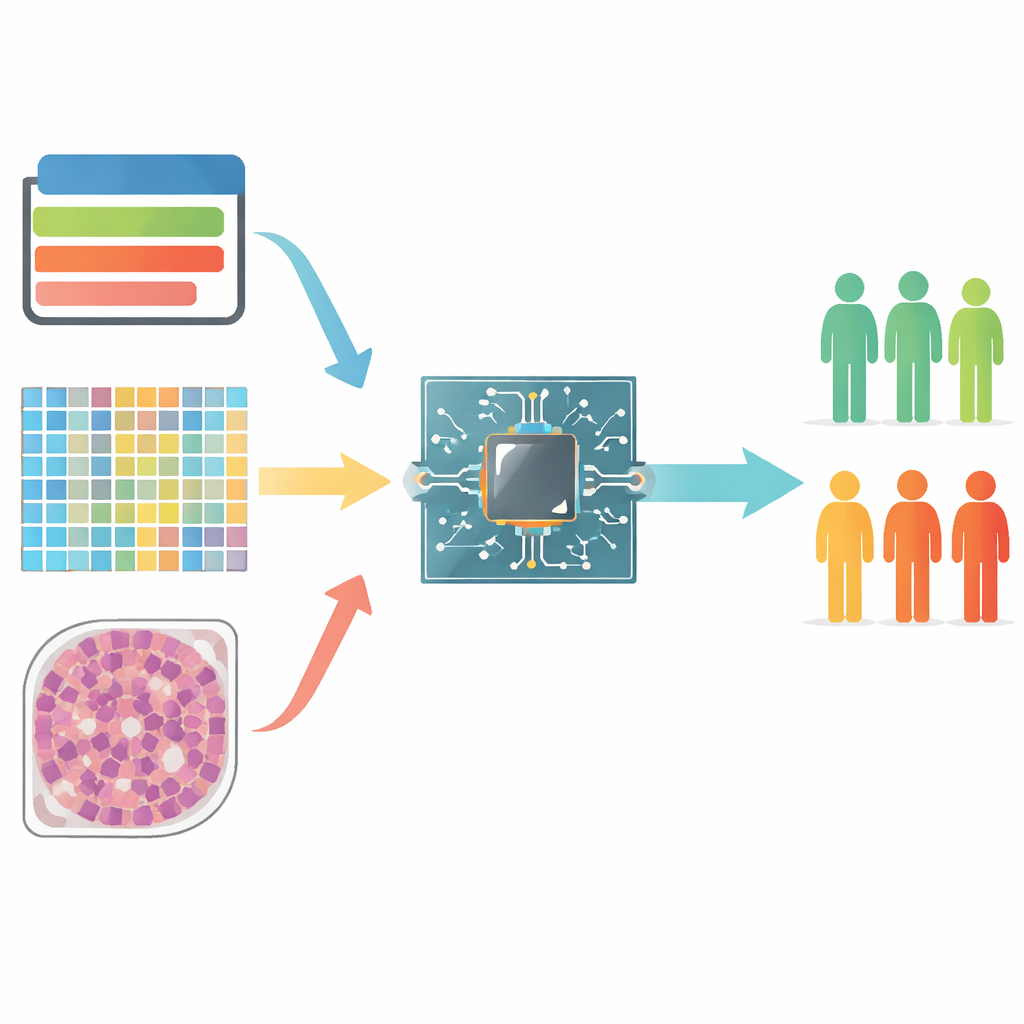
Modern cancer care generates a flood of information for each patient: hospital records, genetic test results, and high-resolution microscope images of tumor tissue. Each offers a different glimpse of how aggressive a tumor may be. Traditional computer models usually focus on just one or two of these data types, or simply glue their features together without really learning how they interact. The authors argue that this wastes crucial clues hidden in the relationships among records, genes, and tissue patterns. Their work centers on building a system that can understand all three at once and learn which pieces of evidence matter most for survival.
A new hybrid of quantum and deep learning
The team introduces QTMPN, a framework that marries standard deep learning with quantum-inspired networks. First, they clean and shrink the raw data: noisy or uninformative items are removed from electronic health records, and tens of thousands of genetic measurements are reduced to a focused set of bladder-cancer–related markers. For the gigapixel pathology slides, they cut each image into many small patches and pass them through a powerful image network to obtain compact visual features. These features are then fed into a quantum-style module that represents information using qubits and their entangled relationships. In practical terms, this module is designed to preserve subtle patterns in the tissue that might be lost with ordinary techniques, especially when the images are extremely detailed.
Teaching the model to weight and connect patients
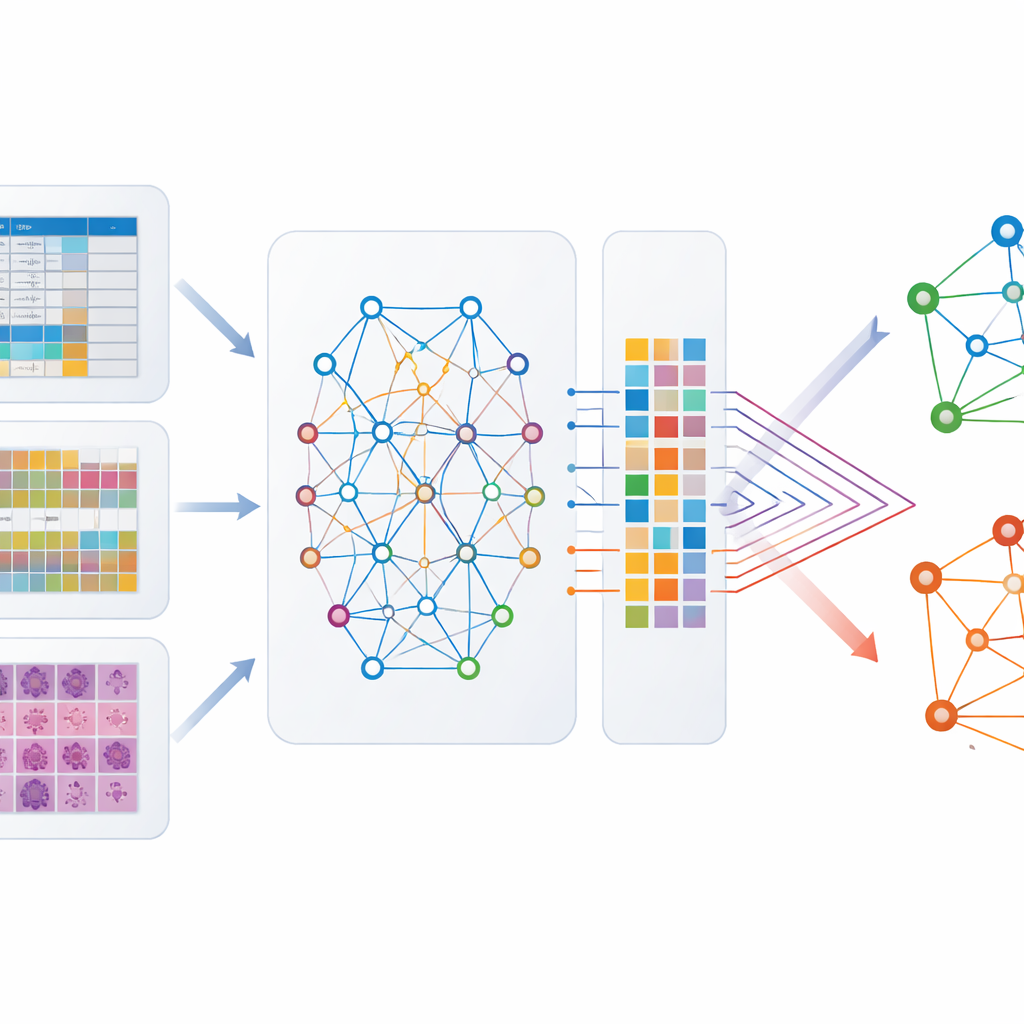
Once features from clinical records, genes, and images are extracted, QTMPN must decide how to fuse them. The authors use Transformer attention—a method popularized in language models—to let the system "look around" and decide which parts of each modality should influence the prediction most. On top of this, they build a graph-style network where every patient is represented as a node connected to others with similar profiles. This graph lets the model learn from patterns across patients, not just within one person’s data. By combining attention with this network of patient-to-patient links, the system can emphasize strong, consistent signals across the entire cohort while downplaying noisy or conflicting clues.
How well does it work in practice?
The researchers test QTMPN on 394 people with bladder cancer from a large public database that includes genetics, pathology slides, and clinical records. They compare their method with several leading models that use either fewer data types or more conventional neural networks. QTMPN correctly predicts survival status about 76 percent of the time—noticeably higher than previous best approaches, which topped out around 70 percent on the same task. Careful “ablation” tests, where key components are swapped out or removed, show that both the quantum-inspired feature extractor and the attention-plus-graph fusion module contribute to the gains. In particular, the quantum module improves the model’s ability to recognize patients who are at higher risk of death, a group that is especially important to flag early.
What this could mean for future cancer care
In plain terms, the study demonstrates that blending quantum-style computing ideas with advanced deep learning can squeeze more prognostic value out of the same medical data. While the work is still at the research stage—run on simulated quantum circuits and tested on a single public dataset—it points toward decision tools that might one day help oncologists better stratify bladder cancer patients, choose treatments, and design follow-up plans. If validated in larger, more diverse groups and streamlined for hospital use, approaches like QTMPN could become part of a new generation of multimodal, precision-medicine systems that turn complex data into clearer guidance for doctors and patients.
Citation: Qin, Z., Zhou, H., Hu, Y. et al. Survival prediction for bladder cancer using multimodal data with quantum neural networks and transformer architectures. Sci Rep 16, 12545 (2026). https://doi.org/10.1038/s41598-026-42047-4
Keywords: bladder cancer prognosis, multimodal medical AI, quantum neural networks, pathology image analysis, transformer graph models