Clear Sky Science · en
Multi-representation thermal features for enhanced defect analysis in pulse thermography
Seeing Hidden Flaws with Heat
Modern airplanes, cars, and bridges are built from complex materials that must be inspected without cutting them open. Infrared cameras already let engineers "see" heat patterns that reveal hidden defects below a surface. This paper introduces a smarter way, called PT-Fusion, to read those thermal fingerprints so that tiny flaws can be found more reliably and their depth beneath the surface can be estimated with remarkable precision.
How Heat Reveals What the Eye Cannot See
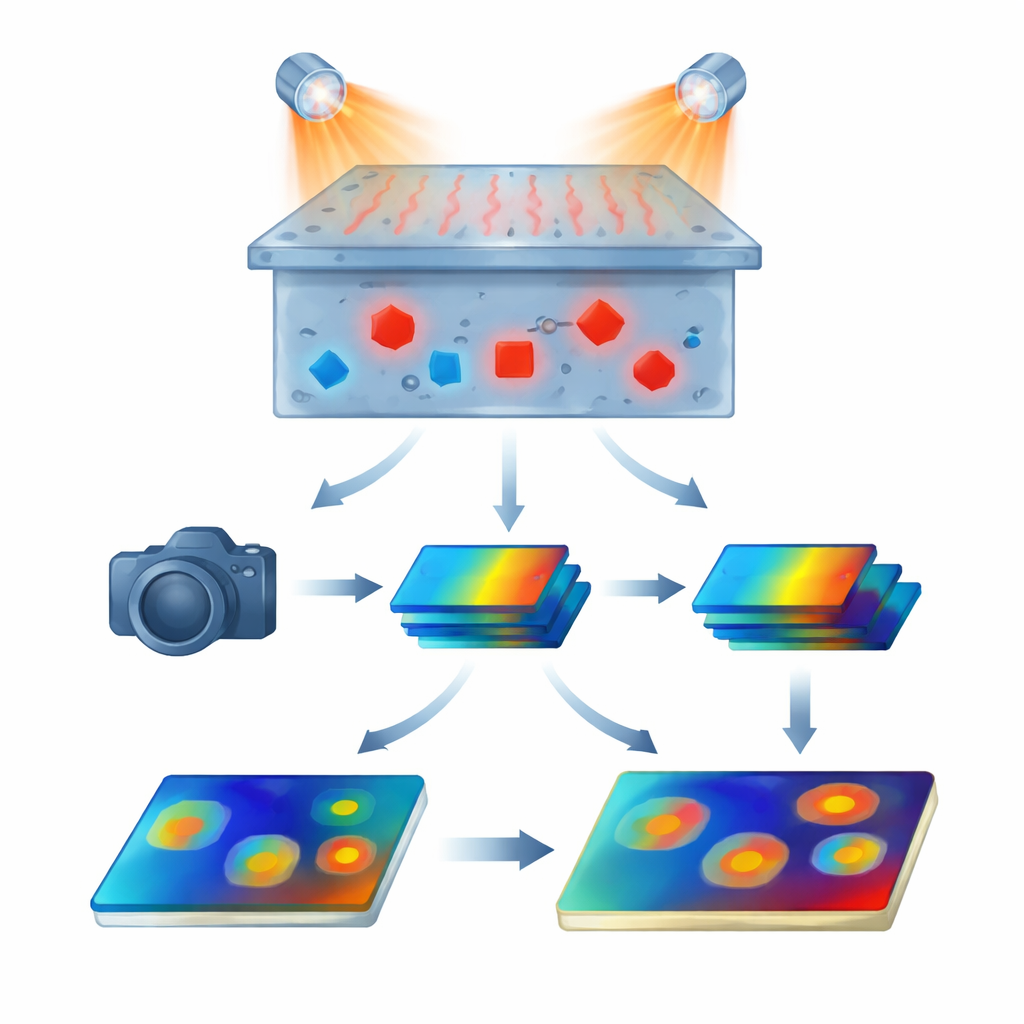
Pulse thermography is a simple idea: a short, intense flash of light briefly heats the surface of a part, and an infrared camera records how the heat spreads and fades over time. If the material is sound, heat flows smoothly. If there is a void or crack beneath the surface, heat gets trapped or diverted, creating a subtle temperature disturbance on the surface. By analyzing a short movie of these temperature changes, inspectors can detect problems without drilling, cutting, or otherwise damaging the component.
Why Current Thermal Maps Leave Information on the Table
Because the raw thermal movies are large and noisy, engineers use mathematical tricks to summarize them into more compact images before feeding them to artificial intelligence. Two of the most popular summaries are Principal Component Thermography (PCT), which sharpens the visual contrast of defects, and Thermographic Signal Reconstruction (TSR), which focuses on how each pixel’s temperature evolves over time. Most existing inspection systems pick one or the other, or simply stack them together as extra channels. That approach turns out to be wasteful: each view contains different, complementary clues about where defects are and how deep they lie, but conventional neural networks are not guided to combine them intelligently.
A Smarter Way to Blend Thermal Clues
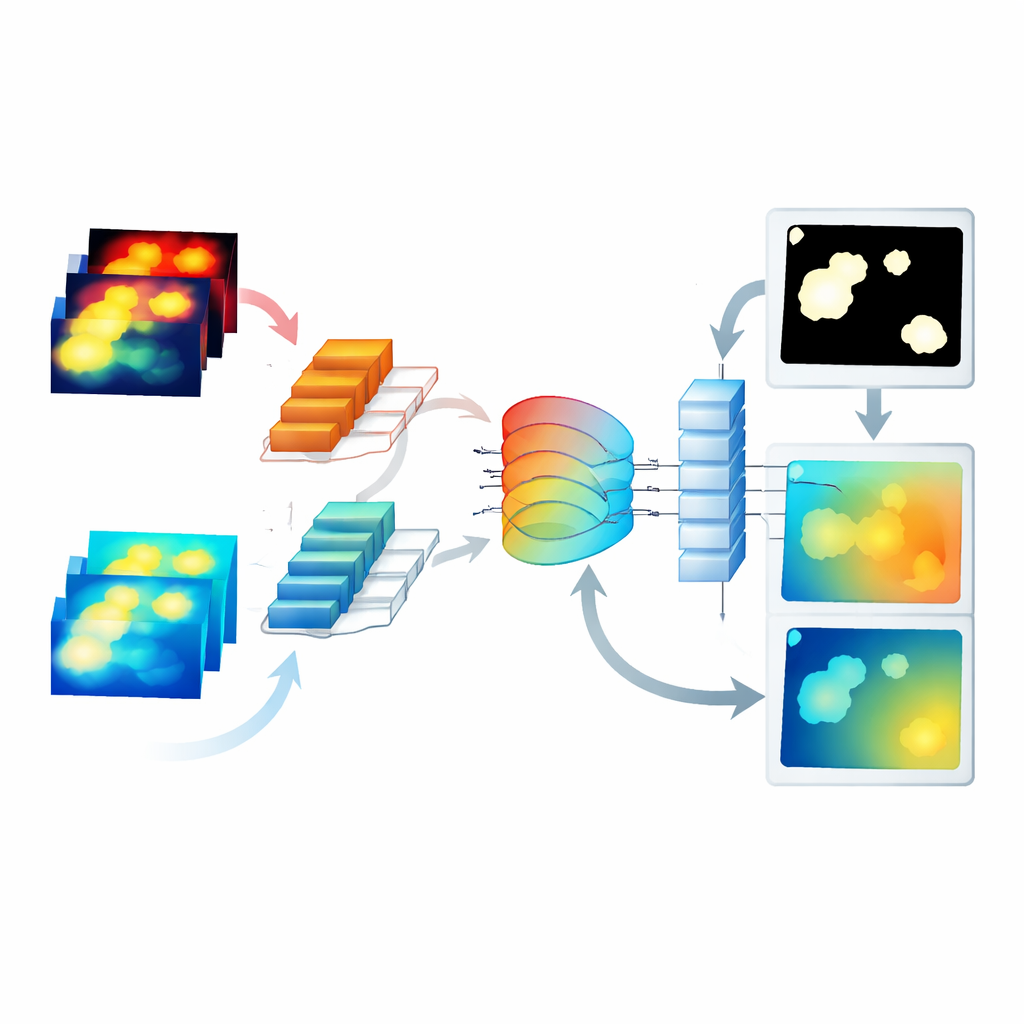
The PT-Fusion system is designed specifically to merge these different thermal views. It uses two parallel processing branches, one devoted to PCT images and one to TSR images, each extracting patterns that are especially clear in its own view. At key stages, special fusion modules step in. An Adaptive Weighting Fusion Gate decides, pixel by pixel, how much to trust each branch, while a Gating Enhanced Decoding Block gently injects fused information back into the reconstruction layers that produce the final predictions. Instead of blindly concatenating data streams, the network learns which representation is more informative in each region, and balances them accordingly.
Making the Most of Limited Test Data
High-quality thermography experiments are expensive and time-consuming, so large labeled datasets are rare. To tackle this, the authors devise a spatiotemporal data augmentation strategy tailored to thermal movies. Rather than only rotating or shifting images, they randomly sample frames within each sequence to mimic different heating and cooling histories, then inject controlled noise to imitate real camera artifacts. New PCT and TSR images are computed from these modified sequences, greatly increasing variety while preserving the underlying physics of heat diffusion. This richer training diet helps PT-Fusion learn robust patterns instead of memorizing a small set of examples.
Sharper Maps and More Trustworthy Depths
The researchers test PT-Fusion on a public dataset of plastic samples containing artificial subsurface holes at known depths. They evaluate two tasks: assigning each pixel to a depth class and performing both defect/no-defect labeling and continuous depth estimation at once. PT-Fusion not only segments defects more accurately than classic convolutional networks like U-Net and 3D-CNN, it also competes with heavier transformer-based models while using far fewer parameters and running faster. Its predicted depths closely track the true values, with very small average errors. Importantly, when trained on one defect shape (such as squares) and tested on another (circles), the system still performs well, showing that it has learned the physics of heat flow rather than just memorizing outlines.
What This Means for Safer Structures
For non-specialists, the key message is that PT-Fusion makes thermal imaging a more powerful and reliable tool for safeguarding critical structures. By intelligently fusing two different heat-based views and enriching scarce data through physics-aware augmentation, the method can spot defects more clearly and judge how deep they are beneath the surface. This kind of progress brings us closer to fast, automated inspection lines that can quietly monitor aircraft parts, pipelines, and other vital components—catching hidden problems early, without ever having to take them apart.
Citation: Salah, M., Werghi, N., Svetinovic, D. et al. Multi-representation thermal features for enhanced defect analysis in pulse thermography. Sci Rep 16, 12926 (2026). https://doi.org/10.1038/s41598-026-42031-y
Keywords: infrared thermography, non-destructive testing, deep learning inspection, subsurface defect detection, pulse thermography