Clear Sky Science · en
Autonomous robots with socially-aware navigation using memory-assisted deep reinforcement learning
Robots That Can Move Politely Through Crowds
Imagine delivery robots gliding through a busy mall or hospital corridor without bumping into anyone, slowing people down, or acting strangely. This paper presents a new way for robots to move through crowds that not only avoids collisions but also behaves in a way that feels natural and comfortable to the people around them.
Why Moving Around People Is So Hard
For a robot, walking through a crowd is far more difficult than following a painted line on the floor. People suddenly change speed, walk in groups, or pause to check their phones. Traditional navigation methods often treat people as simple moving obstacles and react only to what the robot sees at a given instant. This can make the robot overly cautious, causing it to stop in place when the scene becomes too complex, or too bold, cutting through groups in ways that feel unsafe or rude. The authors argue that a successful service robot must combine awareness of its surroundings, sensitivity to people’s personal space, and quick, intelligent decision-making.
A Robot That Remembers What People Just Did
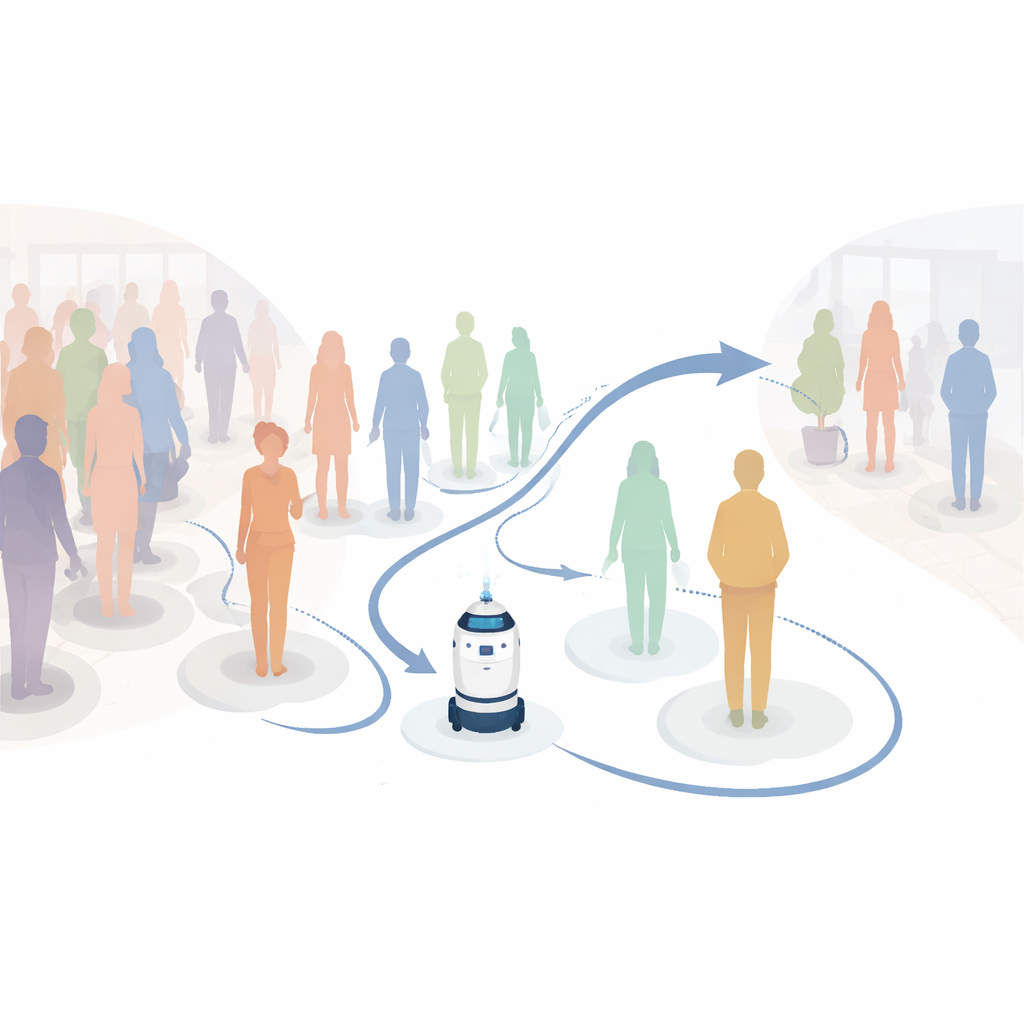
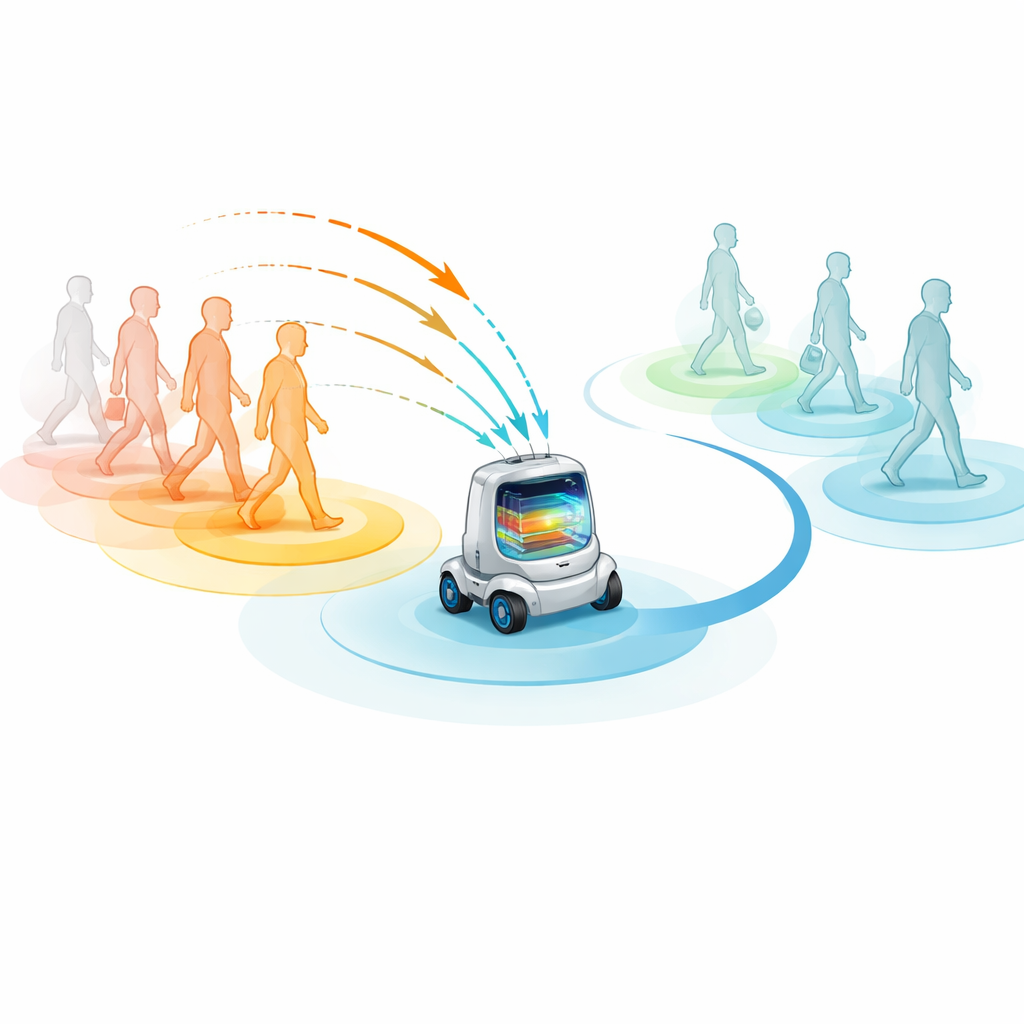
The research team introduces ARSA, a new navigation approach that lets a robot use short "memories" of how nearby people have been moving. Instead of looking only at the current positions of people, ARSA considers a short history of where they were and how they moved. This history is processed by a special kind of neural network that excels at handling sequences, allowing the robot to form an internal picture of crowd motion over time. In simple terms, the robot learns to spot patterns, such as someone starting to veer left or a group beginning to cluster, and adjusts its path before problems arise.
Giving People Space With Moving Safety Bubbles
To keep people comfortable, ARSA surrounds each person with a "warning zone"—a moving safety bubble that changes size depending on how fast they are walking and their body size. When the robot gets too close to one of these zones, it is gently punished in its learning process, teaching it to skirt around people rather than cutting through tight spaces. The system also uses an attention mechanism, which acts like a spotlight, to focus the robot’s decision-making on the few people that matter most at each moment—for example, the person directly in its path rather than someone far away. Together, these ideas help the robot choose smoother, more human-friendly paths.
Putting the New Method to the Test
The authors put ARSA through thousands of simulated crowd situations, with up to twenty moving people and additional obstacles. They compared it against several leading navigation methods that also use modern learning techniques. ARSA reached its goals more often, collided less frequently, and finished its routes faster, especially in tight and busy scenes where other methods hesitated or froze. The team then ran real-world tests using a mobile robot equipped with a laser scanner in indoor settings with several people and even another robot. Without retraining, ARSA guided the robot safely through irregular human movements and occasional deliberate blocking, achieving all runs without a single collision.
What This Means for Everyday Robots
To a layperson, the key message is that this work brings us closer to robots that can share our walkways without getting in the way. By remembering how people have been moving, predicting their next steps, and respecting flexible personal space zones, ARSA helps robots move more like considerate pedestrians than rigid machines. While the authors note that future work must better handle limited sensors and more complex buildings, their results suggest that memory- and attention-based navigation could become a core ingredient of safe, trustworthy service robots in shopping centers, hospitals, campuses, and beyond.
Citation: Montero, E., Pico, N., Alvarez-Alvarado, M.S. et al. Autonomous robots with socially-aware navigation using memory-assisted deep reinforcement learning. Sci Rep 16, 13214 (2026). https://doi.org/10.1038/s41598-026-42026-9
Keywords: social robot navigation, crowd-aware robots, deep reinforcement learning, human–robot interaction, autonomous mobile robots