Clear Sky Science · en
Analysis of construction impact and safety evaluation of metro shield tunnel under-crossing existing bridge pile foundation
Why digging under bridges matters
As cities build more subway lines to ease traffic, many new tunnels must pass close to or directly beneath existing bridges. If the ground shifts too much while a tunnel is being dug, the bridge above could tilt, crack, or even fail. This study looks at a real project where a metro tunnel was driven under the pile foundations of a busy urban viaduct and asks a simple question with very high stakes: can we do this safely, and which protective measures work best?
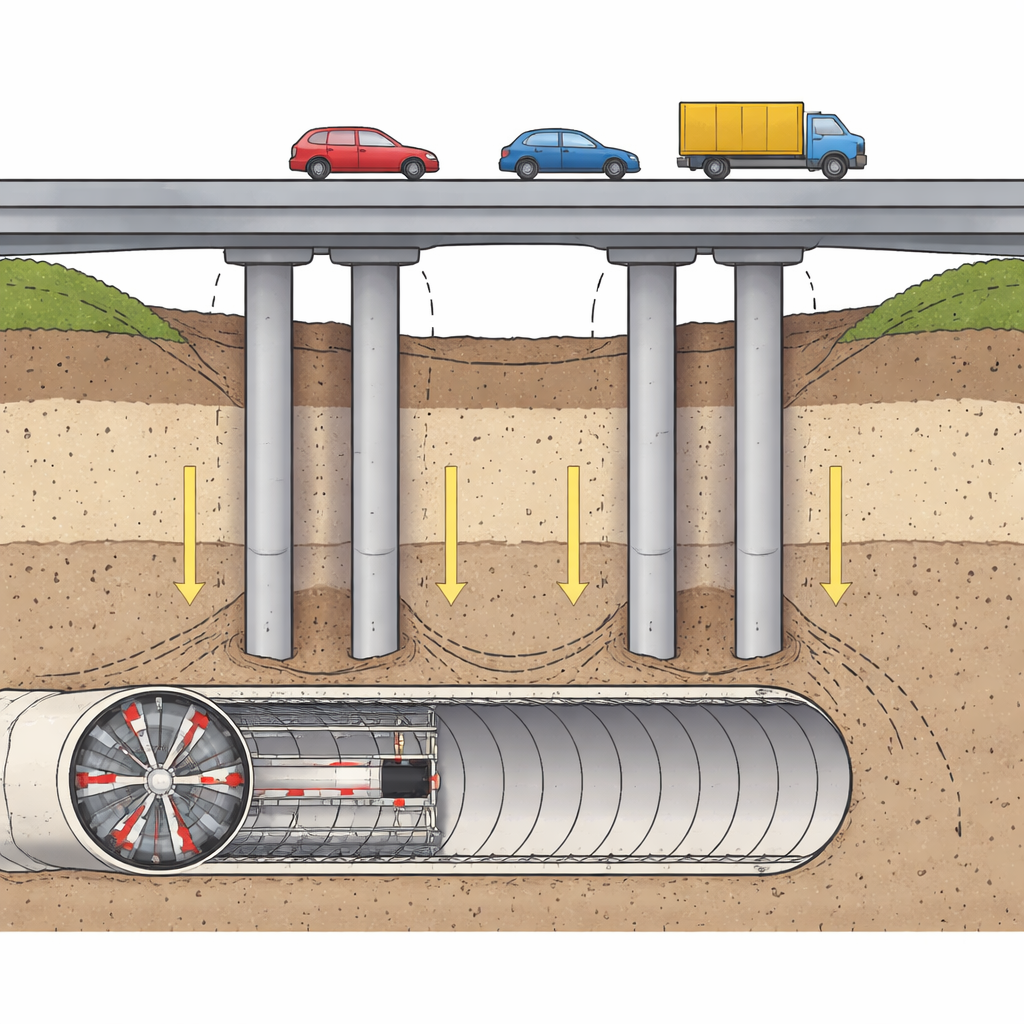
City traffic above, tunneling below
The project takes place in a dense district where a new metro line runs beneath a highway bridge supported on deep concrete piles. The shield tunnel boring machine advances through mixed rock and soil layers only a few meters below the bridge foundations. Because the bridge carries heavy traffic and its piles are hard to alter, engineers must predict how the ground and piles will respond before construction and decide how much risk is acceptable during the work.
Virtual testing with a 3D digital model
To preview what would happen underground, the authors built a detailed three-dimensional computer model of the bridge, piles, soil layers, and advancing tunnel. They calibrated this model by comparing its predictions with real monitoring data from sensors on the bridge during construction. The match was very close, giving confidence that the model could reproduce key behaviors such as how much the piles settle, how stresses within the concrete change, and how the surrounding rock and soil deform as the tunnel passes underneath.
How much movement and stress is still safe
The simulations showed that the bottom of the bridge piles sinks more than the top as the tunnel approaches, passes beneath, and moves away. The maximum vertical settlement of the piles reached about one centimeter and then stabilized, staying within the limits allowed by Chinese safety codes for existing bridges. Stresses and strains in the pile concrete and surrounding rock also remained well below values known to cause cracking or failure. In other words, in the modeled conditions, the bridge could continue to operate normally despite the underground disturbance.
Turning complex risks into a clear safety grade
Because real ground conditions are uneven and construction does not always follow the ideal plan, the team did not rely on simulation alone. They mined more than 300 technical papers to identify which factors most affect safety when a shield tunnel passes under bridge piles, such as how far the tunnel is from the piles, how strong the soil is, and how stiff the bridge is. Using expert judgment together with statistical weighting, they built a multi-index rating system and then applied a ranking method that compares the actual project to ideal safe and unsafe cases. This process classified the construction scenario as Grade III, meaning a relatively high risk that demands special control measures and close monitoring, even though outright failure is unlikely.
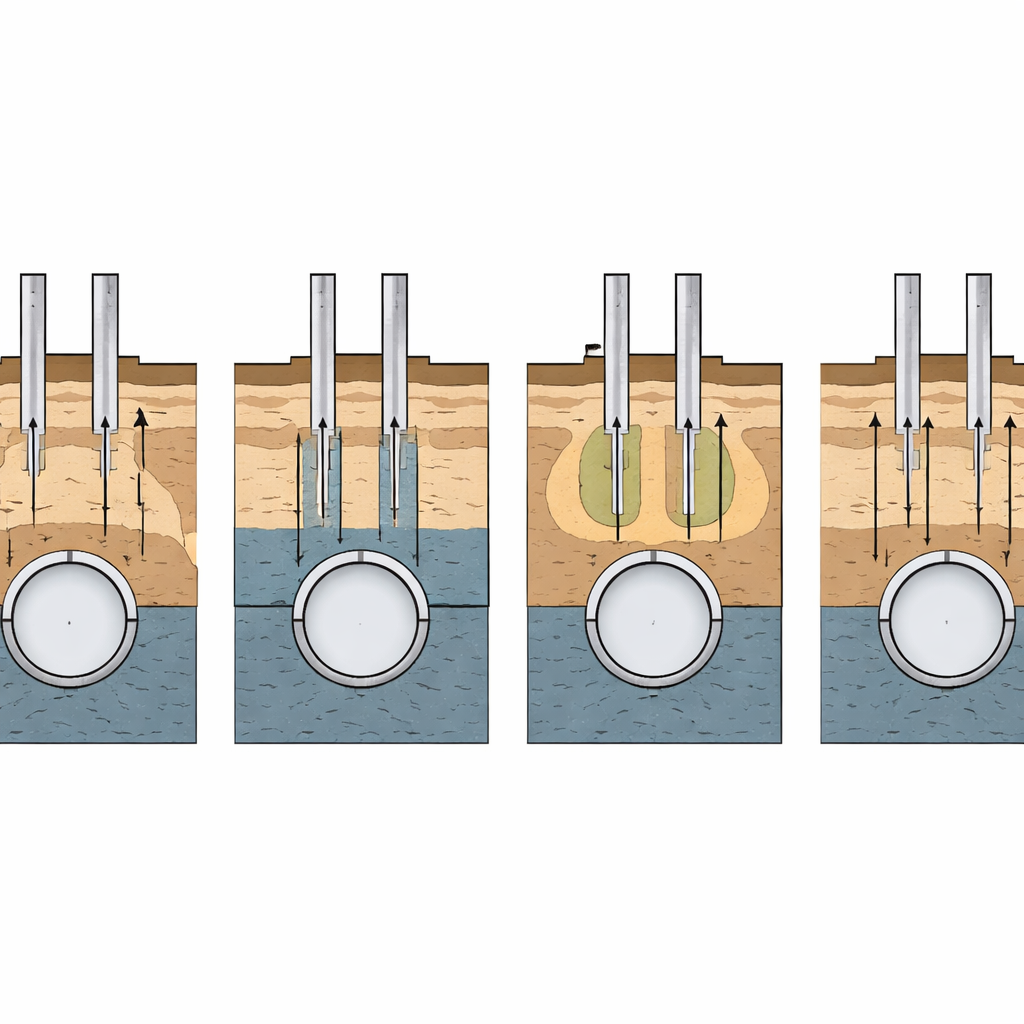
Testing four ways to protect the bridge
The study then returned to the digital model to compare four protection strategies. One adds new underpinning piles to help carry the bridge load. Another strengthens the existing piles with additional concrete. A third injects grout into the soil around the piles to form a stiffer block of ground. The fourth swaps the standard concrete tunnel lining for stronger steel segments just beneath the bridge. All four options reduce bridge settlement to safer levels, but not equally: replacing the tunnel lining with steel gives the smallest pile movements, followed by grouting, then pile strengthening, with active underpinning offering the least improvement relative to its cost and complexity.
What this means for future city tunnels
For non-specialists, the main takeaway is reassuring yet cautionary. The research shows that with careful planning, advanced computer modeling, and tailored protective measures, new metro tunnels can safely pass under existing bridges without endangering them. At the same time, the quantitative risk rating—Grade III—signals that such projects are never routine and must be treated as sensitive operations. Among the options tested, locally replacing tunnel segments with steel near bridge piles emerged as the most effective and practical safeguard, offering a clear path for engineers facing similar underground challenges in growing cities.
Citation: Xu, J., Zhang, X., Lin, S. et al. Analysis of construction impact and safety evaluation of metro shield tunnel under-crossing existing bridge pile foundation. Sci Rep 16, 11899 (2026). https://doi.org/10.1038/s41598-026-42025-w
Keywords: metro tunnel construction, bridge pile foundations, underground risk assessment, shield tunneling safety, urban infrastructure protection