Clear Sky Science · en
Numerical investigation of soil-tunnel interaction under surface blast loads with regression-based energy correlations
Why Hidden Tunnels Matter in a World of Surface Blasts
Modern cities are increasingly turning to underground tunnels to move people and protect vital services. But as surface explosions from bombs, missiles, or improvised devices become a real concern, engineers need to know: how safe are these buried lifelines when a powerful blast goes off above them? This study uses advanced computer simulations to explore how a metro tunnel buried in soft, clay-rich soil behaves under surface explosions, and how deep it needs to be to stay in the safe zone.
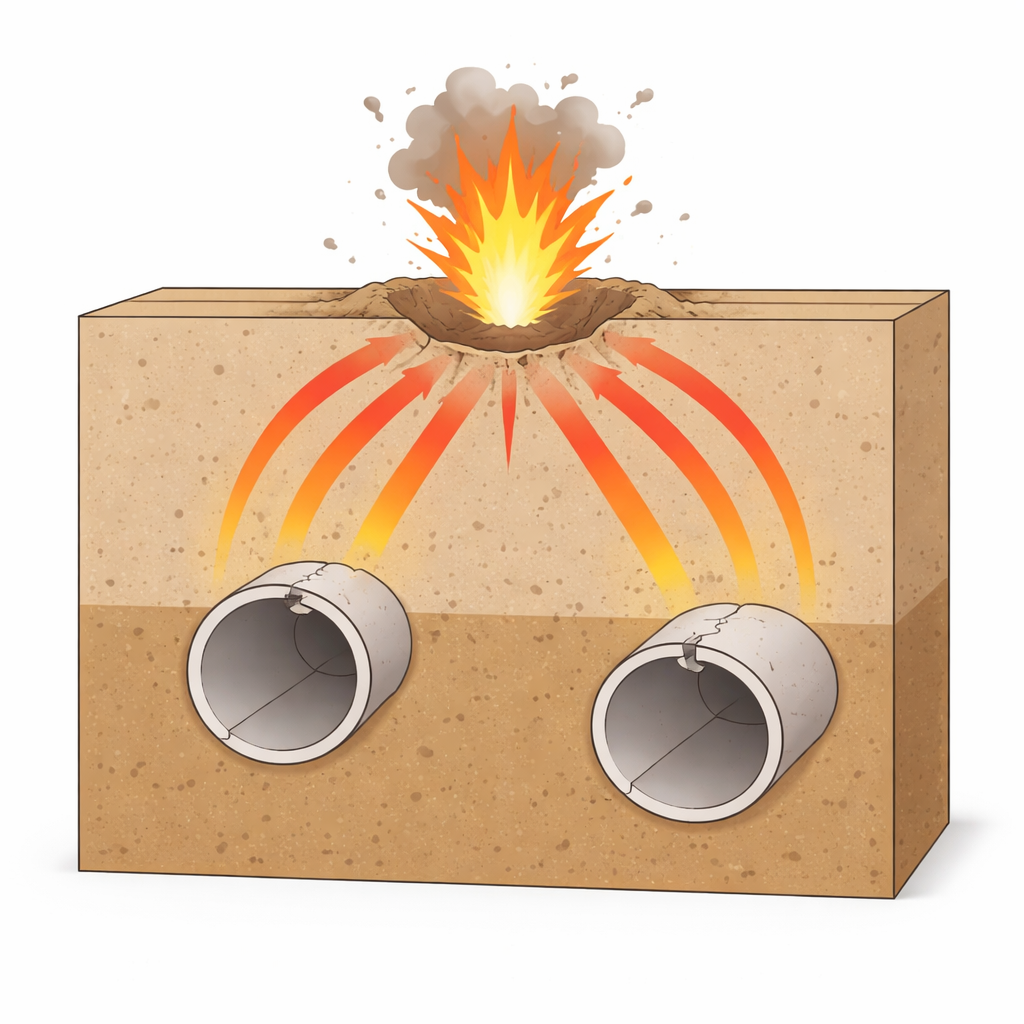
Underground Highways Under Fire
Urban tunnels are typically built to deal with everyday traffic loads and, at most, earthquakes—not direct attack. Yet in modern conflicts and terrorist incidents, surface explosions are common and can send shock waves through the ground toward buried structures. Running full-scale explosion tests on real tunnels is extremely expensive and dangerous, so the authors rely on detailed three-dimensional computer models instead. They focus on a circular metro tunnel embedded in sandy clay, a soil type often found in city projects, and ask how a blast on the ground surface deforms the tunnel and damages its concrete lining.
Building a Virtual Tunnel and Blast
To explore this problem, the researchers create a digital replica of a five-meter-wide reinforced concrete tunnel surrounded by a large block of soil. The soil, concrete lining, and steel bars are each given realistic mechanical behavior taken from experiments, so the model can capture cracking, permanent deformation, and energy absorption. Surface explosions are simulated using a widely used blast model originally developed by the U.S. Army, which converts the weight of TNT into a changing pressure wave on the ground. Before trusting their setup, the authors test it against known results: they compare predicted ground shock and crater sizes with well-established formulas, and they simulate explosions on concrete slabs that have been tested in the lab. In all cases, the numerical predictions and real-world data match closely, giving confidence that the virtual tunnel behaves credibly.
Following the Energy Through Soil and Tunnel
The heart of the study is an energy-based picture of what happens when a blast hits the ground. As TNT charge increases from 25 to 1000 kilograms, the model tracks how much of the blast’s energy shows up as rapid motion (kinetic energy), how much is locked into permanent deformation (plastic dissipation), and how much is stored temporarily as elastic stretching (strain energy) in the soil–tunnel system. These energy measures all rise faster than linearly with explosive weight, meaning a tenfold increase in charge produces far more than ten times the impact. The authors then use regression—simple mathematical fits—to turn these trends into easy-to-use formulas that relate explosive weight to crater size, energy levels, and tunnel deformation within the studied range.
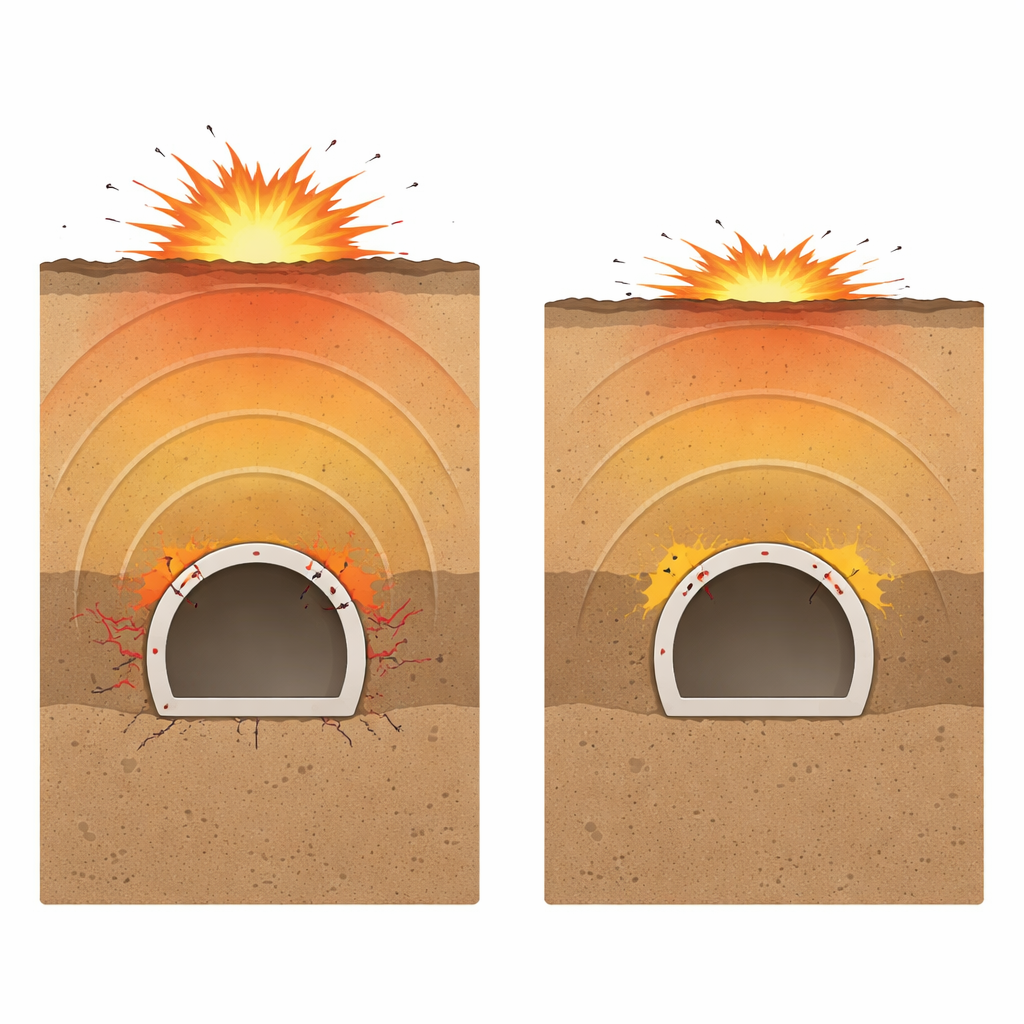
How Deep Is Deep Enough?
A central practical question is how burial depth changes tunnel safety. The study tests three cover depths above the tunnel crown: 15, 12, and 9 meters, across many blast scenarios up to 1000 kilograms of TNT. Two performance rules define a “safe” tunnel: cracking in the concrete must remain limited, and the tunnel’s radial deformation must stay below half a percent of its diameter. The results show a strong depth effect. For the deepest case, 15 meters, the tunnel remains within these limits for blasts up to about 500 kilograms, though a 1000-kilogram blast starts to produce serious local damage. At 12 meters, larger charges push the lining beyond both cracking and deformation thresholds. At the shallowest depth, 9 meters, powerful blasts cause extensive tensile cracking and much larger distortion, clearly marking this configuration as unsafe for high-intensity events.
What This Means for Safer Cities
In plain terms, the study shows that deeper tunnels in soft, clay-rich soils are far more resilient to surface explosions than shallow ones, and that there is a practical “safe depth” for a given blast threat. Within the assumptions of the model, a metro tunnel buried about 15 meters beneath the surface can withstand surface blasts up to roughly 500 kilograms of TNT without suffering crippling damage, whereas shallower tunnels become vulnerable at much lower charge levels. The regression formulas the authors provide offer engineers quick tools to estimate crater sizes, energy transfer, and tunnel deformation for similar conditions, helping guide preliminary design and rapid risk assessments in conflict-prone or high-threat urban environments.
Citation: Alsabhan, A.H., Rais, I., Ahemad Khan, J. et al. Numerical investigation of soil-tunnel interaction under surface blast loads with regression-based energy correlations. Sci Rep 16, 12665 (2026). https://doi.org/10.1038/s41598-026-42024-x
Keywords: underground tunnel safety, surface blast loading, metro tunnel design, soil–structure interaction, blast-resistant infrastructure