Clear Sky Science · en
Managing salinity stress through microclimate control to enhance tomato productivity in arid regions
Why salty water matters for your salad
In many desert regions, including the Middle East, farmers increasingly rely on salty groundwater to grow everyday foods like tomatoes. Salt may seem harmless, but in the soil it quietly stunts plants, shrinks harvests, and can render farmland unusable. This study asks a practical question with global implications: can smart control of temperature, light, and humidity inside simple structures like net houses and greenhouses help tomatoes cope with salty water and keep producing abundant, healthy fruits?
Tomatoes under desert skies
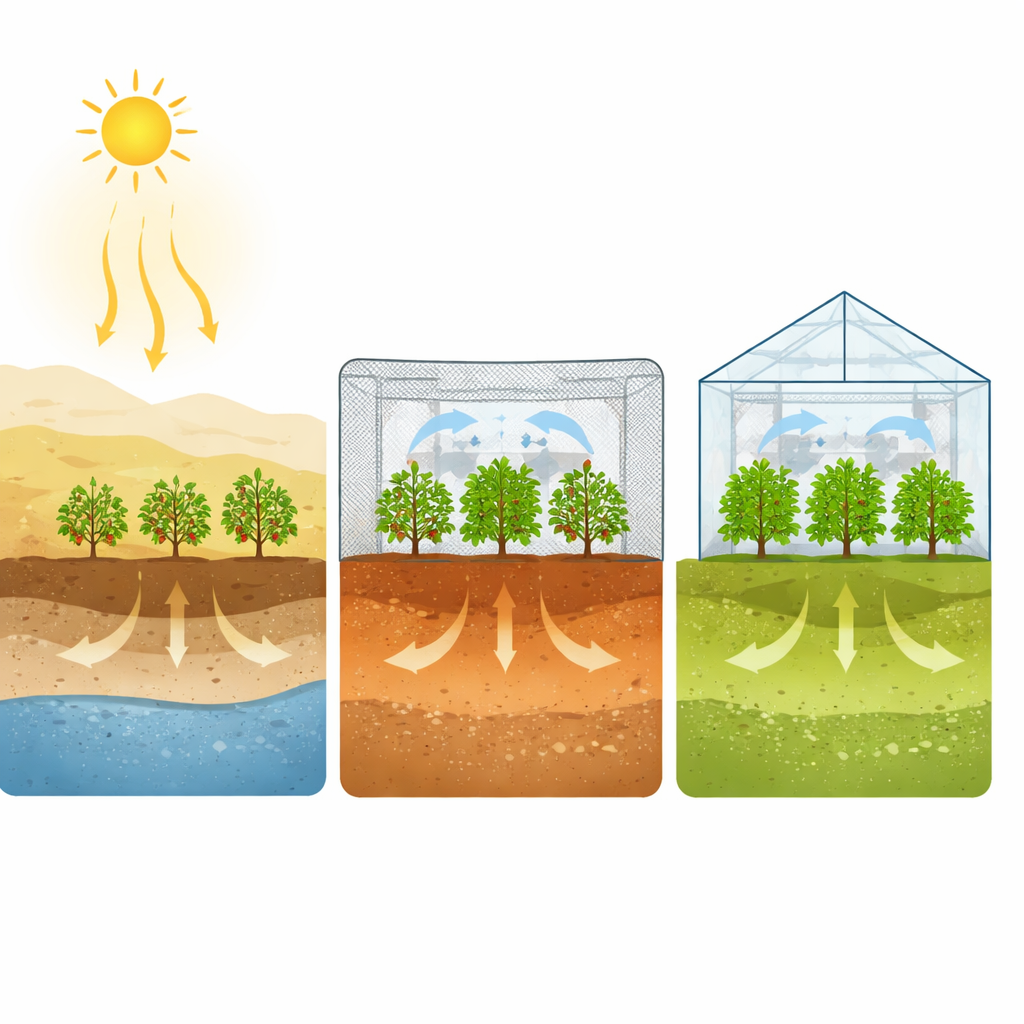
The researchers worked in Qatar, where summers are scorching, rain is scarce, and groundwater is often salty. They grew the same tomato variety in three common production setups: an open field exposed to the weather, a semi-protected net house that softens heat and wind while letting in natural light, and a fully controlled greenhouse with air conditioning and red-spectrum LED lighting. Within each setup, plants were irrigated with water ranging from mildly to moderately salty, similar to the conditions farmers face when pumping local groundwater.
Testing how much stress tomatoes can take
Across these environments, the team tracked how plants grew, how many leaves they produced, how thick their stems became, when they flowered, and how many and how large the fruits were. They also measured leaf greenness and canopy vigor using two sensor-based indicators widely used in agriculture. One handheld meter estimates how much chlorophyll is in a leaf, while the other looks at how plants reflect light to gauge how dense and healthy the canopy is. Together, these measurements reveal how efficiently the plant is photosynthesizing and how early stress begins to bite, long before the fruits reach your plate.
Where tomatoes thrive and where they struggle
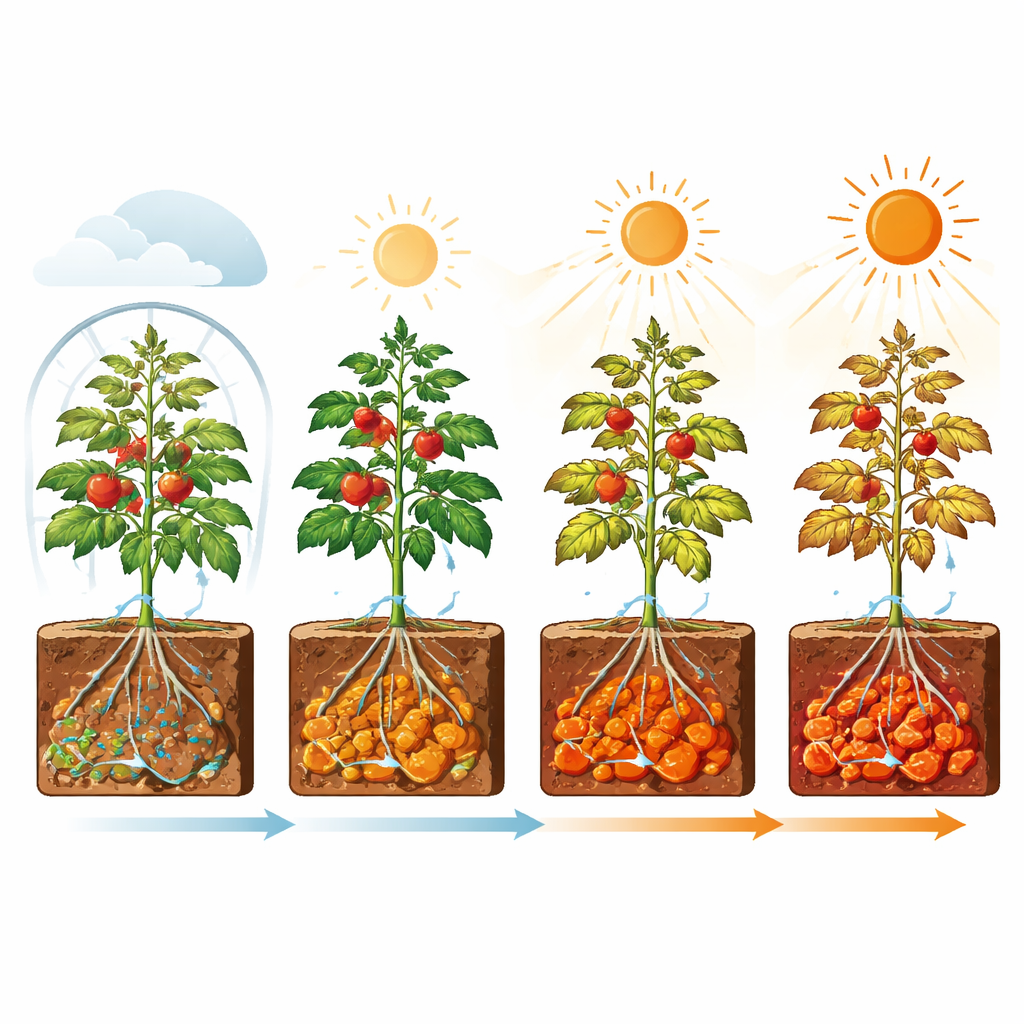
The results were clear: more salt in the irrigation water meant shorter plants, thinner stems, fewer leaves, smaller fruits, and lower yields in all systems. But the severity of these losses depended strongly on where the plants were grown. The net house consistently came out on top. Under low salinity, tomatoes there produced the heaviest fruits and the greatest overall yield, with robust leafy canopies. The open field fared reasonably well at low salt levels but suffered under combined heat, fluctuating humidity, and salinity. Surprisingly, the fully controlled greenhouse performed worst when salinity was high, with yields dropping by more than half compared with the best net house conditions, likely because certain light and temperature settings unintentionally amplified stress.
What sensors reveal about plant health
As salinity increased, both leaf chlorophyll readings and canopy greenness steadily declined, showing that salt was eroding the plants’ photosynthetic machinery. These two indicators rose and fell together, confirming that quick, non-destructive sensor readings can reliably flag stress before it shows up as lost yield. The greenhouse, with its stable temperature and humidity, tended to maintain greener canopies at higher salinity than the open field, even when yields were modest. The net house struck a favorable balance: moderate temperatures, good light, and manageable humidity supported both healthy sensor readings and strong harvests, especially when the water was only mildly salty.
Heat, water loss, and plant comfort
The team also looked at canopy temperature, a useful indicator of how well plants are cooling themselves through transpiration. In the open field, hotter canopies went hand in hand with higher salinity, suggesting that salt-stressed plants were closing their leaf pores, losing their natural “sweating” ability, and overheating. In the net house, canopy temperatures stayed relatively cool and stable even as salinity rose, pointing to better water use and stress tolerance. In the greenhouse, the coolest canopies under the saltiest water did not signal comfort but rather a sparse, weakened canopy that simply absorbed less heat, a reminder that temperature readings must be interpreted alongside growth and yield.
What this means for food security in dry lands
For farmers in arid regions who must depend on salty groundwater, this study shows that the growing structure matters almost as much as the water itself. Net houses, which are cheaper and less energy-hungry than high-tech greenhouses, offered the best combination of high yields and resilience to salinity. Greenhouses can still be valuable but need carefully tuned light and climate settings to avoid unintentionally stressing plants. Regular use of simple sensors to track leaf greenness and canopy vigor can help growers spot salinity problems early and adjust irrigation or microclimate before yields crash. In short, by managing the small climate around each plant, we can keep tomato harvests robust even as water gets saltier and conditions grow harsher.
Citation: Abbas, F., Al-Naemi, S. Managing salinity stress through microclimate control to enhance tomato productivity in arid regions. Sci Rep 16, 13042 (2026). https://doi.org/10.1038/s41598-026-42022-z
Keywords: salinity, greenhouse tomatoes, controlled environment agriculture, arid agriculture, crop stress sensing