Clear Sky Science · en
Association of triglyceride-glucose index fluctuation with in-hospital all-cause mortality in critically ill patients: a multidatabase retrospective study
Why swings in blood fats and sugar matter in intensive care
When people are rushed to an intensive care unit, doctors closely track blood pressure, breathing, and lab results to judge who is most at risk. This study looks at a simple number, based on routine blood sugar and blood fat tests, and asks a key question: is it the level of this number that matters most, or how wildly it swings over time? The answer could help hospitals spot which critically ill patients are in the most danger and might benefit from closer monitoring or different treatment.
A simple score that hides a complex story
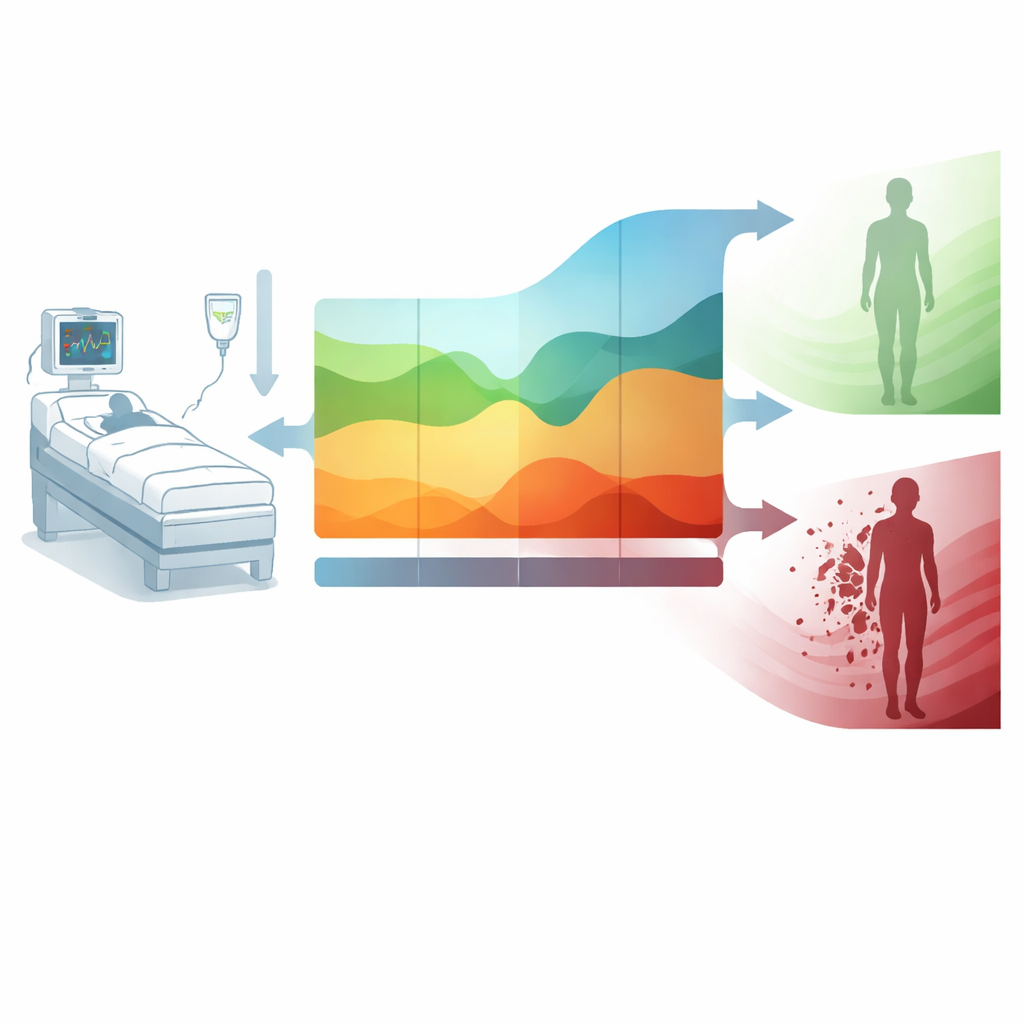
The research focuses on the triglyceride–glucose index, or TyG index, which combines common measures of blood sugar and triglycerides into one value. This index is widely used as a stand‑in for how resistant the body is to insulin, a hormone that helps cells use sugar for energy. In severe illness, stress, inflammation, and powerful drugs can all disturb this system. Earlier studies mostly looked at the TyG index at a single moment, such as at admission to the ICU. But critical illness is rarely static: patients’ metabolism can shift hour by hour. The authors wondered whether the “bumpiness” of TyG over a hospital stay might tell doctors more about survival chances than one snapshot alone.
Two hospitals, thousands of patients
To explore this, the team examined electronic health records from two very different intensive care databases. One, called MIMIC‑IV, contains data from a large academic hospital in Boston. The other comes from Southwest Hospital in Chongqing, China. Together, they included 2,208 adult ICU patients who had at least two paired measurements of blood sugar and triglycerides during their stay. From these repeated tests, the researchers calculated several TyG‑based measures: the first value after ICU admission, the average and median values over time, and multiple indicators of variability, such as how wide a range the values covered and how much they fluctuated around the average.
Fluctuations linked to death in the ICU
The central question was how these TyG patterns related to whether patients died before leaving the hospital. Using statistical models that took into account age, sex, body size, illness severity, and many other lab results, the team found a clear pattern in the MIMIC‑IV data. Patients whose TyG index bounced around more—showing a larger spread and greater ups and downs—had a higher chance of dying in the hospital, even when their average levels were similar to others. Graphs that allowed for curved, rather than straight‑line, relationships showed that death risk rose more steeply once TyG variability passed into higher ranges, suggesting that beyond a certain point, extra instability may be especially dangerous.
Different hospitals, similar signal but softer
In the Chinese cohort, the direction of the link between TyG swings and death was broadly similar, but weaker and less certain once the same long list of other factors was adjusted for. The patients there tended to be lighter and somewhat more stable at ICU admission, and the number of deaths was smaller, which makes subtle patterns harder to detect. Interestingly, a single TyG reading behaved differently across the two sites: it did not clearly separate risk in the Boston group and was even linked with slightly lower death rates in the Chinese group after full adjustment. The authors suggest that one‑time levels may be heavily shaped by local care practices, timing of blood draws, and patient build, whereas variability over days may better capture how strained and unstable a patient’s metabolism truly is.

What this means for ICU care
To a lay observer, these findings highlight an intuitive but often overlooked idea: in the ICU, not just “how high” or “how low” a blood test runs matters, but how violently it swings. Repeated rises and falls in the TyG index likely mirror deep‑seated turmoil in how the body handles energy under stress. This study suggests that such metabolic instability tracks closely with the risk of dying in the hospital, at least in a large U.S. ICU, and hints at similar patterns elsewhere. While the research cannot prove cause and effect or define treatment targets, it points toward a future where simple, routinely collected lab tests are used not only for single readings, but as moving signals over time, helping doctors to better identify and perhaps steady the most vulnerable patients.
Citation: Chen, Z., Xiang, X., Xu, H. et al. Association of triglyceride-glucose index fluctuation with in-hospital all-cause mortality in critically ill patients: a multidatabase retrospective study. Sci Rep 16, 14081 (2026). https://doi.org/10.1038/s41598-026-42020-1
Keywords: intensive care, insulin resistance, blood sugar, triglycerides, metabolic instability