Clear Sky Science · en
Defect mediated pulse terahertz emission from thiocyanate-treated hybrid perovskite nanoparticles: role of the orientation of built-in surface electric field
Why tiny crystals and invisible waves matter
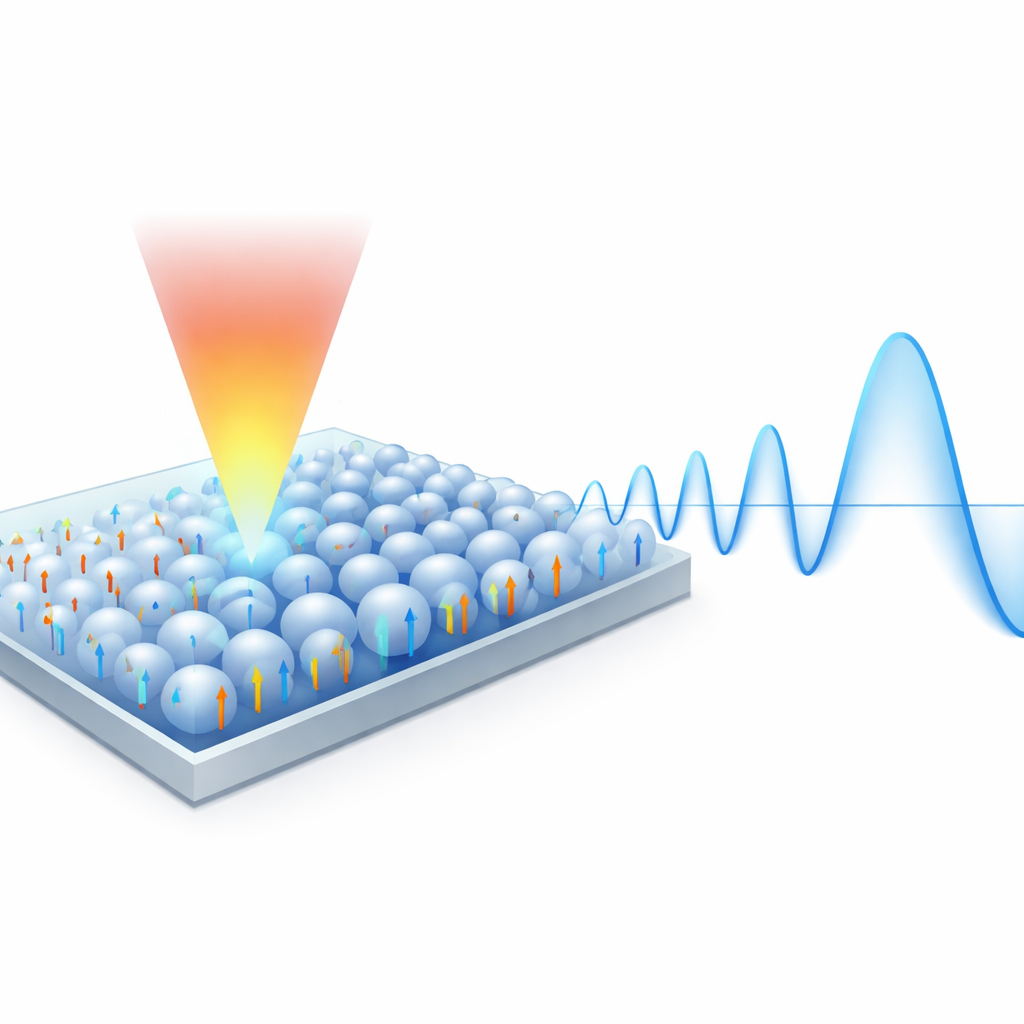
Terahertz (THz) waves sit between microwaves and infrared light and can see through clothing, plastics, and even paint, making them attractive for security scanners, medical imaging, and ultra-fast wireless links. But creating compact, efficient THz sources is still a major challenge. This study explores how to coax intense THz pulses out of a new class of solar-cell materials—hybrid perovskites—by carefully tuning tiny defects and electric fields at the surface of their nanoparticles. The work shows that not just how many defects exist, but how their internal electric fields are lined up, can make or break THz emission.
From solar cells to terahertz emitters
Hybrid perovskites burst onto the scene as high-performance, low-cost solar absorbers and have since spread into light-emitting diodes, photodetectors, and photocatalysts. More recently, researchers discovered that when these materials are hit with ultrafast laser pulses, they can emit brief bursts of THz radiation. However, different groups have disagreed about the main cause of this emission, proposing explanations ranging from subtle nonlinear optical effects to charge diffusion and internal photovoltaic currents. The present work focuses on thin films of a popular perovskite, formamidinium lead iodide, and asks a simple but deep question: if we deliberately manipulate surface defects using a common additive called thiocyanate, how does the strength of the emitted THz pulse change, and what does that reveal about the underlying mechanism?
Tuning tiny grains and hidden electric fields
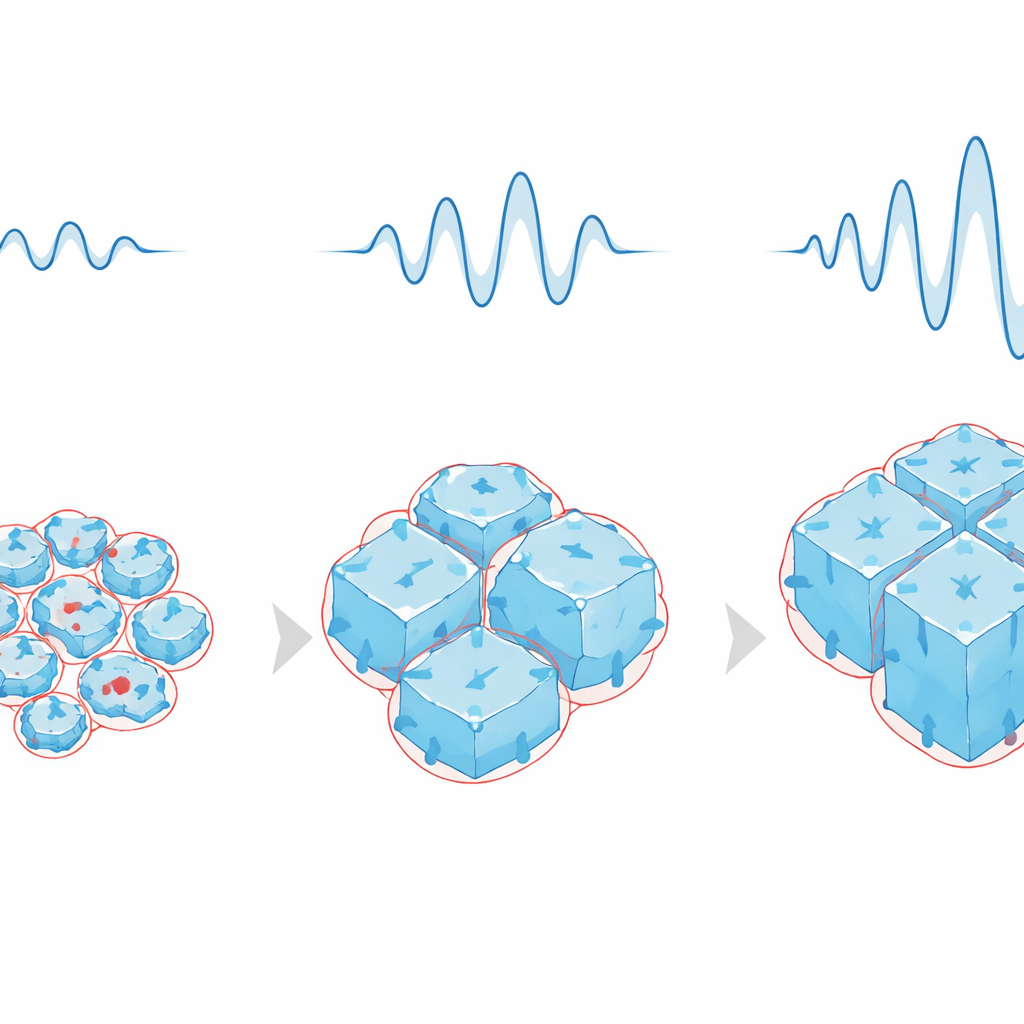
The researchers produced a series of perovskite films with gradually increasing amounts of thiocyanate. This additive is widely used in perovskite solar cells to heal defects and improve performance. Here, atomic-force microscopy showed that as thiocyanate content rose, the nanoparticles making up the film became larger and the surface roughness evolved in a predictable way. At the same time, measurements of surface potential and work function revealed that the electric fields naturally present near the surface—created by defect-related charges—grew stronger and more organized. Surprisingly, the THz emission did not simply track the total number of defects. Instead, it tended to increase with thiocyanate concentration up to a point, indicating that something more subtle than sheer defect density was controlling the emission.
Crystal order and the direction of the push
X-ray diffraction and photoluminescence experiments showed that adding thiocyanate steadily improved the internal crystal quality of the films. Poorly crystallized films without thiocyanate displayed many differently oriented crystal domains, each hosting surface defects that produced electric fields pointing in various directions. These fields partly canceled one another, weakening the net “push” on the newly created charges when the laser hit. As the grains grew larger and better aligned, there were fewer crystal orientations, so the built-in surface fields lined up more coherently. Even though the overall number of defects shrank, their fields now pointed in similar directions, strengthening the effective electric field that accelerates electrons and holes. This better alignment translated into higher charge mobility and, consequently, stronger THz pulses.
When too few flaws become a problem
The story takes an interesting turn at the highest thiocyanate concentration. Here, the nanoparticles are largest, the crystal order is high, and the surface electric field is well oriented—yet both the charge mobility and THz emission drop. Time-resolved THz measurements showed that charges in these films live a long time but are no longer accelerated strongly enough at very early times to create intense THz bursts. The likely reason is that the extreme reduction in surface defects also weakens the overall strength of the built-in field, so there is less instantaneous kick to the charges right after the laser pulse. In other words, a perfectly ordered, nearly defect-free surface is actually worse for THz generation than one with a carefully balanced level of imperfections.
Finding the sweet spot for future devices
For non-specialists, the key outcome is that efficient THz emitters based on perovskites do not simply require the cleanest possible crystals. Instead, there is an optimal middle ground where the material is crystalline enough that the internal electric fields all pull in the same direction, yet still contains enough strategically placed defects to make those fields strong. In this sweet spot, ultrafast laser pulses generate charges that are rapidly yanked by the aligned surface field, producing bright THz flashes. This balance of order and imperfection offers a practical recipe for designing better THz sources and detectors from solution-processed materials, potentially paving the way for low-cost, chip-scale devices that operate in a spectral region long considered difficult to access.
Citation: Ponseca, C.S., Musa, M.O., Wang, F. et al. Defect mediated pulse terahertz emission from thiocyanate-treated hybrid perovskite nanoparticles: role of the orientation of built-in surface electric field. Sci Rep 16, 11542 (2026). https://doi.org/10.1038/s41598-026-42017-w
Keywords: terahertz emission, hybrid perovskites, surface defects, nanoparticles, thiocyanate treatment