Clear Sky Science · en
Enhancing urban vehicular communication and safety through HMM-OCR
Why Smarter Car Conversations Matter
As more cars crowd our city streets, getting them to "talk" to each other becomes just as important as building new roads. Modern vehicles can share warnings about sudden braking, slippery pavement, or traffic jams, but this constant chatter can clog the airwaves, wasting energy and slowing down the very alerts meant to keep us safe. This paper explores a new way to organize those conversations so that messages travel faster and more reliably in busy urban traffic, with the ultimate goal of smoother commutes and fewer accidents.
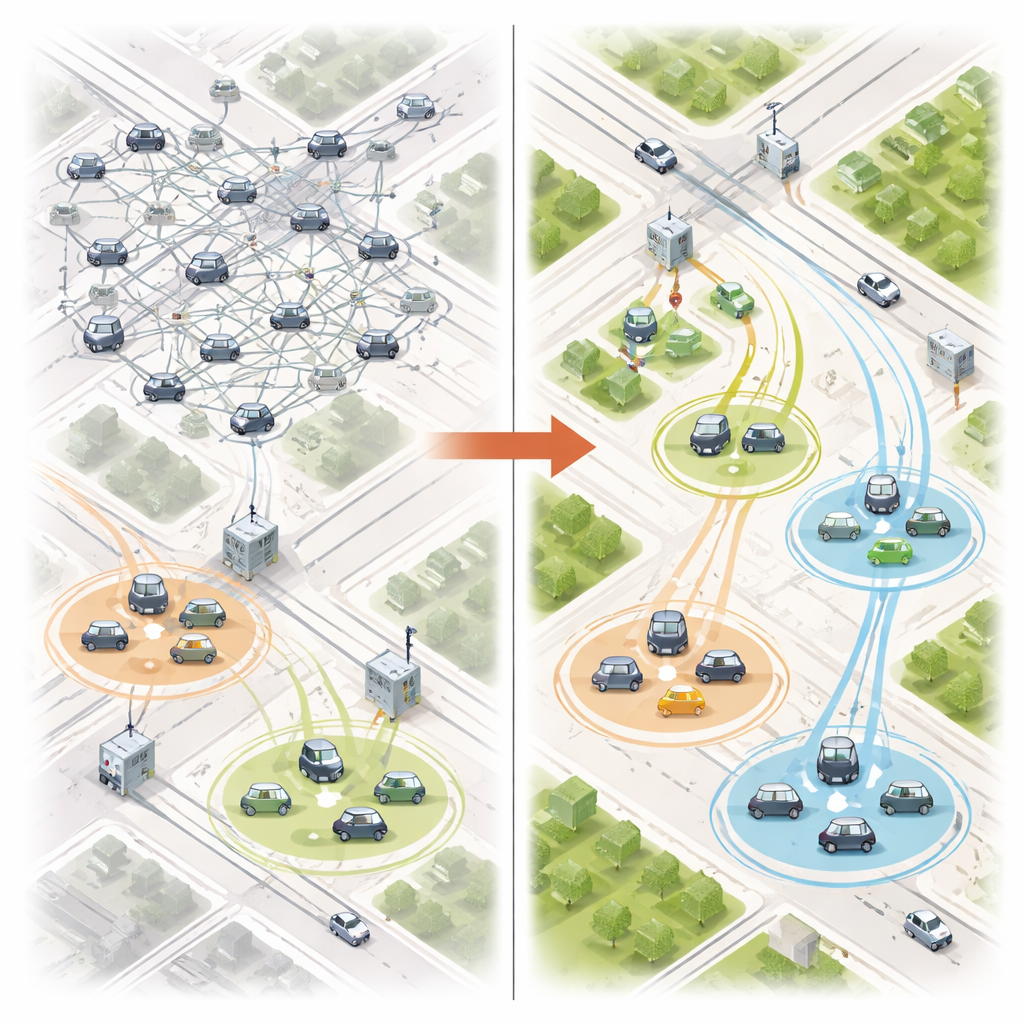
How Cars Form Neighborhoods on the Road
The study focuses on vehicular ad hoc networks, or VANETs—temporary, self-organizing networks formed by moving cars and roadside devices. In packed city environments, cars move quickly, signals get blocked by buildings, and hundreds of vehicles may try to send data at once. Traditional methods often treat each car as an independent speaker, which leads to long message paths, dropped packets, and wasted battery power. The authors propose a different approach: cars on the road should form small, temporary "neighborhoods" so that only a few well-chosen vehicles handle most of the talking for the group.
Turning Traffic into Smart Clusters
To build these road neighborhoods, the paper introduces a technique called HMM-OCR, short for Hybrid Meta-Heuristic and Machine Learning-based Optimised Cluster-Based Routing. First, a clustering step groups nearby vehicles together based on how close they are and how strong their wireless signals appear. This is handled by an algorithm inspired by the hunting behavior of golden eagles, which searches the road network for cluster shapes that keep cars close enough to talk easily while minimizing the distance messages must travel. By shrinking those distances, the method cuts the energy each car uses to send and receive information and reduces how often the group structure has to be rebuilt as vehicles move.
Choosing Spokescars and Guiding Messages
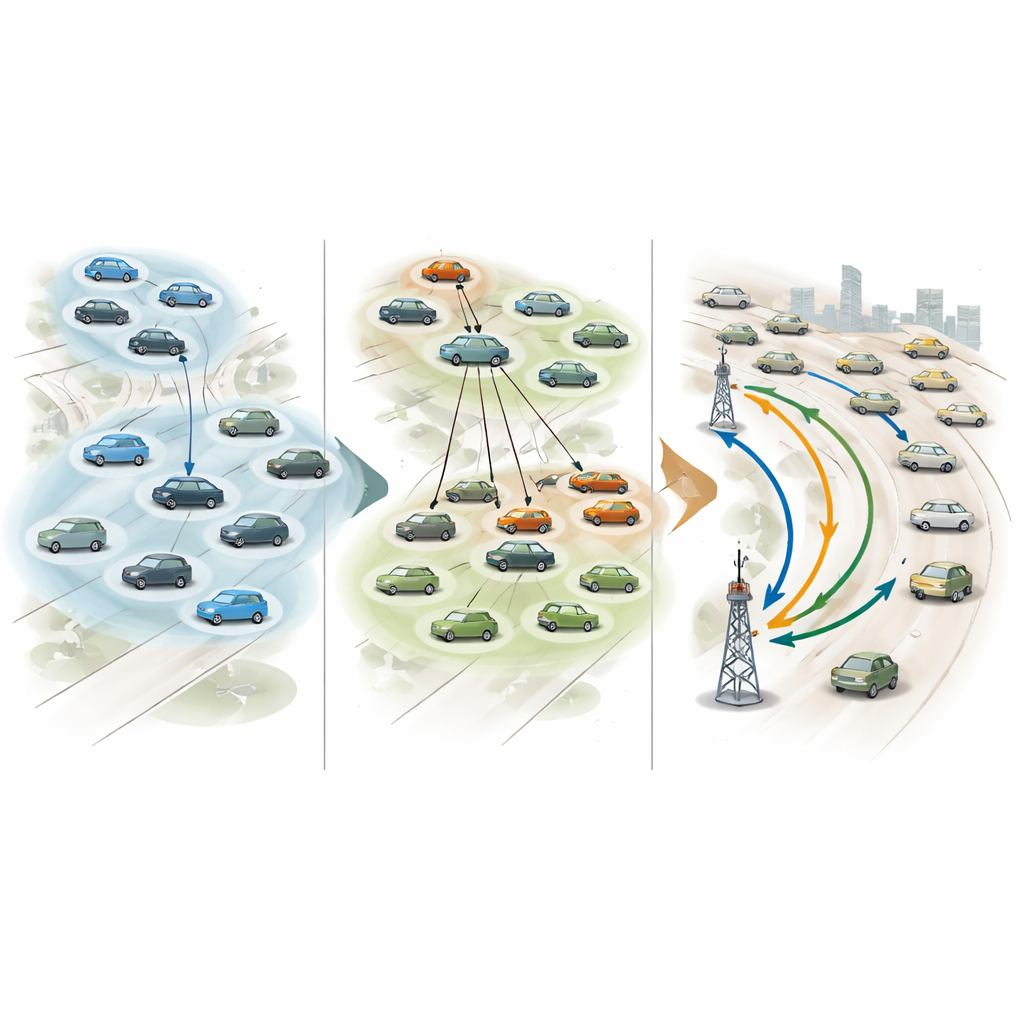
Once clusters are formed, the next challenge is to pick one car in each neighborhood to act as the "spokescar" or cluster head. The paper uses another nature-inspired search method, this time modeled after jackals hunting prey, to weigh many factors at once: remaining energy, local congestion, how stable each link is, and how well a candidate car can reach others. After these leaders are chosen, a neural network steps in to decide how messages should hop from cluster to cluster and through roadside units placed along the streets. This network learns from simulated traffic patterns, signal strengths, and positions so it can pick efficient next steps for each message, steering data around obstacles and toward its destination.
Putting the System to the Test
The authors tested HMM-OCR in a detailed computer simulation of a city grid, comparing it with several widely used routing methods that either ignore clustering or rely on simpler learning strategies. They varied both the number of cars and how long the simulations ran to mimic changing traffic conditions. Across all scenarios, the new method delivered more messages successfully, dropped fewer packets, and used far less energy. It also cut the time it took for warnings to travel from one car to another, and it reduced the extra routing overhead—those housekeeping messages that keep networks running but do not carry useful safety information.
What This Means for Everyday Drivers
For non-specialists, the takeaway is straightforward: by organizing vehicles into smart, temporary neighborhoods and carefully choosing which cars speak for the group, city traffic networks can become both faster and more frugal. The proposed HMM-OCR system keeps more safety messages from getting lost, uses less energy per vehicle, and stays stable even as roads get crowded. In practical terms, that could mean earlier warnings about hazards, less radio interference, and a communication backbone better suited to future self-driving and connected cars. While real-world testing and stronger security protections are still needed, this work points toward urban roads where digital cooperation among vehicles quietly helps reduce congestion and accidents.
Citation: Juvvalapalem, S., Kanagaraj, V. Enhancing urban vehicular communication and safety through HMM-OCR. Sci Rep 16, 13503 (2026). https://doi.org/10.1038/s41598-026-42007-y
Keywords: vehicular networks, intelligent transportation, urban traffic, wireless communication, routing algorithms