Clear Sky Science · en
Data-driven springback prediction of curved metal sections in curtain wall systems
Why bent metal in building skins matters
Glassy building skins often rely on long, curved metal ribs to hold everything in place. When these aluminum parts are bent into shape, they tend to spring back slightly once the presses and clamps let go. That small rebound can throw off the fit of thousands of pieces on a complex facade, slowing construction and raising costs. This study explores a faster, data-driven way to predict how these curved metal sections will behave, so designers and manufacturers can get closer to the desired shape on the first try. 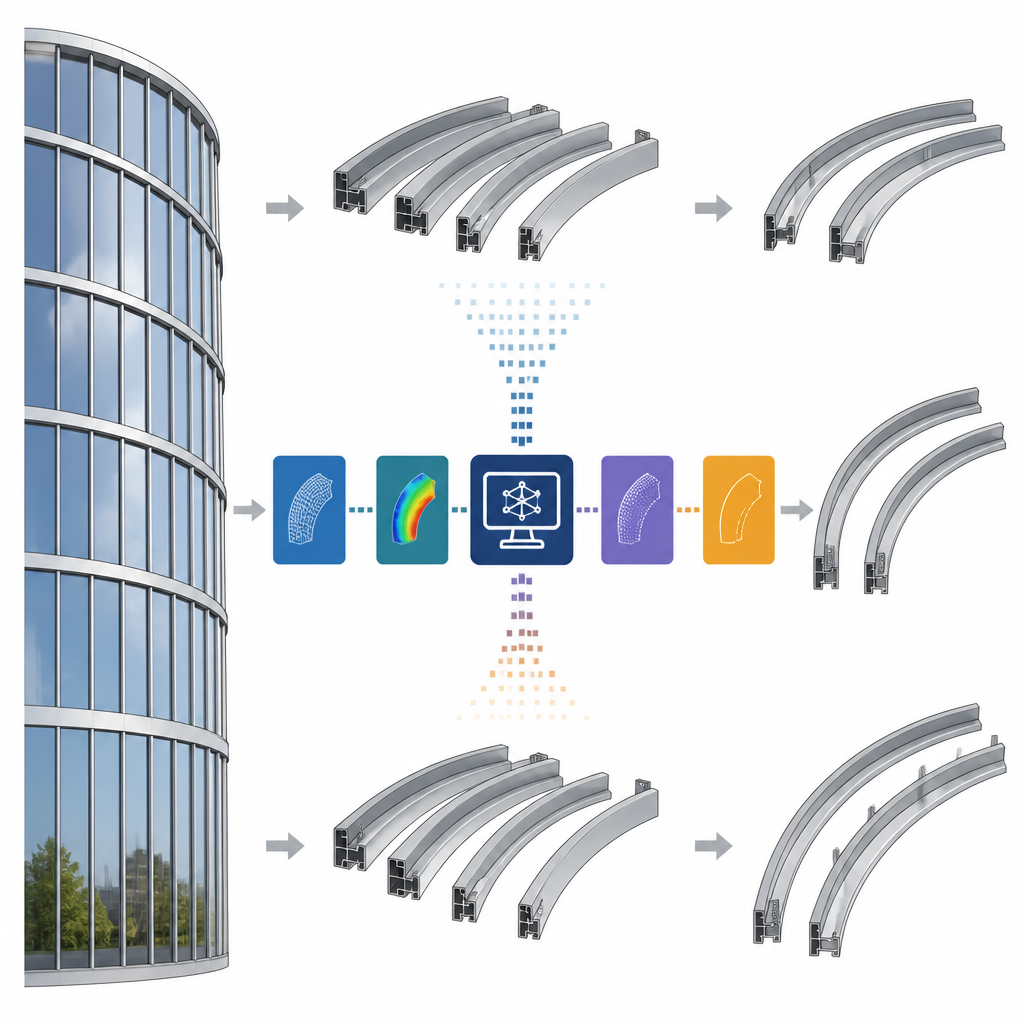
How modern facades use curved metal
Many contemporary curtain wall systems wrap buildings in smooth, flowing lines rather than simple flat panels. To create these shapes, manufacturers bend aluminum sections into U, S, or more complex three-dimensional forms. During the forming process, each piece experiences a mix of stretching, bending, and twisting. When the external forces are removed, the metal recovers part of its original shape, a response known as springback. Even millimeter-level deviations in chord lengths or arc height can reduce assembly precision and spoil the intended architectural effect.
Limits of traditional virtual testing
Engineers have long relied on detailed computer simulations, called finite element models, to estimate how much springback will occur. These models can be accurate but are slow and labor-intensive to set up for every new geometry. In curtain walls, there may be hundreds or thousands of unique curved parts, each with different lengths, thicknesses, and bend angles. Running a full simulation for every variation can quickly become impractical, especially when schedules are tight and design changes are frequent.
Turning simulations into a learning problem
The authors propose a three-step framework that treats springback prediction as a data problem. First, they run a carefully calibrated set of simulations for a wide range of component sizes and bending patterns, and verify these results against measurements from a real curtain wall manufacturer. Second, they use a generative model to create additional synthetic data that resemble the simulated results, increasing coverage of unusual shapes without extra costly simulations. Third, they train a neural network that takes simple inputs, such as dimensions and bend angles, and directly outputs expected springback measures like inner chord length, outer chord length, and sagitta. 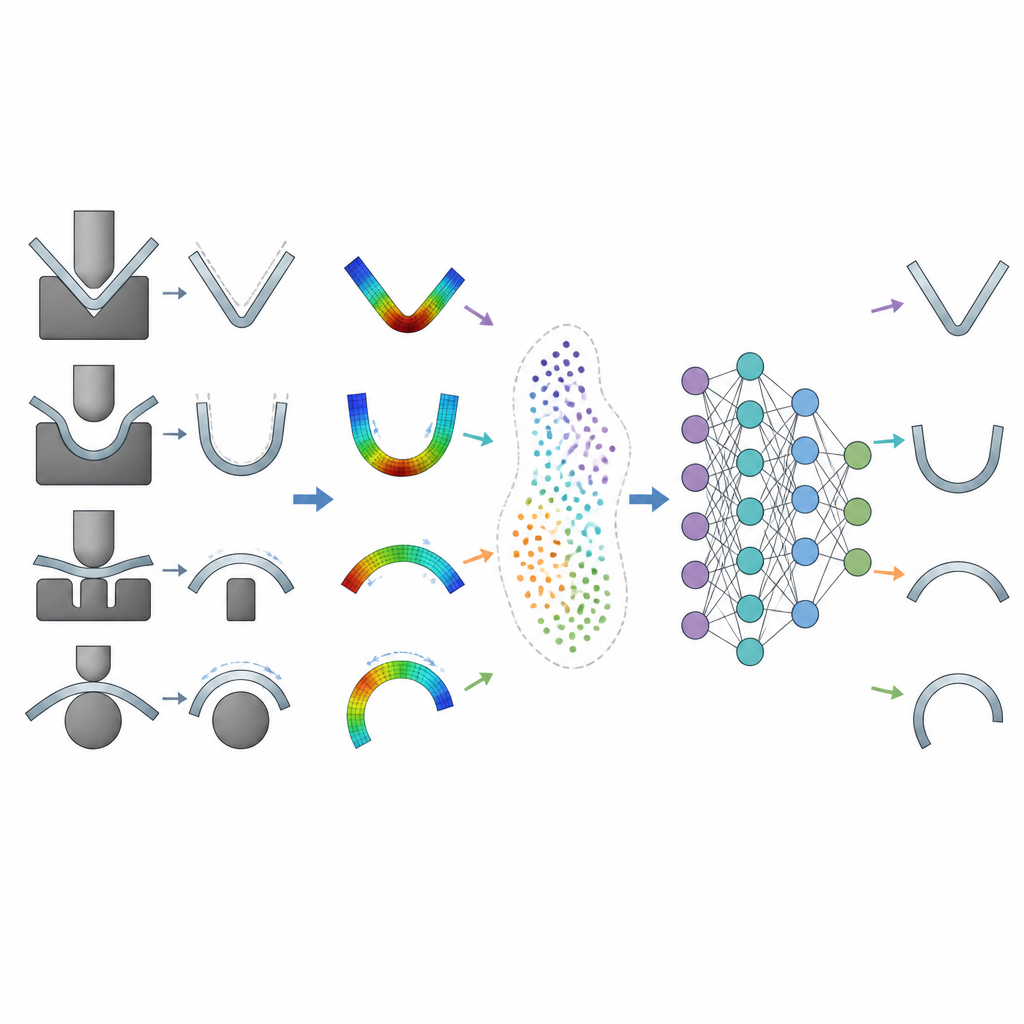
How well the learned model performs
Tests show that the data-driven model reproduces the springback trends of the detailed simulations with good accuracy across many different geometries. On an independent test set, the predictions track measured values closely, with only small average differences. The model performs particularly well when enriched with synthetic data, which is helpful for bending patterns that had fewer original simulations. Once trained, the neural network produces results almost five times faster than running new simulations, an advantage that grows with the number and variety of parts.
What this means for building practice
For architects and facade engineers, the study suggests that reliable springback forecasts can be built into digital design tools without requiring a full simulation for every single component. By learning from a combination of carefully validated simulations and generated examples, a compact model can quickly estimate how much a curved section will rebound after forming. That speed and accuracy can support better shaping of molds, smarter allowances in drawings, and fewer on-site adjustments, helping complex curtain wall systems match their intended designs more closely.
Citation: Jiang, W., Zhang, Y., Liang, Y. et al. Data-driven springback prediction of curved metal sections in curtain wall systems. Sci Rep 16, 14838 (2026). https://doi.org/10.1038/s41598-026-42002-3
Keywords: curtain wall systems, springback, aluminum bending, finite element simulation, neural network modeling