Clear Sky Science · en
A novel spatiotemporal decomposition and identification of sparse equations for human brain deformation
Why Crashes Gently Shake the Brain
When you bump your head, even mildly, your brain jiggles inside your skull in complicated ways that are hard to see or predict. Doctors and engineers would love a simple description of this motion, because it could improve helmets, car safety, and medical diagnosis after a hit to the head. This study introduces a new data-driven method that distills the brain’s intricate internal motion into just a few basic patterns and equations, using advanced MRI scans of people experiencing small, controlled head movements.
Turning Complex Motion into Simple Patterns
Many physical systems that look chaotic on the surface—from ocean waves to swirling air—are actually governed by a handful of dominant patterns that repeat over time. The authors build on this idea for the human brain. They develop a framework called TASC-DMD that takes in measurements of how something changes across space and time and breaks that behavior into a small set of recurring “modes,” each with its own rhythm. Instead of relying on detailed, hand-built physics models, the method learns directly from data, aiming to find the simplest possible description that still captures the essential motion.

A New Way to Read Motion from MRI Movies
The team tests their method first on classic physics problems where the correct answer is already known: traveling waves in a mathematical equation, swirling vortices behind a cylinder in flowing fluid, and the wobble of a gel-filled cylinder used as a stand-in for brain tissue. In each case, TASC-DMD not only recovers the expected patterns and frequencies, but also proves more robust to noise and limited data than commonly used approaches. This gives confidence that the same technique can be trusted on much messier real-world data, like motion inside the human head.
Finding Hidden Rhythms in the Living Brain
The key test is a set of 3D MRI movies showing how the brains of 45 volunteers deform during mild, controlled head motions—either nodding-type or twisting-type motions. From these scans, the researchers compute how every tiny region of the brain stretches or shears over time, creating a rich, four-dimensional picture of internal strain. Using TASC-DMD, they discover that this enormous dataset can be well described by just three dominant deformation patterns, each oscillating at a characteristic frequency in the range of roughly 7–15 cycles per second. Remarkably, these same three basic rhythms appear consistently across all subjects and both types of loading.
Building Simple Equations for Brain Motion
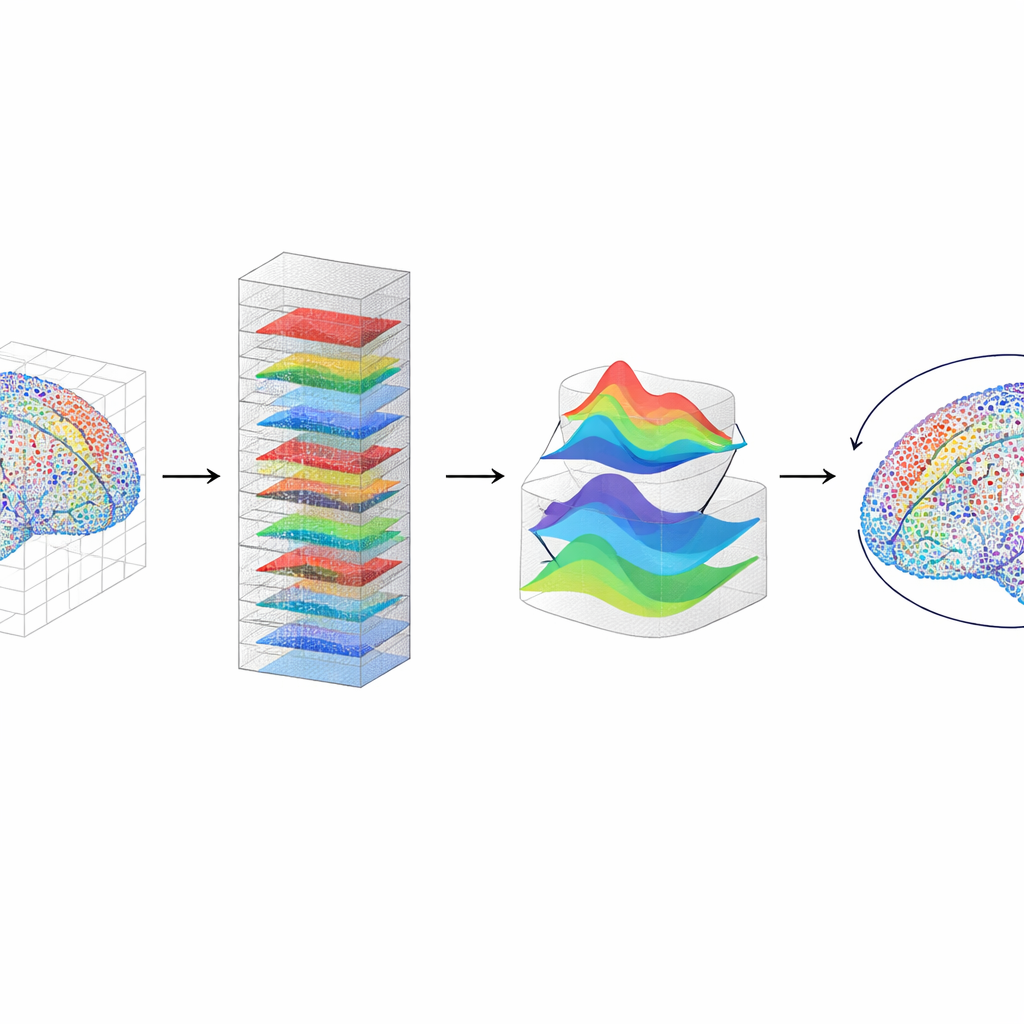
To go a step beyond pattern-finding, the authors use a second tool called SINDy, which searches for the simplest set of mathematical equations that reproduces how these three patterns change over time. Trained on data from 36 of the 45 people, the combined TASC-SINDy model then predicts the full 3D strain patterns in the remaining nine individuals, using only their initial state as input. The predicted brain deformation closely matches the measured MRI data in both local details and overall behavior, even though the model is extremely compact. This shows that the brain’s response to mild impacts, while mechanically rich, is governed by low-dimensional dynamics that can be captured in just a few interacting modes.
What This Means for Brain Safety and Beyond
By revealing that complex brain motion during mild impacts can be reduced to three repeatable patterns and a small set of governing equations, this work suggests that head injury risk may eventually be assessed and predicted using streamlined models rather than massive simulations. The same framework can also be applied to other complex systems—from fluids to engineered materials—whenever rich space-and-time data are available. In essence, the study offers a powerful new way to let the data speak for themselves, uncovering simple rules hidden inside seemingly tangled motion.
Citation: Arani, A.H.G., Alshareef, A.A., Pham, D.L. et al. A novel spatiotemporal decomposition and identification of sparse equations for human brain deformation. Sci Rep 16, 14468 (2026). https://doi.org/10.1038/s41598-026-41995-1
Keywords: brain biomechanics, traumatic brain injury, dynamic mode decomposition, data-driven modeling, tagged MRI