Clear Sky Science · en
Research on target detection algorithm for forest fire images based on multi-scale feature extraction
Why Early Fire Spotting Matters
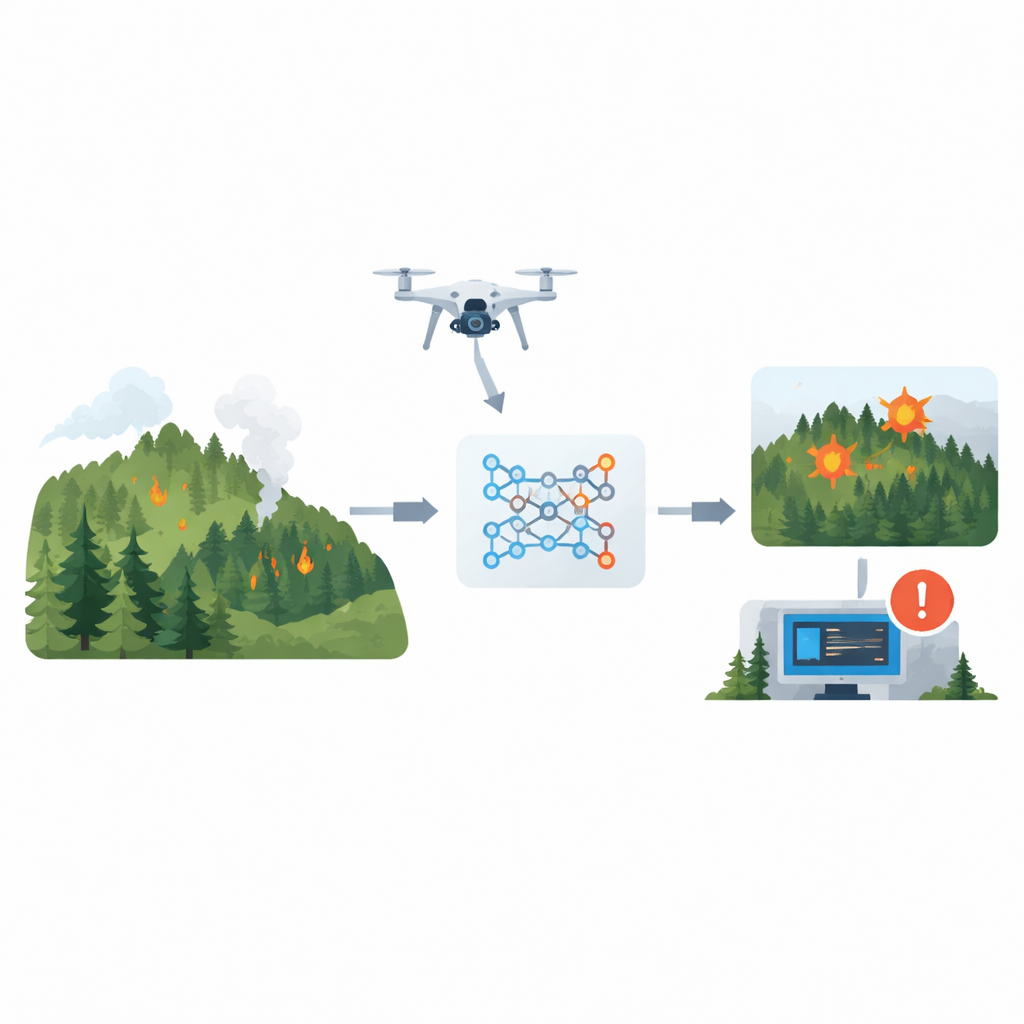
Forest fires often start as tiny flames or wisps of smoke, barely visible against trees, clouds, or nighttime skies. Yet catching these small signals early can mean the difference between a quickly controlled blaze and a catastrophe that destroys ecosystems and threatens towns. This study presents a new computer-vision method that helps cameras on drones and other devices spot small, hard-to-see fire signs in real time, even in cluttered and changing forest environments.
From Patrolling Forests to Smart Watching
Traditional forest fire monitoring has relied on watchtowers, patrols, or simple sensors that react slowly and can easily miss distant fires. In recent years, deep learning—a type of artificial intelligence that learns patterns from vast amounts of data—has transformed how we analyze images. For forests, this means teaching algorithms to recognize telltale shapes and colors of flames and smoke. However, real forests are messy places: smoke can blend with clouds or fog, flames can be tiny specks in a wide landscape, and objects in the scene vary greatly in size. Existing systems often struggle most with those early, small fires that are most important to catch.
Seeing Big and Small at the Same Time
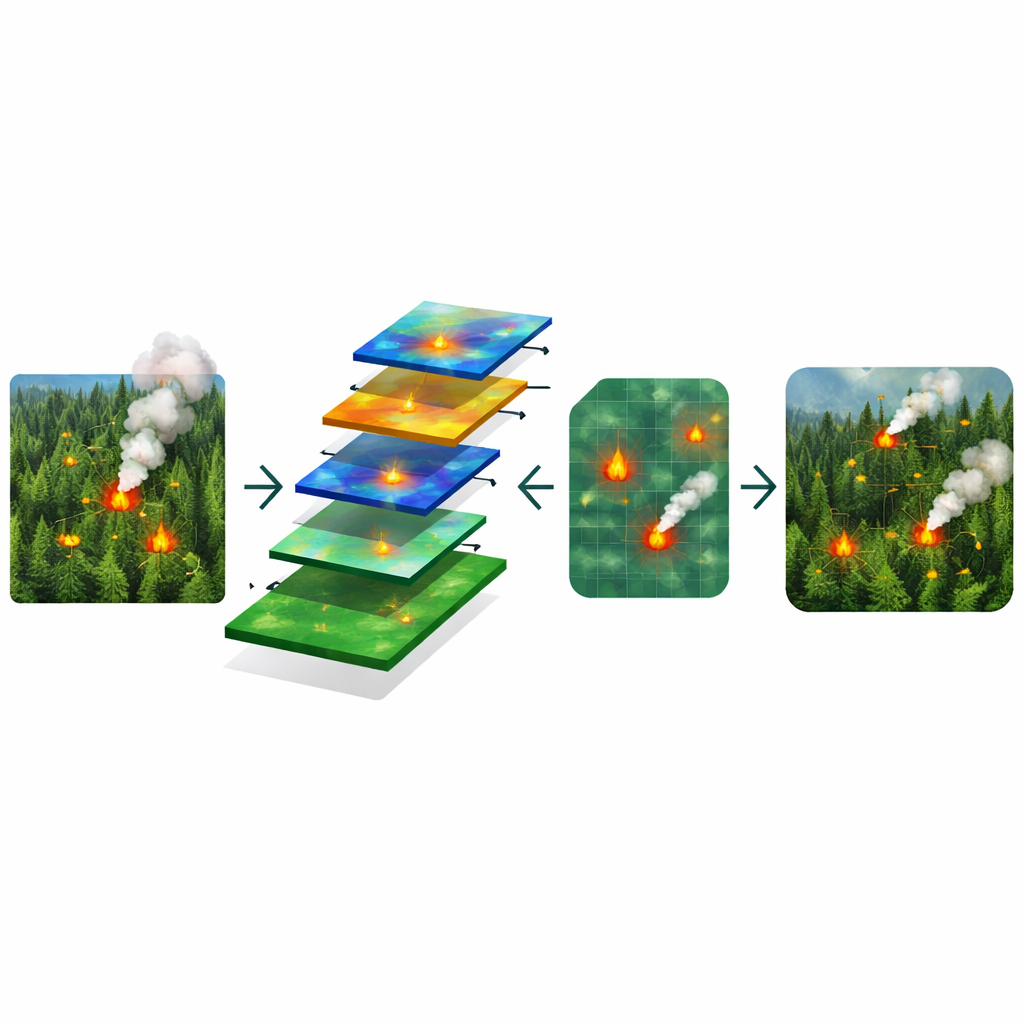
The researchers build on a popular real-time detection framework called YOLO, which scans images and draws boxes around objects of interest. Their upgraded version, based on YOLOv9c, is designed specifically to handle the wide range of fire sizes found in aerial and ground forest images. First, they redesign the model’s “backbone”—the part that extracts visual features—using a new module called EGI. This module splits the incoming image into several processing streams that look at fine details and broader shapes in parallel, then recombines them while automatically emphasizing the most informative patterns and damping confusing background elements like trees or clouds. The goal is to keep the model lightweight enough for devices on drones or remote stations while sharpening its ability to notice subtle signs of fire.
Zooming In on Tiny Flames and Faint Smoke
To further improve early detection, the team adds a special extra output layer, known as the P2 head, that focuses on very small targets. This layer works with a smart “upsampling” component called CARAFE, which reconstructs higher-resolution feature maps so that the model retains fine edges and textures that would otherwise be smoothed out. Together, these additions help the system highlight tiny flames and thin smoke lines that appear far away in a camera’s field of view. The researchers also refine how the model learns to draw boxes around fires by adopting a more nuanced way to compare predicted boxes with the true ones, guiding the training process toward more precise outlines and fewer location errors.
Putting the System to the Test in the Wild
The new approach is evaluated on a large public dataset of forest fire images that covers different weather, times of day, forest types, terrain, and camera viewpoints, including drone footage. The improved model not only detects fires and smoke more accurately than the baseline YOLOv9c system but also outperforms several other well-known object-detection models. It boosts detection accuracy by several percentage points while cutting the number of internal parameters by nearly a third, all while maintaining real-time processing speeds above 25 frames per second on edge-level graphics hardware. Importantly, it shows strong performance in difficult situations such as nighttime scenes, heavy vegetation cover, and backgrounds where smoke resembles clouds.
What This Means for Safer Forests
For non-specialists, the takeaway is clear: this work delivers a smarter pair of “eyes” for forest protection. By combining multi-scale vision, attention to important details, and careful fine-tuning of how the model learns from examples, the system can spot small fires and subtle smoke earlier and more reliably, with fewer false alarms. Because it runs efficiently on lightweight hardware, it can be built into drones and remote stations that continuously watch large forest areas. In practical terms, this means faster warnings, more time for firefighters to respond, and better chances of preventing small sparks from turning into devastating wildfires.
Citation: Wu, W., Zhou, X., Qin, J. et al. Research on target detection algorithm for forest fire images based on multi-scale feature extraction. Sci Rep 16, 12759 (2026). https://doi.org/10.1038/s41598-026-41994-2
Keywords: forest fire detection, deep learning, object detection, drone monitoring, early warning