Clear Sky Science · en
The construction of improved evaluation indicator system and quantitative method of hydropower station dispatching scheme
Why smarter dam planning matters
Rivers that power our lights also irrigate fields, shelter fish, carry cargo, and hold back floods. In huge hydropower systems like China’s Jinsha River and Three Gorges cascade, deciding exactly when and how much water to release is a daily juggling act. This study introduces a new way to judge whether a proposed operating plan for such dams really serves people, the economy, and the environment as well as it should.
Many needs, one river
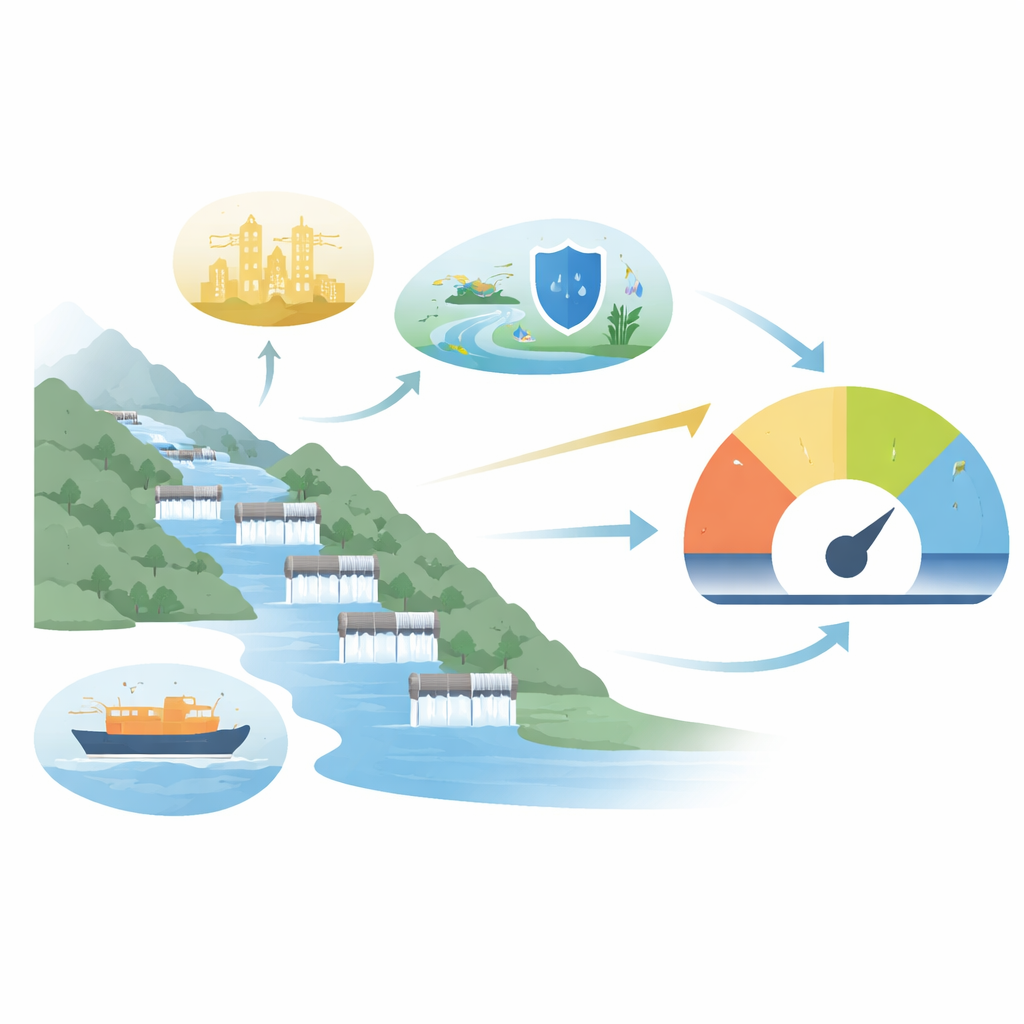
Large hydropower stations do far more than generate electricity. They must keep reservoirs ready for flood season, guarantee drinking and irrigation water, maintain river conditions for fish and wildlife, and provide safe water levels for ships. In practice, dam operators design detailed schedules for raising and lowering water levels over the year. Traditionally, they have judged these plans mainly by experience and by total electricity output, an approach that can overlook ecological or safety concerns and puts a heavy burden on human judgment.
Turning complex trade-offs into clear scores
The authors argue that judging dam schedules is really a multi-goal decision problem: many objectives, many constraints, and many ways to succeed or fail. They build a broad indicator system for the critical “drawdown” season, when reservoirs are gradually lowered from winter highs to make room for summer floods. Their indicators span five groups: electricity production, water supply, ecosystem health, shipping, and other safety and stability factors such as how fast water levels fall and how closely operations approach technical limits. This structure allows very different quantities—like fish-friendly flows, ship channel depth, and power output—to be compared on a common footing.
Letting history reveal hidden priorities
Existing rating methods tend to be either heavily expert-driven or purely data-driven. Expert scoring can be biased or inconsistent, while methods that only look at data swings can misread “quiet” but crucial indicators. To bridge this gap, the study introduces a dynamic calibration method based on how well indicators have historically been met, called HCR-DPAICM. The key idea is that past operation records contain clues about what operators really value: for instance, if ecological flow was kept high while power output was trimmed back, that suggests ecology was treated as more important at that time. The method converts all indicators into “completion rates,” analyzes their average performance and variability over a decade of past operations, and adjusts their importance weights accordingly, while correcting for indicators that are easy to satisfy and might otherwise look falsely critical.
Blending human judgment with hard numbers
To avoid relying on data alone, the authors combine this historical calibration with a well-known expert method called the Analytic Hierarchy Process. Experts compare the relative importance of goals—such as giving water supply and ecological needs first priority—and these judgments are translated into weights. The final evaluation uses a 50–50 mix of expert-based and history-based weights, damping extreme emphasis on any single factor and improving balance among indicators. The team then applies this combined system to a real cascade of five major reservoirs on the lower Jinsha River and Three Gorges, comparing the current operating schedule during the January–June drawdown with an optimized schedule generated by an advanced mathematical planning model.

What better scheduling looks like
Using the new scoring system, the optimized schedule modestly increases total power generation and uses water more efficiently, while also improving ecological flow satisfaction and fully respecting operational constraints. Both the actual and optimized plans keep navigation and key time points on track, but the optimized plan operates closer to safety boundaries and shows somewhat lower stability in water levels and power output, reflecting a sharper push for efficiency. Overall, across multiple evaluation methods, the optimized plan receives a higher comprehensive score, with better constraint compliance and similar or improved performance on most other goals.
Takeaway for rivers and people
In simple terms, this work offers a smarter report card for dam operation plans. By blending what experts say should matter with what past operations reveal actually has mattered, the method produces balanced, comparable scores across economic, ecological, and safety objectives. For large cascades like the Jinsha–Three Gorges system, it helps identify operating strategies that squeeze more value from the river while still honoring environmental flows and safety limits. The approach is general enough to guide more sustainable hydropower management in other complex river systems around the world.
Citation: Xu, Y., Qiu, B., Xu, Y. et al. The construction of improved evaluation indicator system and quantitative method of hydropower station dispatching scheme. Sci Rep 16, 11544 (2026). https://doi.org/10.1038/s41598-026-41993-3
Keywords: hydropower scheduling, reservoir management, multiobjective evaluation, river ecology, water resources planning