Clear Sky Science · en
Optimising thermal and irradiance conditions for enhanced oxygen production in Tetradesmus bajacalifornicus
Why tiny green cells matter for our future air
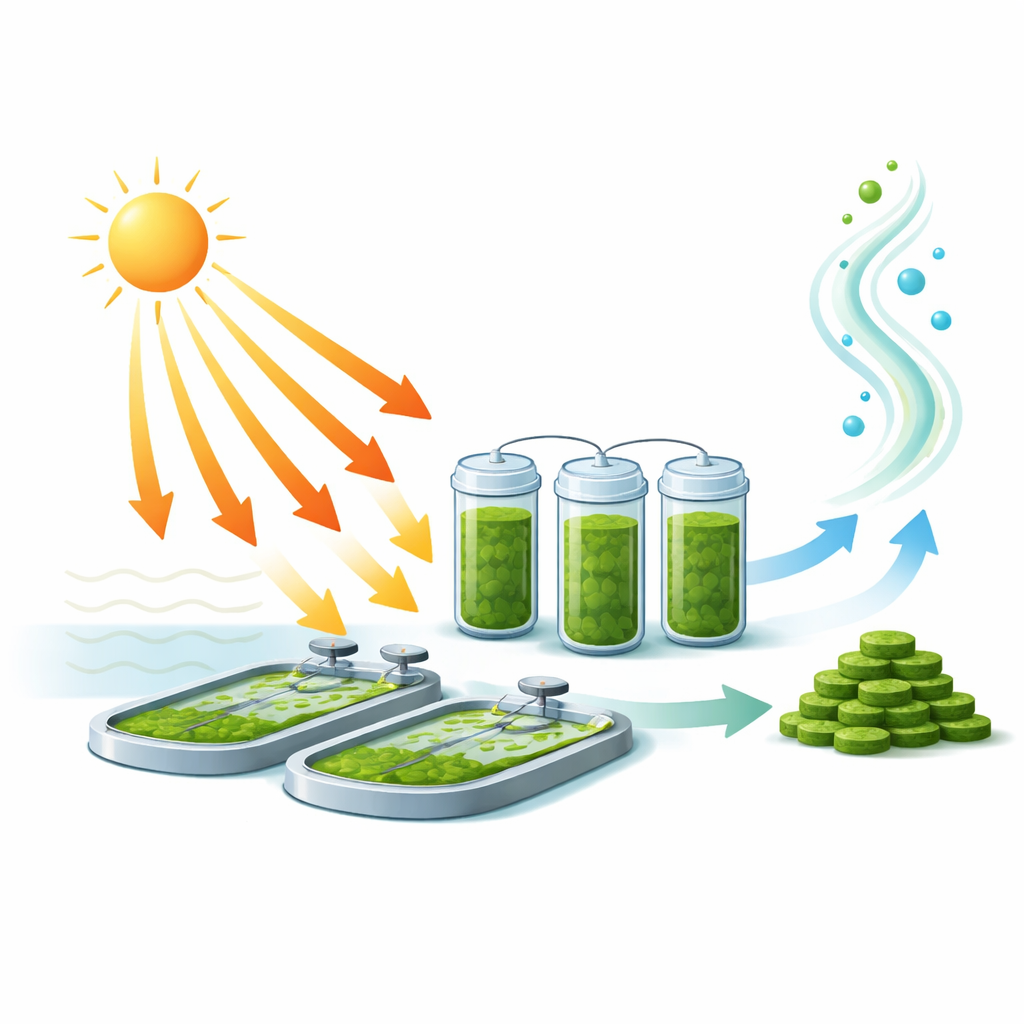
As carbon dioxide levels in the atmosphere climb to record highs, scientists are searching for living "machines" that can pull this gas out of the air and turn it into something useful. One promising candidate is microalgae: microscopic green cells that use sunlight to grow, release oxygen, and build biomass that can become food, fuel, or other products. This study explores how to get a little-known microalga called Tetradesmus bajacalifornicus to produce as much oxygen and biomass as possible by carefully tuning two everyday factors: light and temperature.
Small algae with big potential
Tetradesmus bajacalifornicus is a fast-growing, hardy microalga that tolerates harsh conditions and high levels of carbon dioxide. Previous work showed it can make valuable compounds with antioxidant and antimicrobial activity, accumulate oils useful for biofuels, and thrive where other organisms might struggle. That makes it attractive for future carbon-capture farms and biorefineries. But until now, no one had systematically examined how combinations of light intensity, temperature, and the length of time the cells are heated affect its ability to produce oxygen, a direct indicator of photosynthetic performance and growth.
Finding the sweet spot of light and warmth
To hunt for the best conditions, the researchers used a sensitive setup called a photorespirometer, which tracks how much oxygen the algae release in light and how much they consume in the dark. They tested a wide range of light levels and temperatures that mimic those in indoor, artificially lit reactors. Using a statistical approach, they built a response surface—a kind of topographic map—showing how oxygen production rises or falls as light and warmth change together. The map revealed a clear peak: at about 38 °C and a strong light level, the microalga reached a very high oxygen production rate, comparable to some of the best industrial strains. In simple terms, hotter and brighter generally meant more oxygen, up to a point.
When “too hot” breaks the system
However, what looks optimal in a short test can fail over days. When cultures were kept at this high temperature continuously under strong light, they quickly declined. Within just three days, signs of photosynthetic health dropped sharply, and the cultures collapsed. The problem lies in the heat sensitivity of the photosynthetic machinery, especially a core protein in the system that splits water and releases oxygen. Prolonged overheating damages this protein, causing harmful by-products to build up and overwhelming the cells’ natural repair systems. As a result, the algae can no longer maintain high oxygen output or grow well, despite the conditions being ideal for peak short-term performance.
Using daily heat pulses instead of constant stress
To solve this mismatch between instant performance and long-term survival, the team tested daily “heat pulses.” They kept cultures at a comfortable temperature most of the time, then raised them to the high, performance-boosting temperature for only one, two, or three hours per day. A one-hour daily heat boost turned out to be beneficial: biomass increased by roughly one eighth compared with cultures that never experienced the brief warming, without leaving lasting damage. Longer heat pulses, however, pushed the cells past their coping capacity. At two and three hours of daily stress, oxygen production dropped and, at the longest exposure, cultures eventually crashed. The researchers also checked milder warm-ups at 29 °C and 34 °C for up to four hours. At 29 °C, the algae tolerated extended heating well, maintaining their oxygen output; at 34 °C, they fared well for about an hour, but longer exposures led to a lasting decline.

Designing smarter algae farms
These findings carry a clear message for future algae-based carbon capture and biomass production: temperature is not just about how hot, but also for how long. Short bursts of higher heat and light can be harnessed like a controlled workout that strengthens productivity, while constant or overlong stress becomes destructive. For closed, indoor reactors with artificial lighting, it should be feasible to program both the brightness and the timing of heat pulses to keep algae near their sweet spot. In outdoor or open systems, where sunshine and temperature are harder to control, choosing robust species like Tetradesmus bajacalifornicus and carefully planning reactor design and location will be crucial. Overall, this microalga emerges as a strong candidate for warm, sunny regions, where it could help turn excess carbon dioxide into oxygen and useful biomass—provided we respect its thermal limits.
Citation: Villaró-Cos, S., Cerdá-Moreno, C., Viviano, E. et al. Optimising thermal and irradiance conditions for enhanced oxygen production in Tetradesmus bajacalifornicus. Sci Rep 16, 11301 (2026). https://doi.org/10.1038/s41598-026-41958-6
Keywords: microalgae, oxygen production, temperature stress, artificial photobioreactors, carbon capture