Clear Sky Science · en
Spatiotemporal dynamics of heat stress and cold stress on UK rapeseed cropping over 1961–2020
Why warming matters for a familiar yellow crop
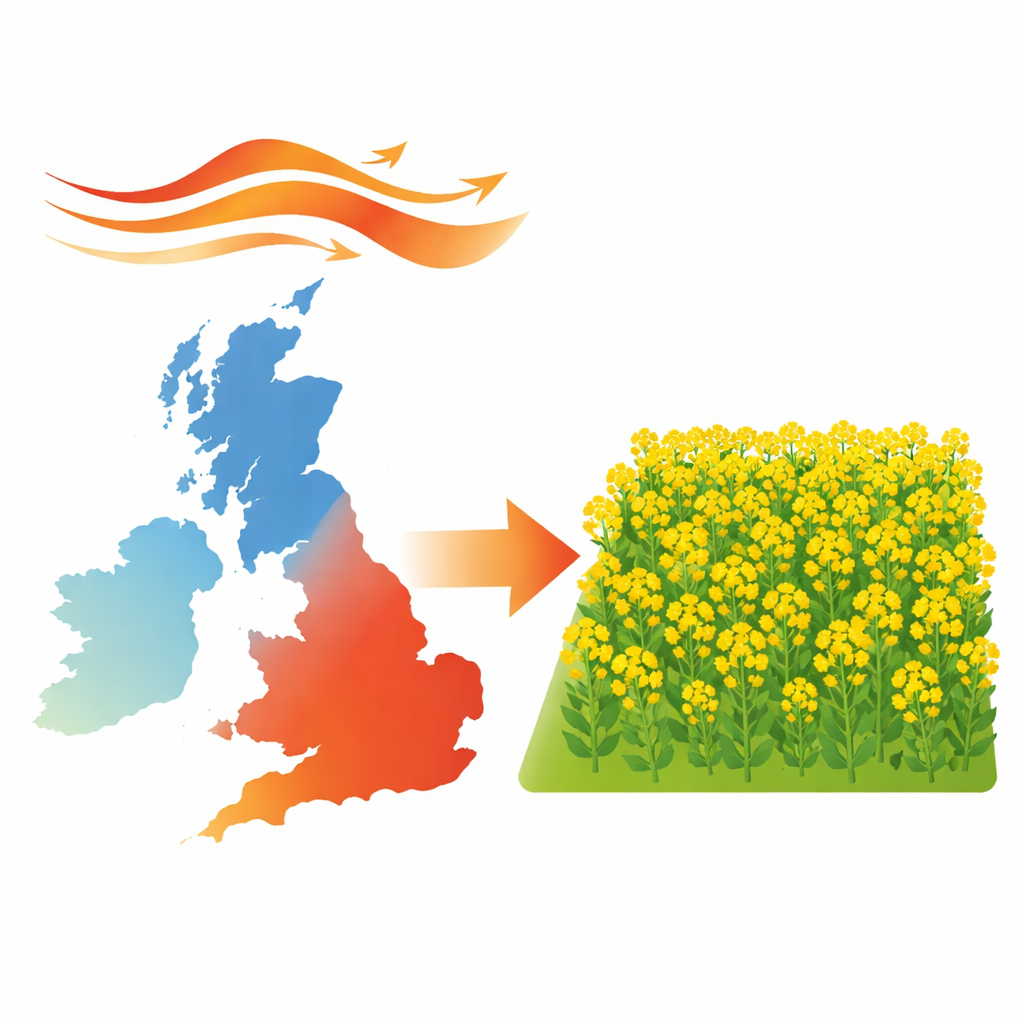
Every spring, fields of bright yellow rapeseed (often called oilseed rape) cover large parts of the UK countryside. This crop underpins cooking oil, animal feed and biofuels, so its reliability matters for food prices and energy security. This study asks a simple but crucial question: as the UK climate has warmed over the past 60 years, how have episodes of damaging heat and cold shifted for rapeseed, and what does that mean for future harvests?
Tracking stressful weather over six decades
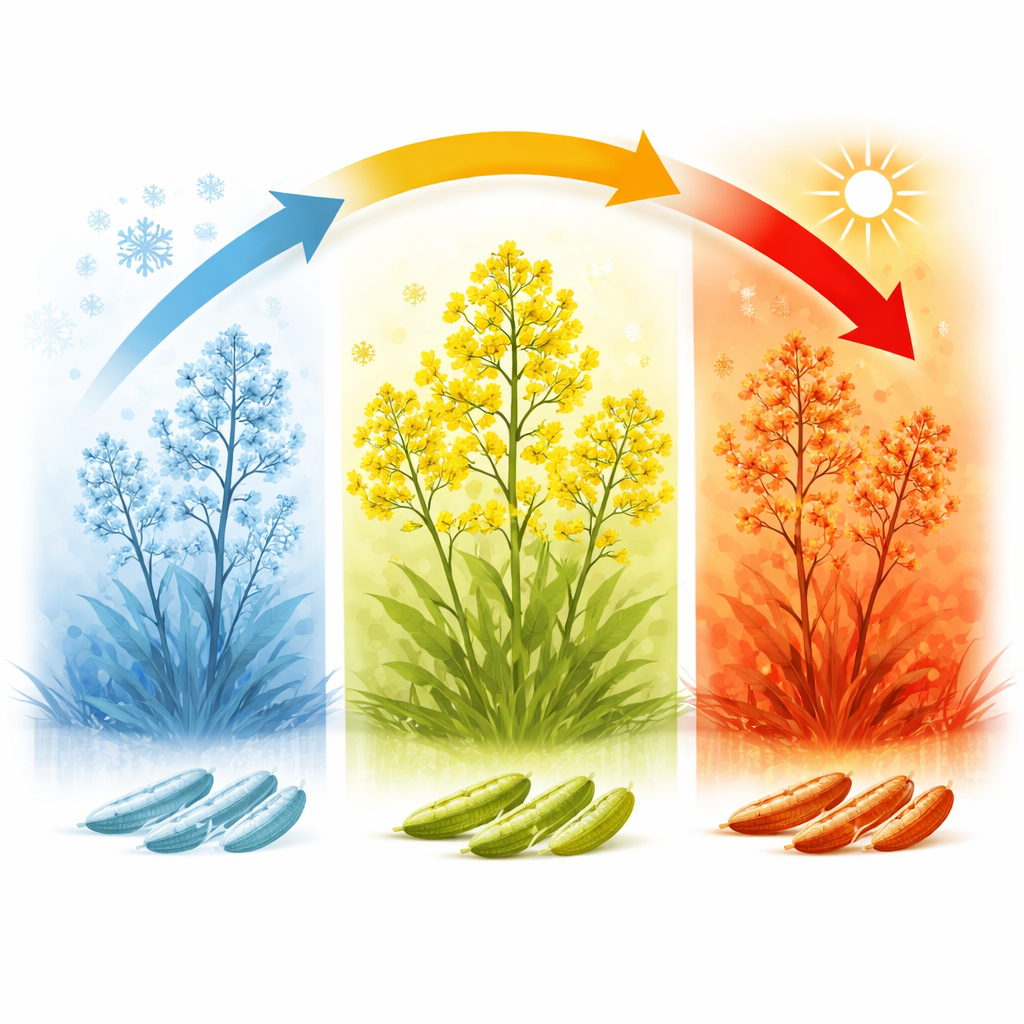
The researchers analysed daily temperature records for the whole UK at one‑kilometre resolution from 1961 to 2020, focusing on land that is both arable and suitable for rapeseed. They zoomed in on the crop’s most sensitive stages: the vegetative period in autumn and early winter, flowering in April and May, and seed filling through June and July. Using thresholds drawn from experiments, they counted how often and how strongly temperatures strayed into harmful territory—too hot during the day or too cold at night. This produced two indices: one for heat stress and one for cold stress, allowing direct comparison of how both types of extremes have evolved across regions and decades.
Colder extremes easing, but not disappearing
Across the UK’s rapeseed‑suitable soils, cold stress generally declined between 1961 and 2020. Nights that dipped below damaging thresholds became less common in the vegetative, flowering and reproductive periods, especially in England. Northern areas such as Scotland still experienced more cold stress than the south, but even there the overall trend was downward. December showed a subtle shift towards warmer minimum temperatures, reducing the length of the cold spells that can actually benefit winter rapeseed by helping it harden and set up for robust flowering. Despite this easing of cold, year‑to‑year variability remained high, meaning occasional cold years still punctuate the long‑term warming trend.
Heat building during critical growth stages
In contrast, hot spells became more frequent and more intense, particularly during flowering in April and May and during seed and pod development in June and July. Southern and eastern England stood out as hotspots where days above the critical high temperature threshold increased over the decades. By classifying stress levels, the study found that areas experiencing at least low to medium heat stress expanded, while areas with virtually no heat stress shrank. Heat stress in June and July was generally stronger than in April and May, but the rate of increase was fastest during flowering—a phase when even short bursts of heat can reduce flower number, pod formation and seed weight.
Estimating hidden production losses
To translate these changing stresses into potential impact on harvests, the authors combined their heat index with independent estimates of how much rapeseed each location could theoretically produce under good management. This produced a normalized “production loss index” that captures where and when heat during flowering is most likely to eat into yields. Between 1961 and 2020 this loss index rose, with statistically significant differences between decades and across regions. The greatest increases clustered in the major rapeseed‑growing belts of eastern and south‑eastern England and the Midlands, indicating that the country’s main production zones are also where heat‑related risks are concentrating.
Current resilience and future risk
Interestingly, when the team compared their recent heat‑stress estimates with official yield statistics from 2016 to 2024, the direct statistical links were weak and often not significant. This suggests that, so far, UK rapeseed yields have been buffered by factors such as rainfall patterns, soil moisture, improved varieties and farm management. In some cooler regions, slightly warmer springs may even have been mildly beneficial. Yet the long‑term picture is clear: heat stress during flowering is rising faster than cold stress is falling, and the potential for heat‑related yield loss is creeping upward in key production regions. For a crop central to UK oils and biofuels, the study concludes that planning for a warmer future—through breeding more heat‑tolerant varieties, adjusting sowing dates and managing water—will be essential to keep those yellow fields productive.
Citation: Hu, B., Cutler, M.E.J. & Morel, A.C. Spatiotemporal dynamics of heat stress and cold stress on UK rapeseed cropping over 1961–2020. Sci Rep 16, 12263 (2026). https://doi.org/10.1038/s41598-026-41957-7
Keywords: rapeseed, heat stress, cold stress, UK agriculture, climate change impacts