Clear Sky Science · en
Performance enhancement and microstructural characterization of pine fiber-reinforced rammed earth stabilized with limestone powder and LC3
Stronger homes from simple earth
Across much of the world, people still build with the ground beneath their feet. Rammed earth walls—made by tightly compacting damp soil in layers—can create cool, comfortable, and low‑carbon homes. But ordinary earth walls can crack, weaken in the rain, and vary a lot in strength. This study explores how to turn this age‑old method into a tougher, more reliable building material by blending earth with pine needles, fine limestone dust, and a new low‑carbon cement, aiming at sturdy, climate‑friendly housing that uses local waste resources.
Old material, new challenges
Rammed earth is drawing attention again because it uses local soil, needs little energy to produce, and keeps indoor temperatures stable. Yet engineers and builders hesitate to rely on it for modern housing, especially where earthquakes and heavy rains are a concern. Traditional earth walls often crumble when soaked, carry little tension (they crack instead of bending), and can be inconsistent because natural soils differ from place to place. To be widely accepted, rammed earth must match some of the strength and durability of conventional masonry, but without simply switching to high‑carbon Portland cement. This study asks whether a carefully planned combination of natural fibers, stone dust, and a low‑carbon binder can deliver that balance.
Turning waste into building strength
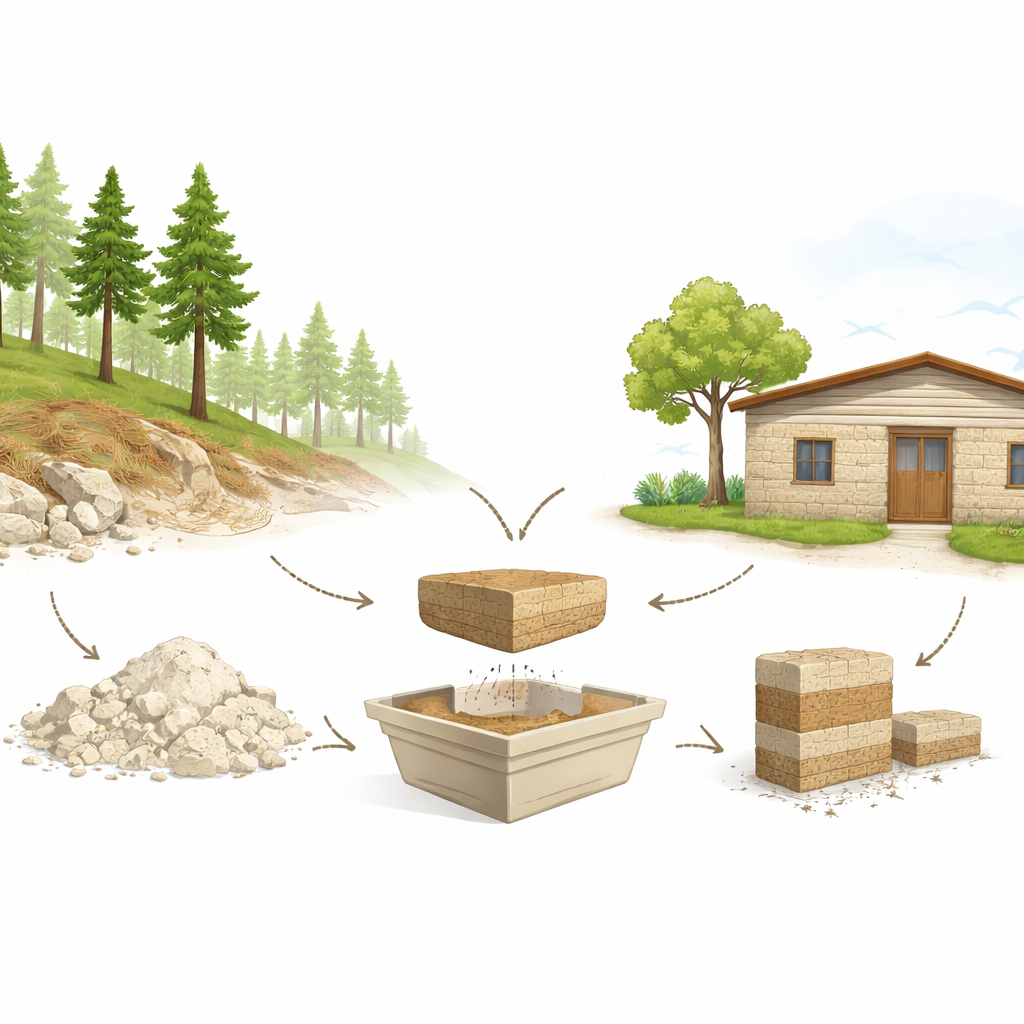
The researchers worked with four main ingredients: local clayey sand, pine needle fibers collected from Himalayan forests, fine limestone dust from quarries, and a special blended binder called LC3, which replaces much of the usual cement clinker with calcined clay and extra limestone. Pine needles are abundant forest litter and a major fuel for wildfires; using them in construction helps clean the forest floor while adding crack‑bridging fibers to the earth. Limestone dust is a quarry by‑product that usually ends up as waste but can pack into soil pores like a fine filler. LC3 has a much smaller carbon footprint than ordinary cement, yet still forms strong bonding gels when mixed with water and soil minerals. Together, these ingredients promise a wall material that is both stronger and kinder to the climate.
Testing blocks under load and in water
The team produced seven sets of rammed earth blocks. First, they made plain earth blocks, then added 1% pine fiber by weight, and then varied limestone dust content between 10% and 25% to find an optimum. Finally, they added 10% LC3 to the best earth–fiber–limestone mix. All blocks were compacted under controlled moisture and cured for 28 days. The scientists then measured how much load the blocks could carry when squeezed or bent, how quickly sound waves passed through them (a sign of internal density and flaws), and how much water they soaked up and how much strength they kept after a day of immersion. They also used powerful microscopes, X‑ray methods, and heating tests to see how the internal structure and minerals changed with each step of improvement.
What happens inside the improved earth
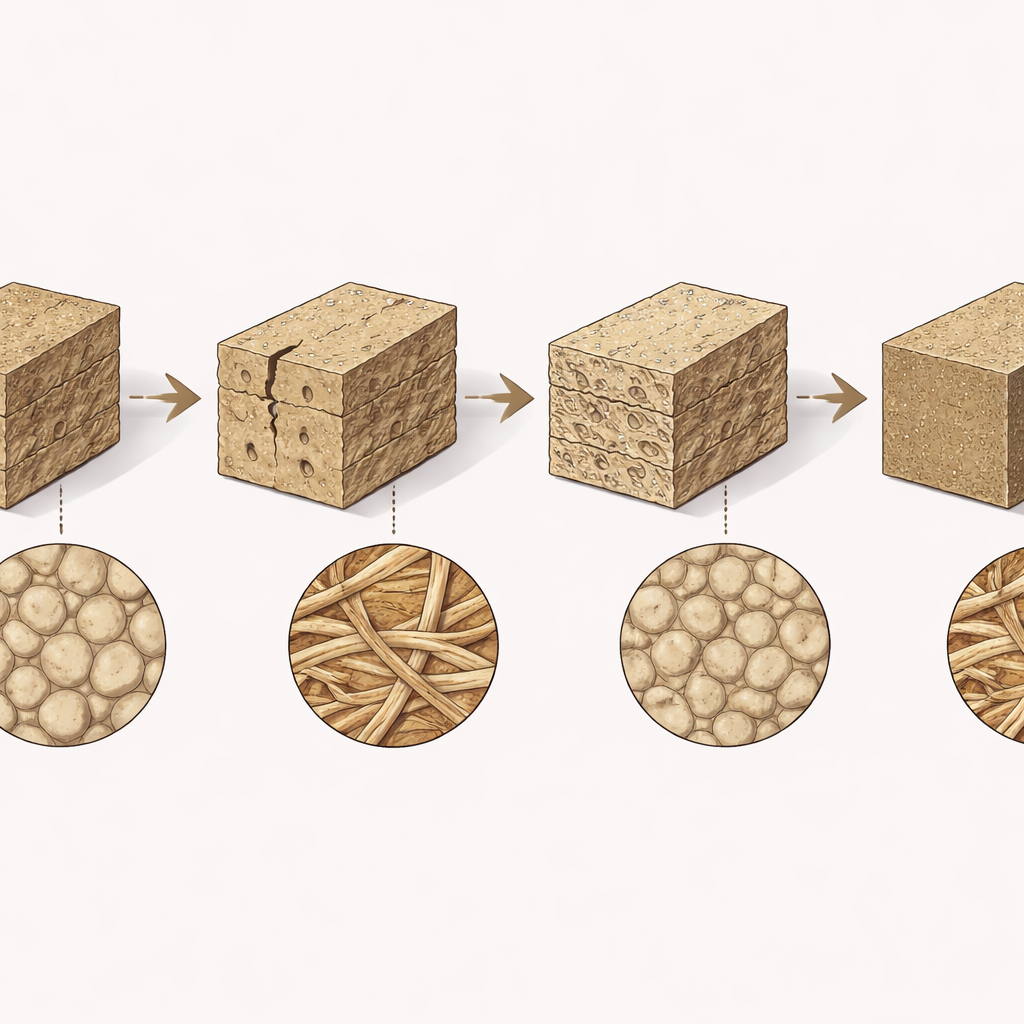
Adding a small amount of pine fiber already made the blocks stronger and more flexible, turning sharp, sudden cracks into a finer network of smaller ones. The limestone dust then filled many of the gaps between soil grains, allowing the material to compact more tightly and gain strength, with about 20% limestone giving the best balance. The real leap came when 10% LC3 was introduced into that optimized mix: the best composition more than doubled its dry compressive strength and achieved much higher bending strength and sound‑wave speed, showing a much denser, more continuous internal skeleton. Water absorption dropped, and the blocks kept about half of their strength even after soaking, unlike untreated earth, which fell apart in water.
Toward durable low‑carbon earth walls
Microscopic images and mineral tests revealed why these changes occurred. With LC3 and limestone dust, the spaces between soil particles filled with new gel‑like products and tiny carbonate crystals, tightening the pore network and locking grains together. The pine fibers, although not strongly bonded chemically, wove mechanically through this denser matrix, bridging cracks and helping the blocks bend instead of snapping. The authors conclude that a step‑by‑step recipe—first adding fibers, then carefully dosed limestone dust, and finally a modest amount of low‑carbon LC3—can turn simple local soil into a stronger, more water‑resistant wall material. While the study only proves short‑term improvements, it points toward rammed earth homes that are safer, longer‑lasting, and significantly lower in carbon than conventional concrete construction.
Citation: Randeep, Sheikh, D.A., Rawat, T.K. et al. Performance enhancement and microstructural characterization of pine fiber-reinforced rammed earth stabilized with limestone powder and LC3. Sci Rep 16, 10513 (2026). https://doi.org/10.1038/s41598-026-41955-9
Keywords: rammed earth, natural fiber reinforcement, low carbon cement, sustainable housing, waste-based materials