Clear Sky Science · en
Buffering effects of shelter and palatable foods mitigate fear responses in foraging wild mice
Why Mice Brave Scary Smells for a Good Meal
Imagine having to choose between a free buffet in a warm shelter and the faint smell of a nearby predator. This study asks how wild mice resolve that kind of trade-off in the real world. The researchers wanted to know whether the promise of food and safety can overpower the instinctive fear that normally keeps small animals alive, and what that means for how we interpret animal behavior outside the lab.
Fear, Hunger, and Tough Choices in Nature
Wild animals constantly balance competing needs: finding food, staying warm, and avoiding predators. In laboratory experiments, the smell of a predator often triggers strong fear responses in mice, such as freezing, fleeing, or heightened vigilance. But in outdoor studies, the same smells sometimes have surprisingly little effect. One idea is that this gap arises because field conditions include many extra pressures and opportunities—like hunger, cold, and shelter—that can change how animals react to danger signals.
Building a Mouse Motel in the Woods
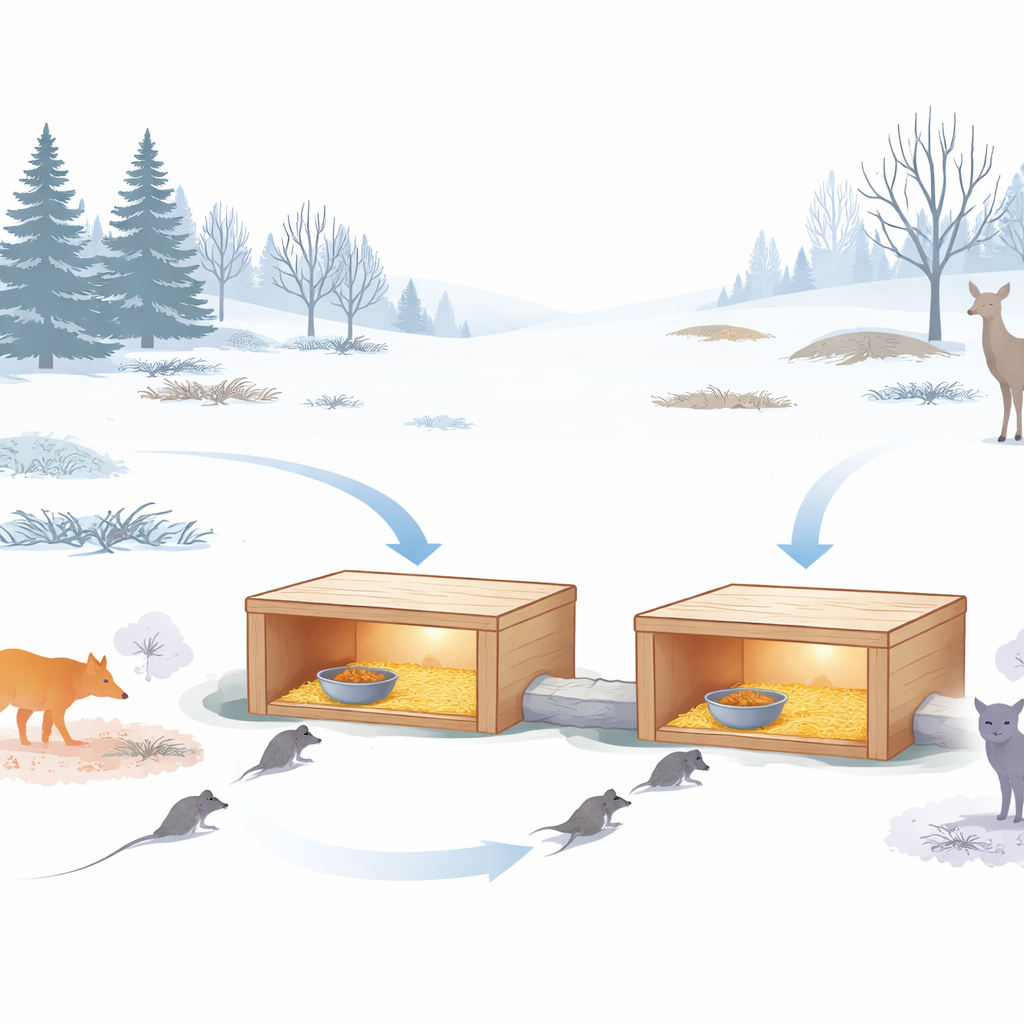
To explore this, the researchers installed two wooden chambers in a peri-urban area near Warsaw, Poland, next to forest and meadows. These box-like shelters had tunnels for mice to enter and were monitored continuously with infrared cameras. Inside, the team placed an extremely attractive treat—chocolate-hazelnut spread—every night during the winter months. They then introduced scent “probes” close to the food: fresh odors from native predators (red foxes and domestic cats), from non-predator deer, and from non-animal controls (plain dry sticks or sticks moistened with water). At any given time, one chamber held an animal scent and the other a “safe” control, giving mice a clear choice between food plus scent and food plus no scent.
Watching for Signs of Worry
The scientists carefully scored how often the two species of wild mice—the striped field mouse and the yellow-necked mouse—visited, how long they stayed, how much time they spent eating, and how often they showed obvious fear-related behaviors such as sudden flight, freezing, or cautious withdrawal from the scent source. They expected that familiar predator scents, which mice have faced over many generations, would cause them to spend less time inside scented chambers and to show more defensive reactions than they did to deer or control scents.
Food and Shelter Outweigh the Smell of Danger
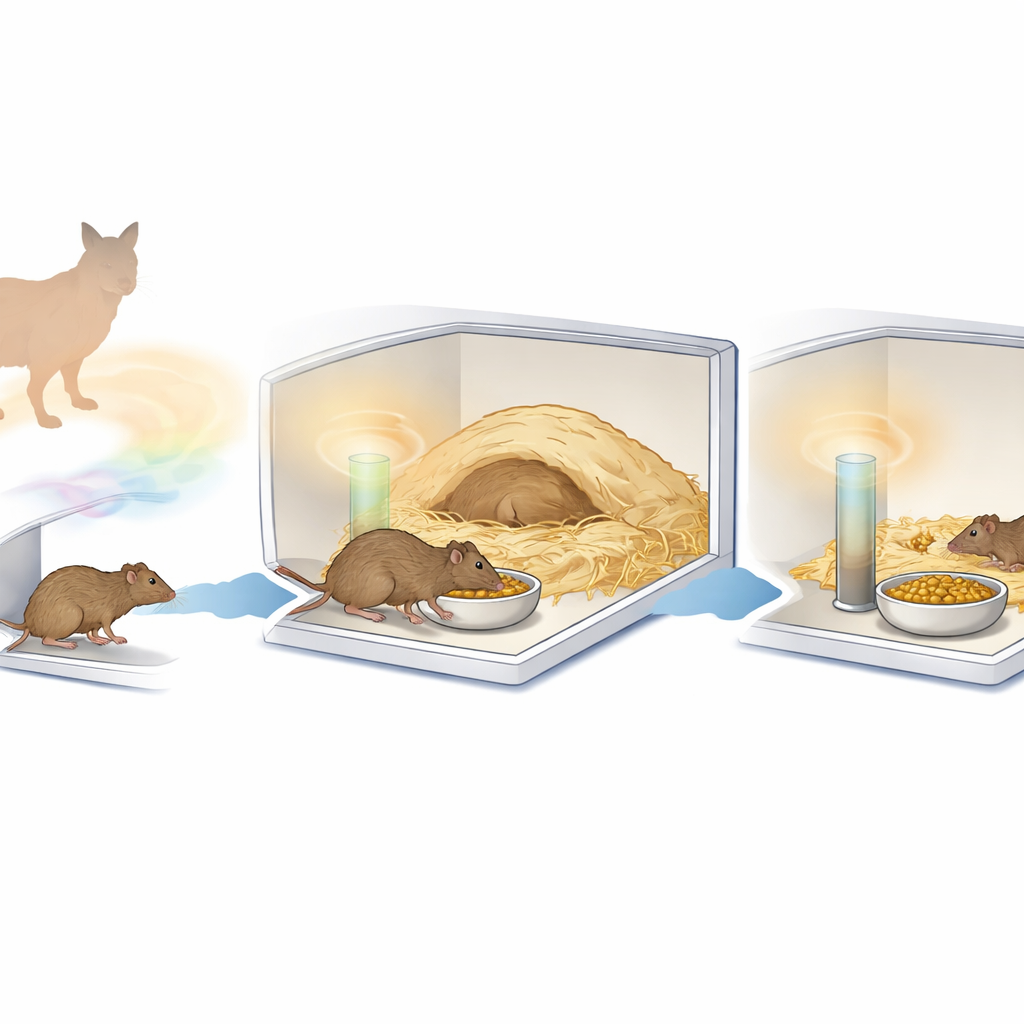
The outcome was strikingly subdued. Across more than 900 visits, predator scents did not reduce visitation or time spent in chambers, nor did they change how long mice spent eating. Classic fear behaviors like freezing, fleeing, or slow withdrawal were never observed in response to any scent type. Statistical tests revealed only tiny differences between treatments that were too small to be biologically meaningful. One subtle pattern did appear: mice showed higher variation in their behavior when chambers contained the non-animal controls than when they contained any animal-derived scent, suggesting that scent-free chambers might have felt slightly safer or encouraged more relaxed use, including occasional long sleep bouts.
What This Means for How We Study Fear
To a lay observer, the key lesson is that under harsh winter conditions, the promise of high-calorie food in a sheltered, warmer space can overwhelm the fear that predator smells normally provoke. The mice seemed willing to accept potential risk in exchange for reliable rewards and refuge. This helps explain why field studies sometimes fail to see dramatic fear responses that are routine in the lab. The authors argue that to truly understand animal decision-making in nature, experiments must account for the broader ecological context—especially the availability of shelter, the attractiveness of food, and seasonal pressures that push animals to take chances when survival is on the line.
Citation: Stryjek, R., Parsons, M.H., Bebas, P. et al. Buffering effects of shelter and palatable foods mitigate fear responses in foraging wild mice. Sci Rep 16, 13804 (2026). https://doi.org/10.1038/s41598-026-41952-y
Keywords: predator scent, wild mice, foraging behavior, risk-reward tradeoff, animal shelter