Clear Sky Science · en
Combined influence of polymeric and mineral fibres on fresh-state performance and fracture properties of high-performance self-compacting concrete
Why this matters for our built world
From bridges and tunnels to high-rise towers, most modern structures rely on concrete. Yet ordinary concrete is much better at withstanding squeezing than pulling; when it cracks, strength and safety can quickly decline. This study explores a new way to make concrete both easier to place on site and far more resistant to cracking, by blending different hair-like fibres inside a special mix that flows into place under its own weight. The findings point toward longer-lasting, safer structures without slowing construction down.
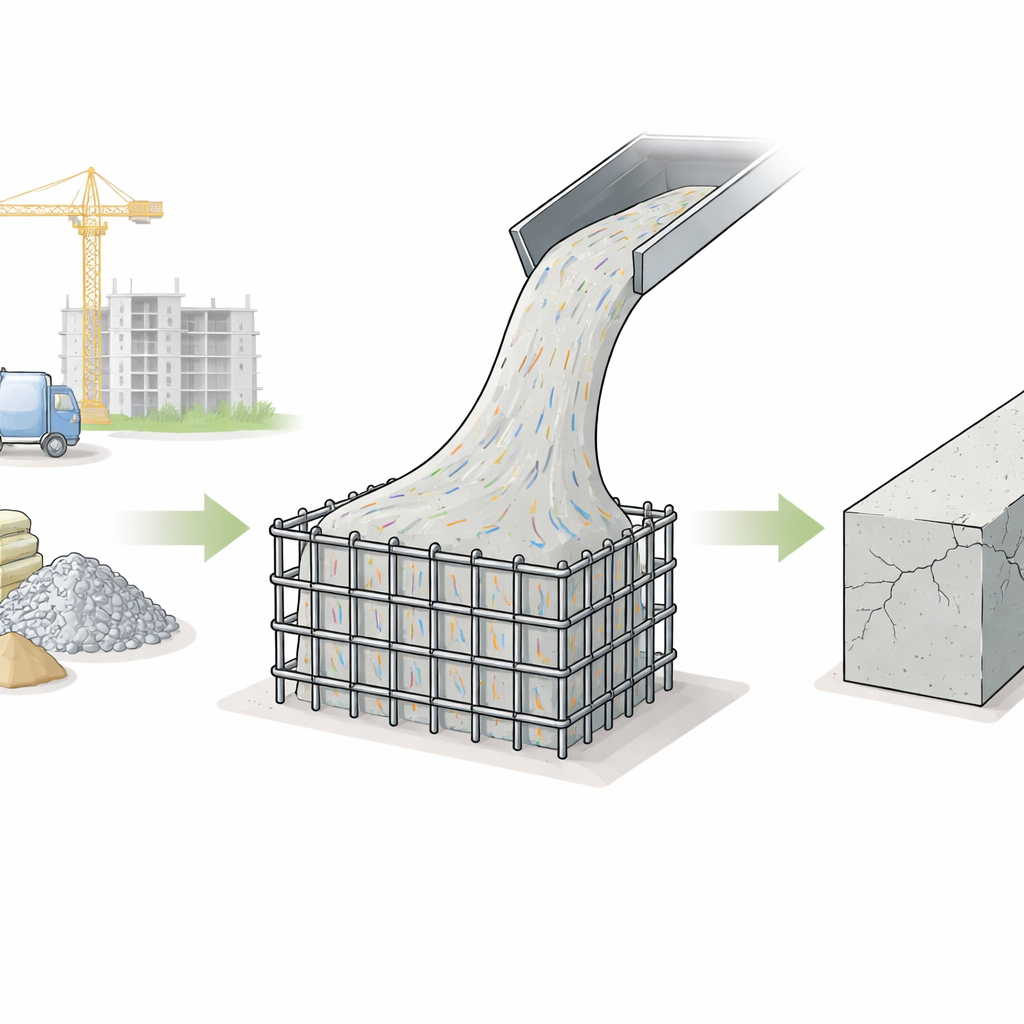
A new kind of flowing, high-strength concrete
The researchers worked with a special material called high-performance self-compacting concrete. Unlike conventional concrete, which must be vibrated to remove air pockets, this mix is designed to be so fluid that it can flow around dense steel bars and into complex formwork under its own weight. At the same time, it reaches very high strengths after hardening. Achieving both traits together is challenging, especially once fibres are added, because fibres can tangle and stiffen the fresh mix. The team set out to see how different kinds and sizes of non-metallic fibres affect both the fresh flow and the eventual cracking behaviour of this demanding material.
Mixing fibres like ingredients in a recipe
Nine different concretes were prepared: one without fibres and eight with various fibre additions. The fibres included two plastics (polypropylene and polyolefin), a rock-based fibre (basalt) and a synthetic fibre that bonds strongly to cement (polyvinyl alcohol, or PVA). Some fibres were long “macrofibres” about the length of a matchstick, meant to span larger cracks, while others were short “microfibres” intended to stop tiny cracks as they first appear. The team also created hybrid blends that combined long and short fibres in the same mix, following a “multiscale” idea: different crack sizes would be handled by different fibres.
How the concrete behaves while still wet
Before the concrete hardened, its ability to flow, pass through obstacles and avoid clogging was measured with three standard tests that mimic narrow gaps and dense reinforcement. Adding any fibre made the mix thicker and slightly harder to move, but the effect depended strongly on the fibre type and size. Long plastic fibres generally preserved good flow, staying within accepted limits for self-compacting concretes. In contrast, very fine PVA fibres, even at modest amounts, created dense networks that dramatically slowed movement and sometimes blocked the test devices entirely. Hybrid mixes that paired long plastic fibres with basalt fibres showed a good compromise, while the blend of long polypropylene with short PVA pushed the mix beyond practical workability.
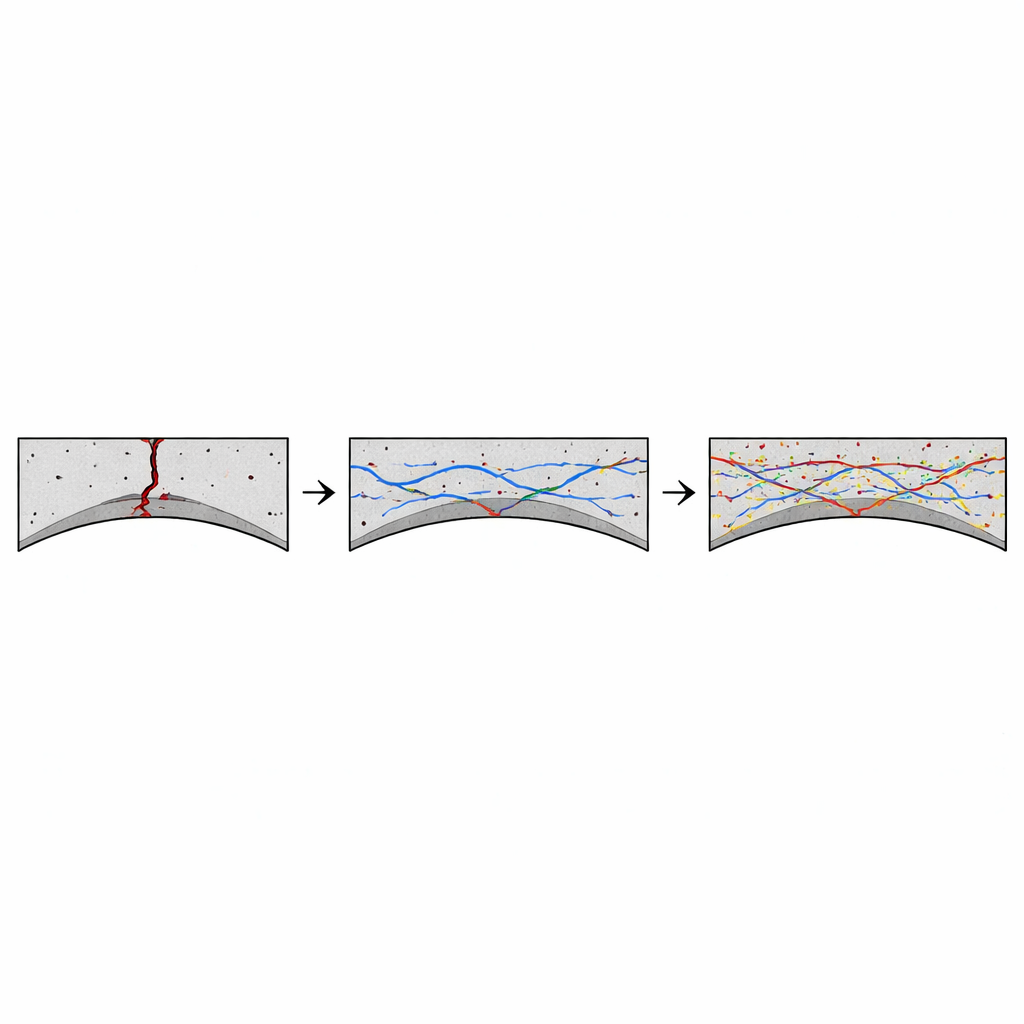
What happens when the concrete cracks
Once hardened, the samples were tested in compression, in tension and in bending, and special notched beams were used to study how cracks start and grow. Compared with the fibre-free concrete, most fibre mixes became stronger and markedly tougher. Long crimped polypropylene fibres gave the largest boost in compressive and splitting tensile strength, because their wavy shape helped them anchor into the cement and bridge developing cracks. Short PVA fibres, though they harmed workability, more than doubled the bending strength, reflecting their ability to tightly stitch small cracks together. The most striking gains came from hybrid systems combining long ductile fibres with short stiff ones. These hybrids absorbed over forty times more fracture energy than plain concrete and maintained load even after visible cracking, showing multiple fine cracks instead of one wide, dangerous split.
Balancing ease of placement and long-term toughness
A key trade-off emerged: the mixtures that flowed most easily were not always the toughest after cracking, and the toughest ones often proved hardest to place. PVA-rich mixes, for example, offered excellent crack control but suffered from severe blocking in fresh-state tests. Conversely, mixes reinforced only with long polymer fibres kept very good flow while giving moderate improvements in strength and toughness. The standout compromise was a hybrid of long crimped polypropylene and short basalt fibres, which preserved self-compacting behaviour and still delivered large gains in ductility and fracture resistance. This suggests that carefully chosen fibre combinations can be tuned to meet both construction and durability demands.
What this means for future structures
For a layperson, the takeaway is clear: by treating fibres inside concrete like a tailored fabric, engineers can design mixtures that not only pour themselves into intricate moulds but also resist cracking far longer in service. Long, flexible fibres help bridges and slabs tolerate deformation without sudden failure, while short, stiff fibres keep cracks narrow and controlled. The study shows that hybrid “multiscale” reinforcement, when balanced against workability, can turn brittle concrete into a more forgiving, damage-tolerant material—promising structures that are safer, more durable and potentially cheaper to maintain over their lifetime.
Citation: Smarzewski, P., Błaszczyk, K. Combined influence of polymeric and mineral fibres on fresh-state performance and fracture properties of high-performance self-compacting concrete. Sci Rep 16, 12998 (2026). https://doi.org/10.1038/s41598-026-41949-7
Keywords: self-compacting concrete, fibre-reinforced concrete, hybrid fibres, crack resistance, high-performance concrete