Clear Sky Science · en
Adaptive training load optimization for track and field athletes: A reinforcement learning approach
Smarter training for everyday runners
Anyone who has trained for a race knows the tightrope between pushing hard enough to improve and avoiding the kind of overtraining that leads to exhaustion or injury. This study shows how ideas from artificial intelligence can help design day to day training plans for track athletes that respond to how their bodies are actually coping, not just to what is written in a fixed schedule.
Why simple plans fall short
Traditional training programs often follow a rigid pattern of increasing mileage or intensity each week, with only occasional rest blocks. Coaches try to adjust based on experience, but they cannot precisely track the invisible build up of fatigue inside each athlete. People differ in their sleep, stress, and recovery, so two runners on the same plan may respond very differently. As a result, some athletes stagnate, others break down, and planned goals are often missed over a long season.
Turning the athlete into a digital twin
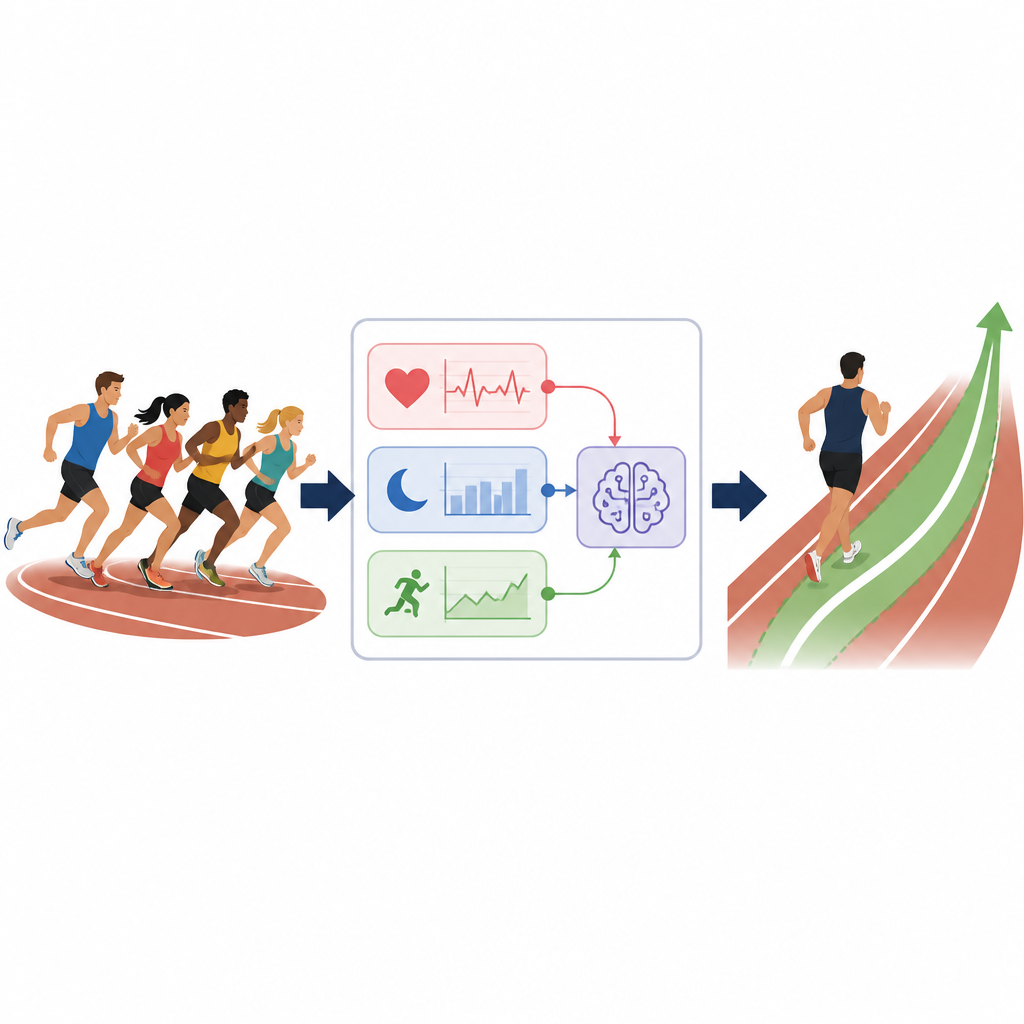
The researchers collected detailed daily data from 25 track and field athletes over a 24 week season. Each day they recorded heart rate variability, a watch based sleep quality score, and training load measures that capture both recent and longer term effort. They also tracked a key performance marker: weekly time for a 400 meter run. Using these records, they built a computer stand in, or digital twin, of an athlete. This digital twin can predict how performance and body signals would change if training were made harder, longer, or easier on a given day, without experimenting on the real person.
How the smart coach learns
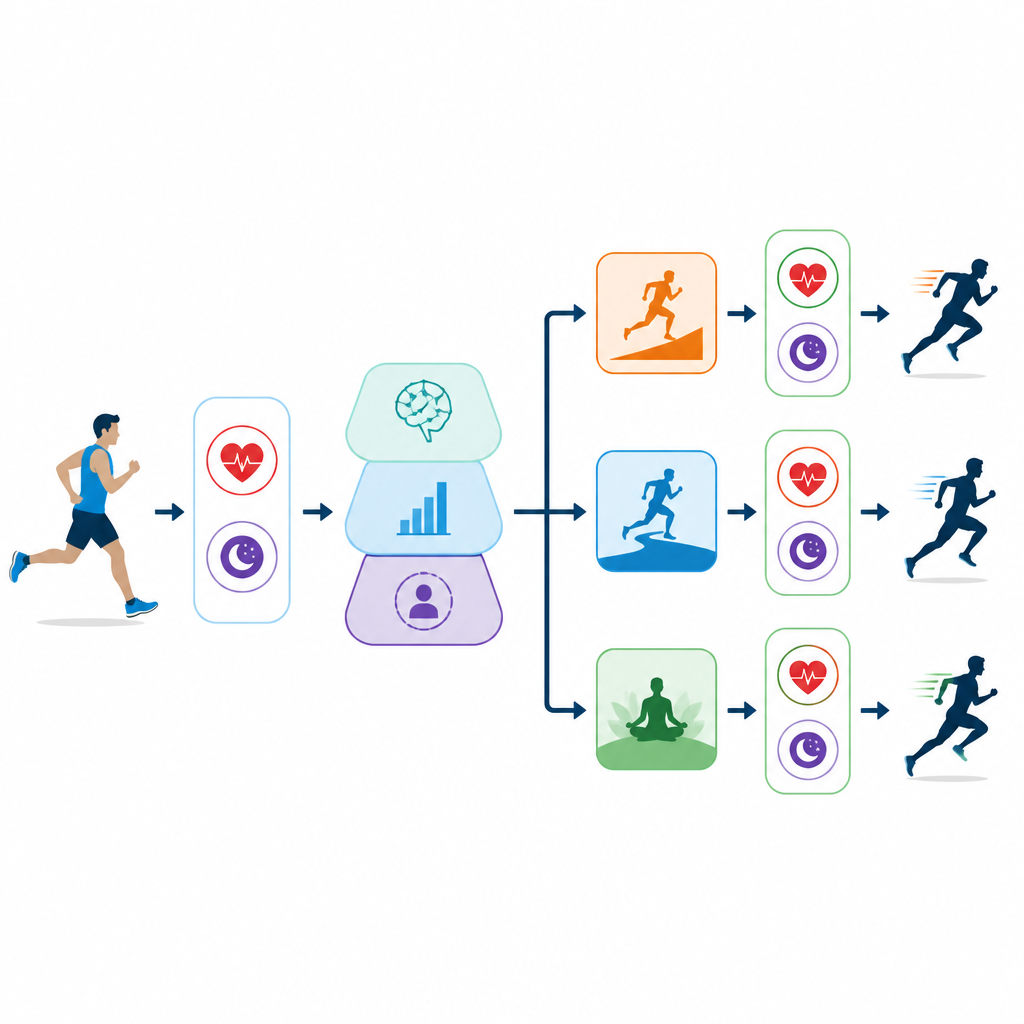
On top of this digital twin, the team trained a decision making system based on deep reinforcement learning. At each step the system sees the athlete’s current state as a six part snapshot of body signals, sleep, workload, and performance. It then chooses one of three actions: increase workout intensity, increase workout volume, or prescribe active recovery. After each choice, the digital twin shows the new state, and the system receives a score that rewards faster 400 meter times but penalizes signs of overload, such as very high short term workload compared to long term workload or drops in heart rate variability and sleep quality. Over many thousands of simulated weeks, the system learns which patterns of decisions lead to long term gains without drifting into risky territory.
How it performs against human style planning
The authors compared their adaptive planner with several realistic alternatives, including a fixed plan that increases load each week, a hand crafted rule system that simply keeps workload in a safe range, a machine learning rule that always chases the best short term reward, and a classic table based reinforcement learner. All approaches improved 400 meter times over the season, but the adaptive deep learning system achieved the largest gains while almost never entering the danger zone for injury risk. In contrast, the static and greedy methods often pushed weekly workload into unsafe levels, and the purely health focused design kept athletes safe but sacrificed much of the possible speed improvement.
What this means for athletes and coaches
For a lay reader, the key message is that training does not have to be guesswork. By listening closely to simple body signals like heart rhythm, sleep, and how hard recent workouts have been, and letting a learning system test many what if scenarios in simulation, coaches can generate daily training suggestions that are both ambitious and cautious. While this study is an early proof of concept using a small group of track athletes and simplified choices, it shows that a balanced, data informed approach can help athletes get faster while sharply reducing the time they spend in high risk states.
Citation: Zhang, Q., Wang, Q. & Niu, Y. Adaptive training load optimization for track and field athletes: A reinforcement learning approach. Sci Rep 16, 14862 (2026). https://doi.org/10.1038/s41598-026-41946-w
Keywords: training load, reinforcement learning, track and field, injury risk, heart rate variability