Clear Sky Science · en
Surfactants promote the transport of hydrophilic compounds through hydrophobic nanopores in leaves: mechanistic insights
Why this matters for crops and the environment
Farmers rely on sprays to deliver fertilizers and pesticides onto leaves, yet plants typically absorb less than a tenth of the active material. The rest can wash away into soil and waterways, wasting money and harming ecosystems. This study uses computer simulations at the molecular level to uncover how certain additives in spray formulations help water-loving nutrients slip through the plant’s natural waxy shield. The findings point toward smarter spray recipes that could feed crops more efficiently while reducing chemical losses and environmental impact.
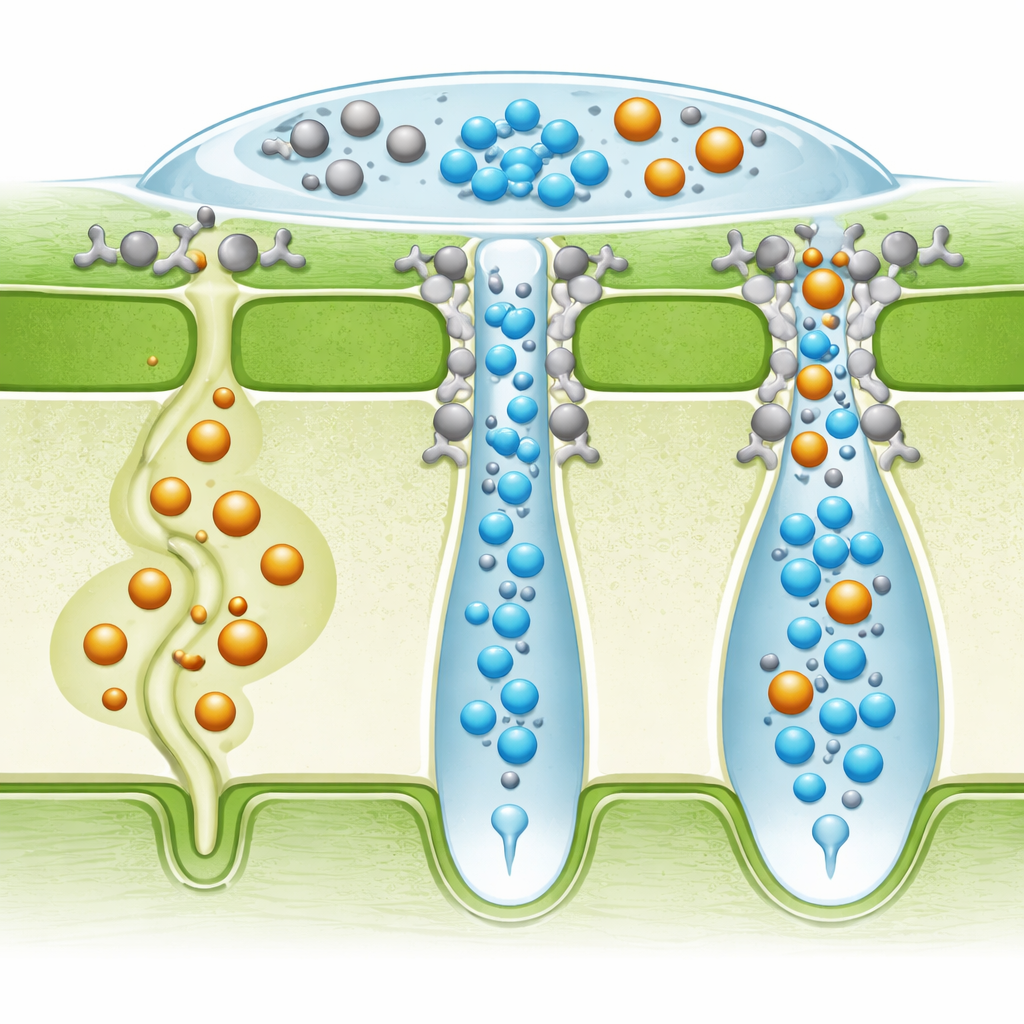
The waxy shield on leaves
Most land plants are wrapped in a thin, waxy coating that keeps them from drying out. This coat, especially its outermost layer called epicuticular wax, is made mainly of tightly packed hydrocarbon chains that repel water. To reach living cells inside the leaf, any dissolved nutrient or pesticide must first cross this wax barrier. Researchers have long recognized two main routes: oily (lipophilic) molecules can dissolve into the wax and slowly diffuse through it, while water-loving (hydrophilic) substances are thought to pass through tiny water-filled pores that open only under very humid conditions. However, many laboratory observations did not fit neatly into this two-pathway picture, especially when surfactants—soap-like molecules added to sprays—were present.
A hidden third doorway
The authors propose and test a third pathway in which carefully chosen surfactants act as molecular “door openers” in nanometer-sized voids inside the wax. Using detailed molecular dynamics simulations, they built a realistic model of the leaf’s outer wax, complete with a single narrow pore, and followed the behavior of different surfactants and nutrients over hundreds of nanoseconds. They compared alcohol ethoxylates—one common example is a molecule called C12E6—with sugar-based surfactants known as alkyl polyglycosides. Both types gather at interfaces and lower surface tension, but field data show that only alcohol ethoxylates strongly enhance the uptake of some nutrients. The simulations reveal why: C12E6 molecules can collectively snake their way into hydrophobic pores, carrying water and certain dissolved hydrophilic compounds along with them, while the sugar-based surfactants largely remain outside.
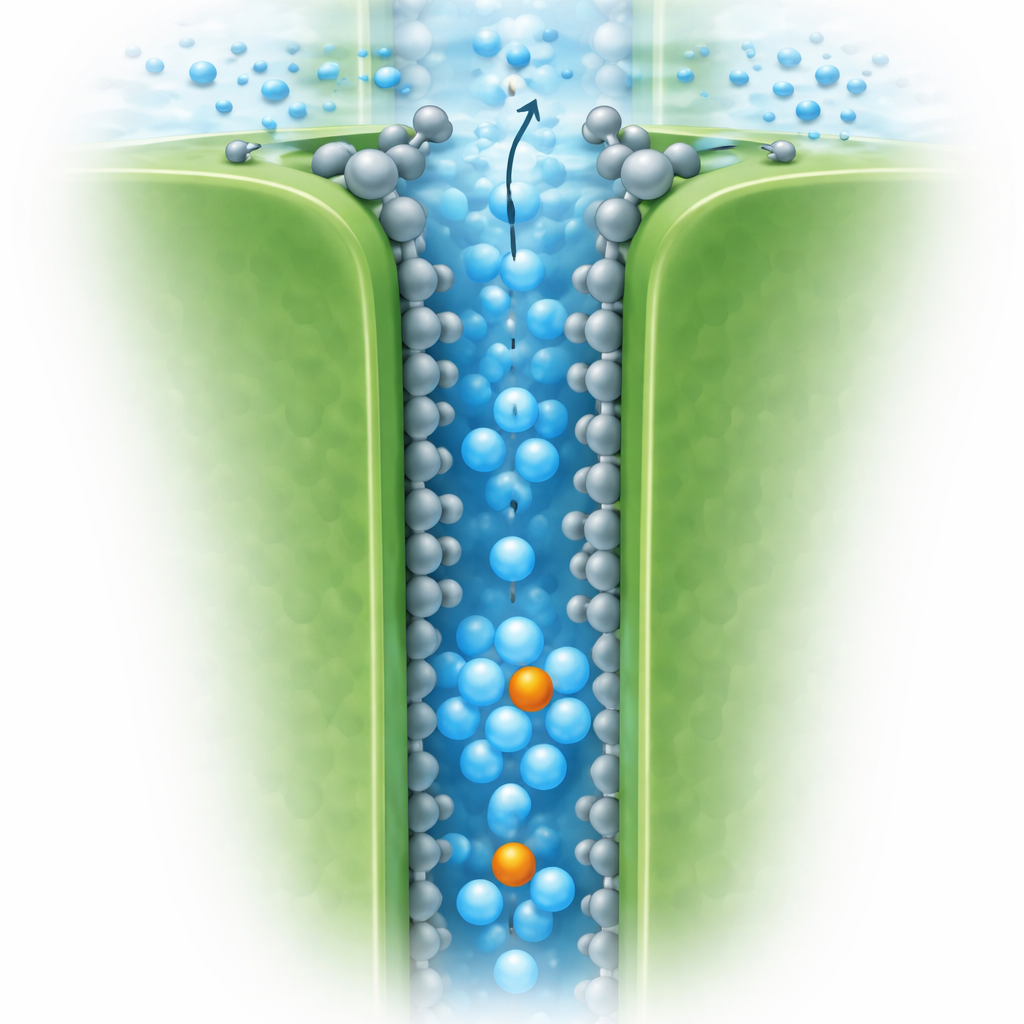
How surfactants build tiny water pockets
The key lies in molecular architecture. C12E6 has a flexible head built from repeating ethylene-oxide units. When several of these molecules insert their tails into a wax pore, their head groups bend inward and line the pore, creating a narrow, water-friendly region inside an otherwise oil-like space. Water molecules then gather into tiny clusters in this hydrophilic pocket, and hydrophilic solutes such as the sugar-like nutrient methylglucose can partition into these nanoclusters. In contrast, the more rigid sugar head groups of alkyl polyglycosides stay outside the pore, unable to reorganize and create such an interior water niche. As a result, only specific “accelerator” surfactants like alcohol ethoxylates can form these microscopic water pockets and open the third pathway for hydrophilic cargo.
Why hard water can work against sprays
Field agronomists have long noted that “hard” water—rich in calcium—can blunt the benefits of some surfactant-based formulations. The simulations provide a mechanistic explanation. The wax surface is not chemically uniform; a small fraction of its groups carries negative charge under typical conditions. Calcium ions bind tightly to these charged sites, forming hydrated patches that disrupt the orderly film of alcohol ethoxylate molecules that would otherwise assemble on the surface. At sufficiently high densities of such sites, the surfactant film partially detaches, reducing the number of molecules that can penetrate pores and build internal water clusters. Sodium ions, by contrast, bind much more weakly and do not cause the same disruption. In this way, calcium indirectly slows the third pathway without greatly changing surface tension or bulk solution properties.
Designing better leaf sprays
Taken together, these results show that some surfactants do more than simply help droplets spread. With the right molecular shape, they can invade tiny hydrophobic pores in the leaf’s wax, nurse stable water nanoclusters inside them, and thereby chaperone specific hydrophilic nutrients and salts into the plant. This newly clarified “third doorway” helps make sense of puzzling earlier experiments, including why certain nutrient–surfactant combinations work far better than others and why calcium-rich water can sometimes undermine performance. By using these insights to choose surfactant structures, match them with target nutrients, and account for water hardness, formulators could design foliar sprays that deliver more active ingredient into leaves using less chemical input, supporting higher yields with a smaller environmental footprint.
Citation: Kobayashi, T., Moriarty, A., Kotsi, K. et al. Surfactants promote the transport of hydrophilic compounds through hydrophobic nanopores in leaves: mechanistic insights. Sci Rep 16, 12535 (2026). https://doi.org/10.1038/s41598-026-41943-z
Keywords: foliar uptake, leaf wax, surfactant, nanopores, agrichemical delivery