Clear Sky Science · en
Exploring mechanisms governing cartilage interstitial fluid load support in lubrication through experimental and computational analysis
Why our joints stay smooth—until they don’t
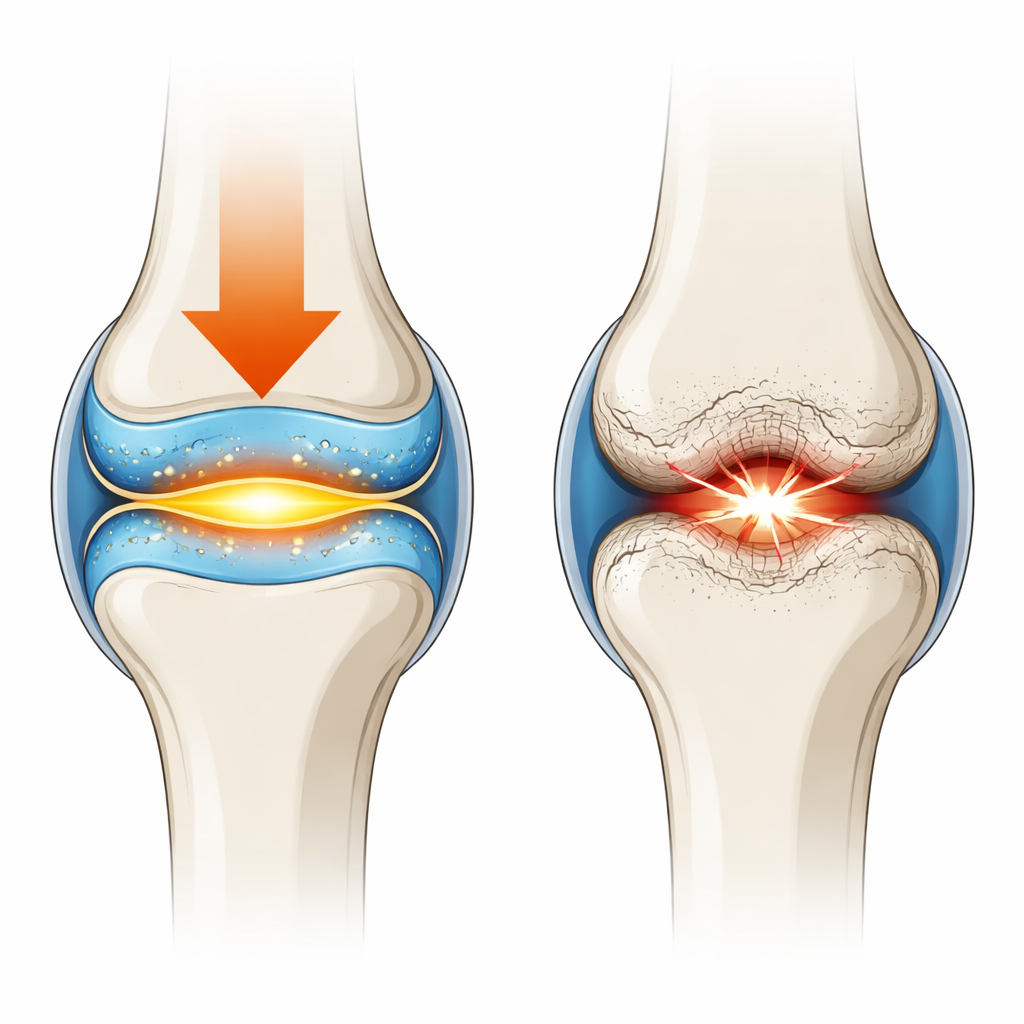
Every time you walk, run, or climb stairs, the smooth cartilage coating your joints quietly keeps bones from grinding against each other. This thin, slippery layer lets joints move with astonishingly low friction, and when it starts to fail, painful diseases like osteoarthritis can follow. This study asks a deceptively simple question with big implications: how exactly does fluid inside cartilage help carry weight and reduce rubbing, and what happens when early damage begins to disrupt that balance?
The hidden cushion inside joint cartilage
Cartilage is more than a passive padding between bones. It is a sponge-like material made of a tough collagen framework filled with water-attracting sugars that draw in and hold fluid. When you load a joint, that trapped fluid becomes pressurized, allowing it to carry most of the load so the solid tissue itself is spared excessive stress. Scientists call this share of the load carried by the fluid “interstitial fluid load support.” In healthy joints, this internal pressure can shoulder more than 90 percent of the force, keeping friction low as surfaces glide past one another, much like a skate gliding on a thin film of water on ice.
Testing healthy and mildly damaged cartilage
To explore how this fluid support changes with damage, the researchers used plugs of bovine joint cartilage, some left intact and others gently degraded with an enzyme to mimic very early osteoarthritis. They rubbed cartilage against cartilage under controlled load, using either natural synovial fluid—the body’s own joint lubricant—or a salt solution that mimics the thinner fluid often seen in diseased joints. While the experiment measured how much the samples compressed and how slippery they felt, a detailed computer model filled in the missing piece: how much of the load the internal fluid was actually carrying at each moment. This model, based on established physics of porous, fluid-filled materials, was carefully tuned so its simulated deformations matched the real measurements almost perfectly.
How fluid support, motion, and lubricant work together
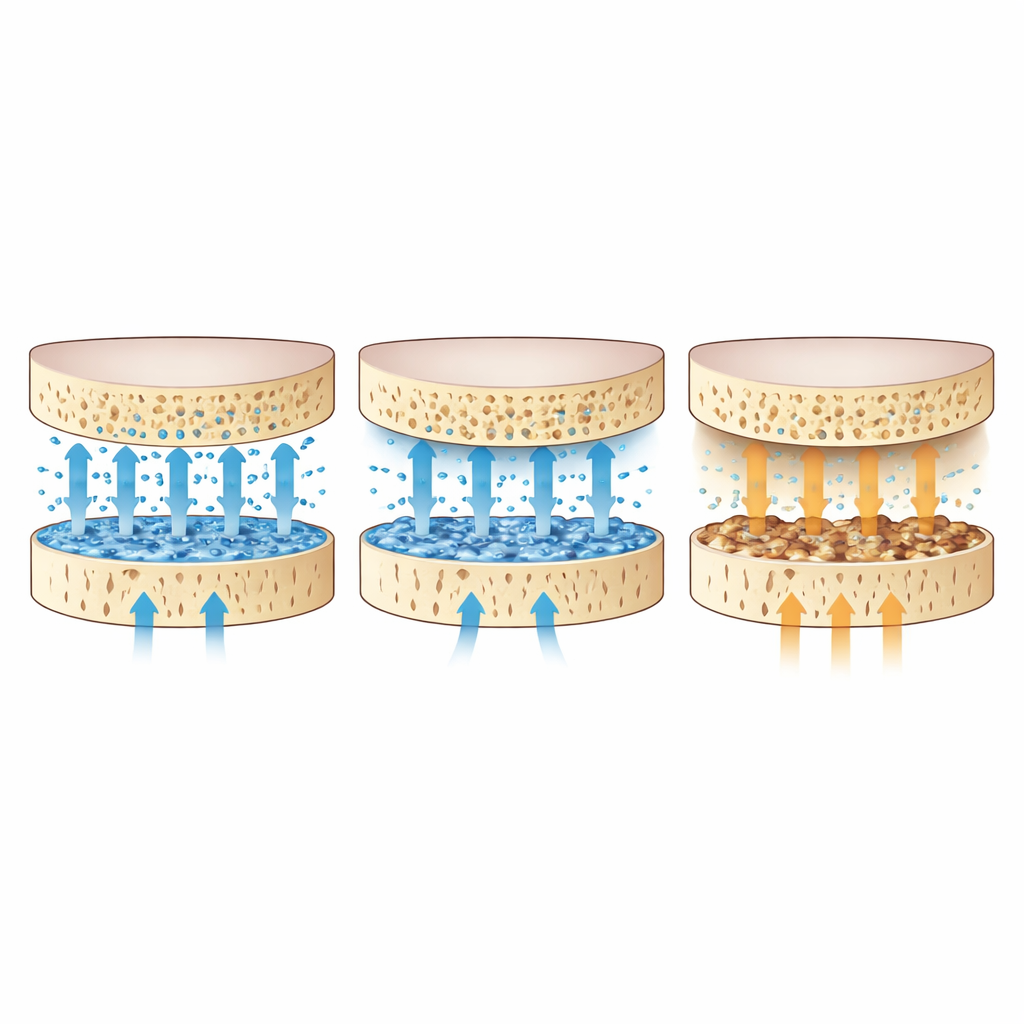
Across all tests, the internal fluid support dropped over time as fluid gradually seeped out under sustained load, and this decline tracked closely with how much the tissue compressed. In other words, strain in the cartilage served as a reliable indirect measure of how much help the fluid was still providing. As that fluid support faded, friction rose—but not in a simple, one-size-fits-all way. In healthy cartilage, the relationship between fluid support and friction stayed nearly linear and predictable. Once the internal pressure was high, friction remained low regardless of whether the bath contained synovial fluid or saline. But when fluid support fell to low levels, the outside lubricant suddenly mattered more: synovial fluid kept friction lower than saline, revealing that joint fluid becomes crucial as the internal cushion weakens.
What early damage really changes
The mildly damaged cartilage told a subtler story. Its solid framework was softer and leakier, so it deformed more and lost fluid support faster. Yet the basic link between compression and fluid support stayed intact: the tissue still behaved like a sponge whose squeezing reveals how much fluid is left inside. Where damage made a real difference was in the tie between fluid support and friction. Instead of a simple, nearly straight-line drop in friction with increasing fluid support, the damaged samples showed more curved, less predictable behavior, especially at low and intermediate support levels. This suggests that once the solid matrix starts to weaken and its tiny pores enlarge, fluid escapes more rapidly and the surfaces transition to higher friction sooner, even if, for brief periods, they can still glide as smoothly as healthy cartilage when fluid pressure is high.
Why this matters for joint health and future therapies
By blending careful friction experiments with a powerful computer model, this work identifies internal fluid support as a unifying principle linking cartilage structure, mechanical behavior, and lubrication. It shows that early degeneration does not immediately destroy low-friction motion, but instead alters how quickly and under what conditions joints lose the protective fluid cushion. The study also hints at a practical threshold: below a certain level of fluid support, friction becomes strongly dependent on the quality of the joint fluid and the integrity of the tissue. This framework can guide the design and testing of cartilage repairs, injectable biomaterials, and engineered replacements by asking a clear question: do they restore the tissue’s ability to pressurize and retain fluid under real joint-like loading? In the future, such measures could help doctors detect early joint damage and evaluate whether new treatments truly rebuild not just the structure, but the silent, fluid-based protection that keeps our joints moving smoothly.
Citation: Mäkelä, J.T.A., Lawson, T.B., Korhonen, R.K. et al. Exploring mechanisms governing cartilage interstitial fluid load support in lubrication through experimental and computational analysis. Sci Rep 16, 12902 (2026). https://doi.org/10.1038/s41598-026-41939-9
Keywords: articular cartilage, joint lubrication, interstitial fluid load support, osteoarthritis, finite element modeling