Clear Sky Science · en
Machine learning-based MPPT integration with quadratic double-extended DC-DC converter for grid-connected PV-powered BLDC electric vehicles
Clean Power for the Road Ahead
As electric vehicles move from niche to mainstream, a key question looms: how can we charge and drive them using clean energy without wasting precious power along the way? This paper explores a solar-powered drive system that aims to squeeze more electricity from sunlight, move it more efficiently through electronics, and reliably propel an electric motor, all while keeping the grid and onboard battery in balance. The result is a technical blueprint for cleaner, more efficient electric mobility that could make solar-charged vehicles far more practical in everyday life.
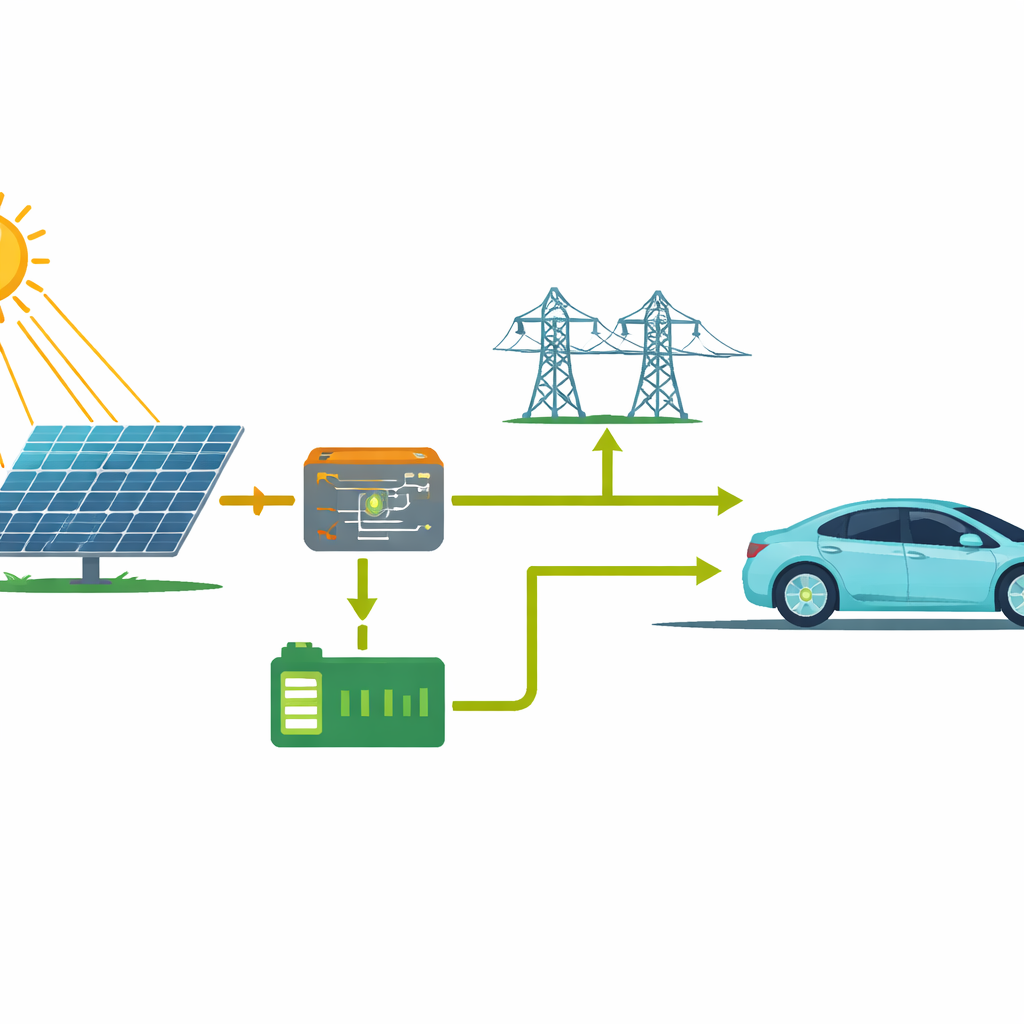
Why Solar Cars Need Smarter Electronics
Solar panels are attractive for powering vehicles because they turn free sunlight into electricity with no tailpipe emissions. But a single panel produces relatively low voltage, and its output constantly shifts with clouds, temperature, and time of day. To run an electric motor, that wobbly, low-level power must be boosted, stabilized, and steered between the motor, battery, and grid. Traditional electronic converters can do this, but they struggle to reach high voltages efficiently, especially under changing conditions. Likewise, many existing control methods that search for a panel’s “sweet spot” of maximum power are slow, prone to oscillations, or easily confused by rapid weather changes and partial shading.
A New Way to Boost Solar Power
To tackle these hurdles, the authors design a new type of DC-DC converter called a quadratic double-extended (QDE) converter. In simple terms, this circuit takes in a modest DC voltage from the solar array and, through a carefully arranged network of inductors, capacitors, diodes, and two active switches, multiplies it to a much higher, more useful level. Unlike conventional multi-stage boosters that chain several converters together—adding cost, complexity, and extra power losses—the QDE design reuses energy paths over time within a single structure. This produces a quadratic increase in output voltage with the control signal (duty cycle), while keeping voltage stress on components relatively low. Lower stress means the parts can be smaller, cooler, and more reliable, helping the whole system run at higher efficiency.
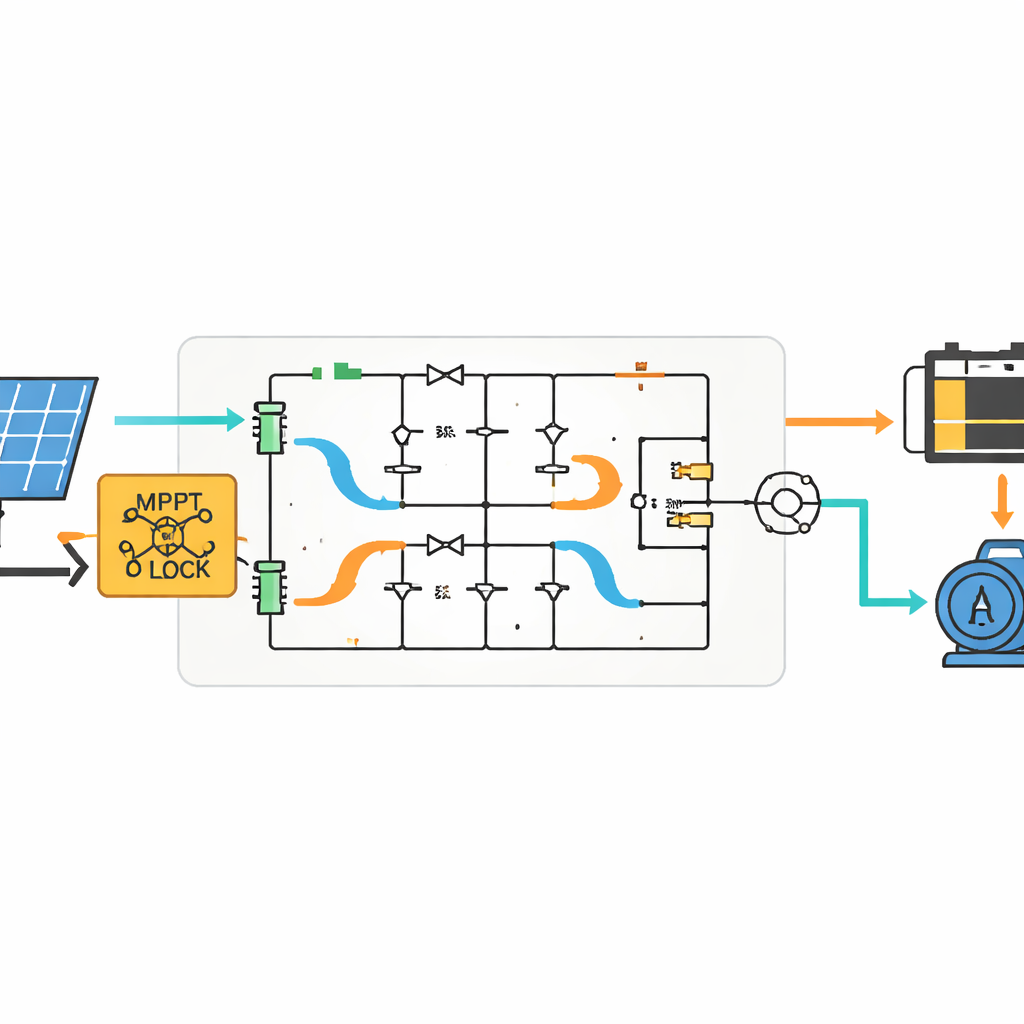
Letting a Learning Algorithm Hunt for Sunlight
Boosting voltage is only half the story; the system must also decide exactly how hard to drive the converter to harvest the most power from the panels at any moment. Here the authors turn to machine learning and a nature-inspired search strategy. They use a Radial Basis Function Neural Network (RBFNN), a type of simple learning model that can capture nonlinear relationships, to output the converter’s control signal. The neural network is tuned by an optimization method modeled on the foraging behavior of sea turtles, which follow chemical cues through the ocean to rich feeding grounds. In the electronic analogue, many “virtual turtles” explore different parameter combinations, gradually converging on settings that maximize a performance score related to power capture. This Sea Turtle Foraging Optimization (STFO) process gives the controller the ability to respond quickly and smoothly to shifts in sunlight and temperature, keeping the panels close to their maximum power point with minimal fluctuation.
Sharing Power Between Sun, Battery, and Grid
On the vehicle side, the boosted solar power is sent to a DC bus that feeds a three-phase inverter and a brushless DC (BLDC) motor, the workhorse that actually turns the wheels. A simple proportional–integral (PI) controller keeps the motor speed steady across different loads. To make sure the vehicle never runs short on energy—or wastes surplus solar production—the system includes a bidirectional converter connected to a battery pack, as well as a second inverter that links to the electric grid. The battery can charge when the sun is strong and the motor demand is modest, or discharge to support driving and even feed power back to the grid in a vehicle-to-grid scenario. Grid interaction is likewise managed so that real and reactive power stay within healthy limits, helping maintain a clean, nearly sinusoidal current with very low distortion.
Putting the Design to the Test
The researchers validate their approach through computer simulations and a hardware prototype. With realistic solar inputs, the QDE converter lifts the panel voltage to around twice its level while maintaining a measured conversion efficiency above 95 percent in simulation and nearly 94 percent in hardware. The STFO-trained neural controller achieves high tracking efficiency, meaning it captures almost all of the power the panels can deliver, while keeping ripples and overshoot small. The grid currents exhibit total harmonic distortion well below common standards, indicating that the power fed back into the network is exceptionally clean. Throughout tests where the sun fades, the solar array is shut off, or loads change, the battery and grid seamlessly take over so the BLDC motor continues to run smoothly at its target speed.
What This Means for Everyday Drivers
In plain terms, the study shows that smart electronics and learning-based control can make solar-powered electric vehicles far more efficient and dependable. By combining a high-gain, low-stress converter with a biologically inspired, self-tuning controller, the system extracts more useful energy from each ray of sunlight and wastes less in heat and electrical noise. The coordinated use of battery and grid support keeps the motor running steadily, even when conditions are far from ideal. While future work is needed to confirm long-term robustness under harsh environments and aging components, this architecture points toward cleaner, more resilient EVs that are better partners for both rooftop solar systems and modern power grids.
Citation: Karthikeyan, D., Shukla, .K. & Rajesh, K. Machine learning-based MPPT integration with quadratic double-extended DC-DC converter for grid-connected PV-powered BLDC electric vehicles. Sci Rep 16, 11466 (2026). https://doi.org/10.1038/s41598-026-41938-w
Keywords: solar electric vehicles, power electronics, maximum power point tracking, renewable energy integration, brushless DC motor drives