Clear Sky Science · en
Study on the effect of sprinkler layout parameters on dust removal in tunnel construction
Why cleaner air in tunnels matters
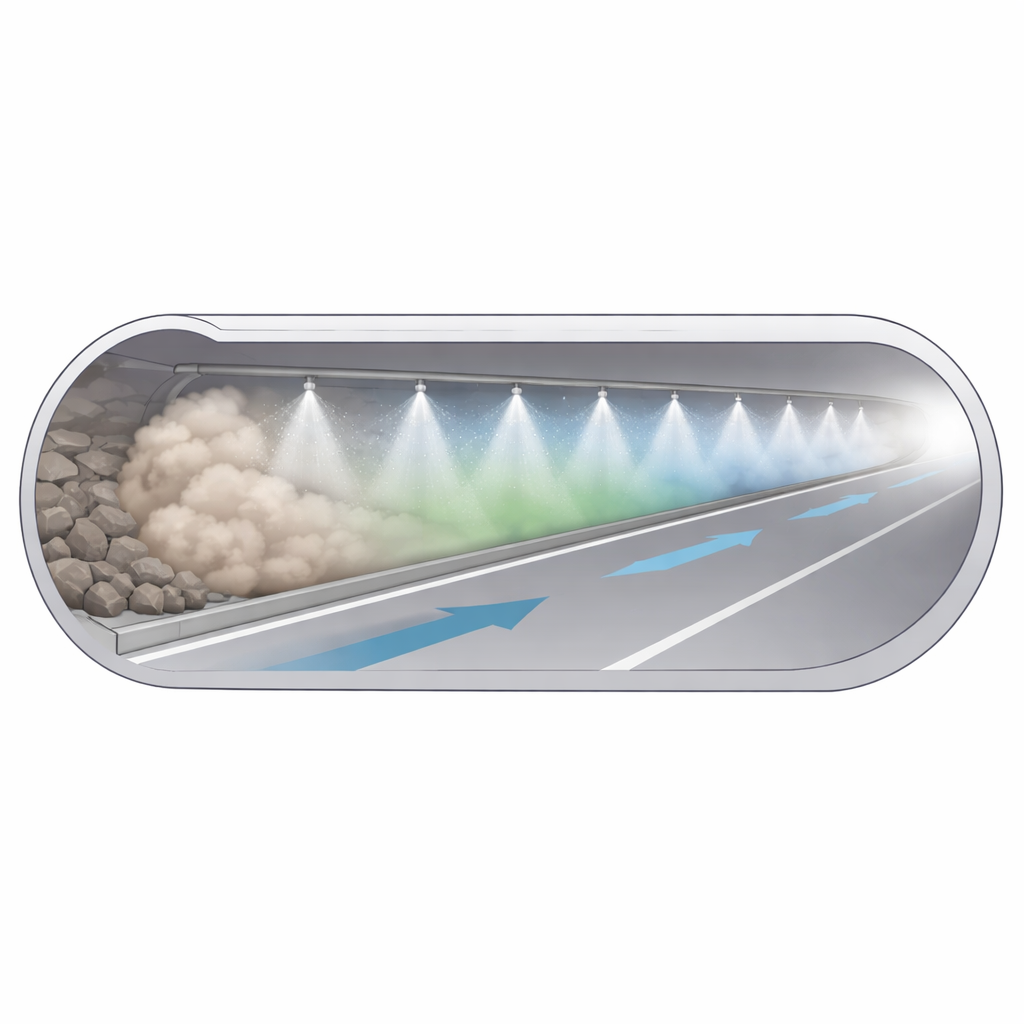
Modern highway tunnels are engineering marvels, but building them fills confined underground spaces with clouds of fine dust. That dust does more than make the air look hazy: it can damage workers’ lungs, hide hazards from view, and wear out machines faster. This study asks a very practical question with big implications for worker safety and construction quality: how should sprinkler-like water-mist systems be arranged inside a tunnel so they can knock dust out of the air as quickly and efficiently as possible?
How water mist can tame tunnel dust
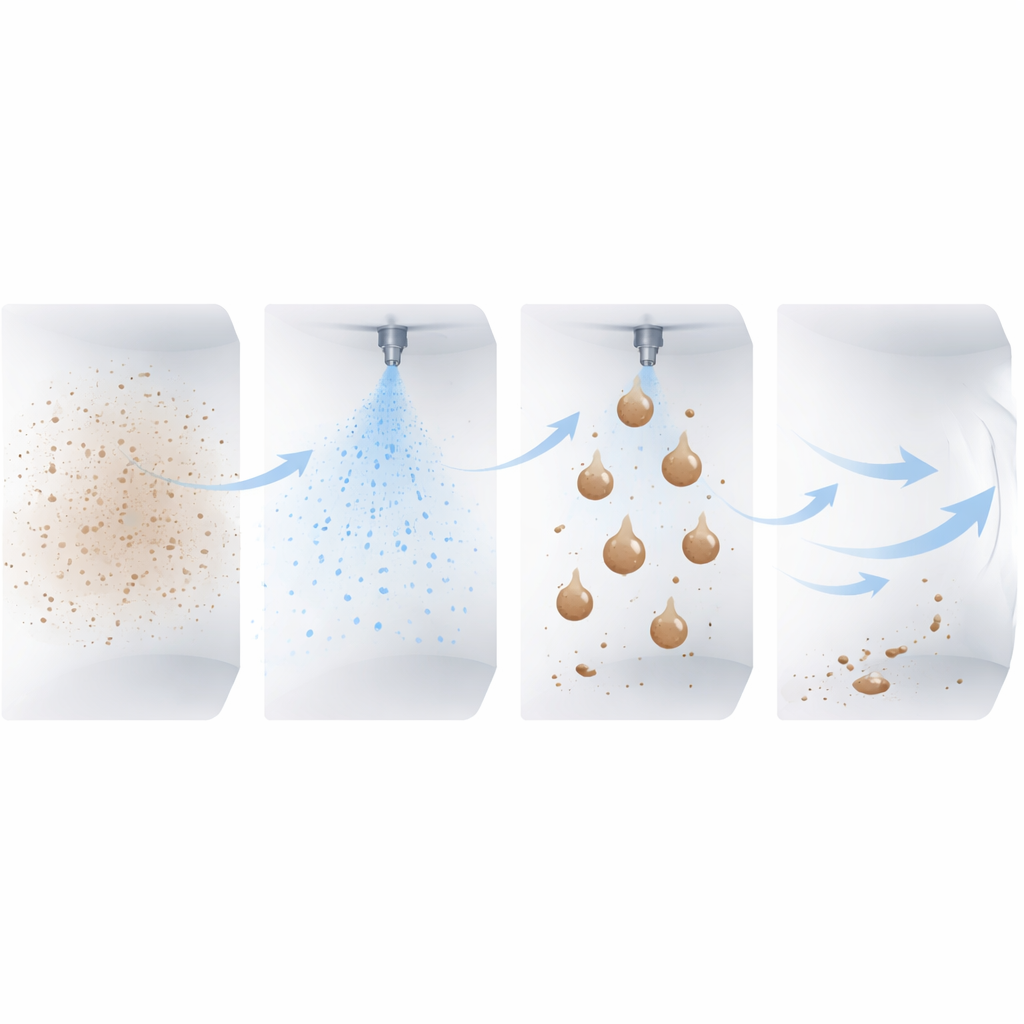
The research focuses on a long highway tunnel in China and looks at dust created by drilling and blasting at the rock face. The team studies a fine “water mist” system, where high‑pressure nozzles spray tiny droplets into the air. When these droplets collide with dust particles, the dust sticks to the water, forms heavier clumps, and falls to the ground. Using advanced computer simulations of air and particles flowing together, backed up by laboratory experiments, the authors track how both water mist and dust spread and interact over time in a 50‑meter stretch near the working face.
Three stages of mist and dust in a tunnel
The simulations show that once the sprinklers switch on, the mist doesn’t simply form a uniform curtain. Instead, it goes through three stages. First, driven by its initial speed, the mist shoots upward and forward, with the highest droplet concentration appearing 15–25 meters from the rock face. Next, swirling air currents created by the ventilating fan and the tunnel walls cause pockets of strong and weak mist coverage, including a low‑mist region near the floor 10–20 meters from the face. Finally, as the system keeps running, the mist fills the whole 50‑meter zone. During this time, dust is strongly reduced within the active spray region, but not evenly: dust tends to gather along the wall on the return‑air side, where the airflow carries particles farther before the mist can capture them.
Finding the best spray angle and position
A key part of the study is testing how the angle and location of the sprinklers change their effectiveness. Spraying straight ahead (0 degrees) sends mist farther down the tunnel but with a narrower vertical spread; larger angles (30, 45, and 60 degrees) create a wider “umbrella” of droplets but a shorter reach. Early on, when dust is freshly produced and still concentrated near the face, what matters most is how soon dust meets mist. In this period, a 0‑degree spray angle gives the highest reduction within the first 10 meters. As time goes on and dust drifts toward the tunnel entrance, both contact time and cross‑sectional coverage matter. After spraying stops, the lingering droplets become crucial: a 45‑degree angle leaves a broad cloud of residual mist that continues to capture dust, pushing overall removal efficiency as high as 86.7 percent.
Where to place the sprinklers for lasting protection
The team also varies how far the spray device is set back from the working face—5, 10, 15, 20, or 25 meters—and tracks dust at multiple points along the tunnel. In the first ten minutes or so, devices closer to the face intercept dust sooner and protect the busiest work zone more strongly; placing the system about 10 meters from the face works especially well in this early phase. But once the pumps stop, the pattern flips: mist clouds that form a bit farther back, roughly 15–25 meters from the face, hang in the air longer and keep scrubbing dust as it flows outward. Overall, setting the device 15 meters from the face gives the best compromise between quick interception and long‑lasting cleanup, cutting dust levels by up to about 86 percent in the simulations.
Putting the findings to the test in the lab
To check that the computer model matches reality, the researchers build a high‑pressure water‑mist system using a plunger pump, filter tank, and a ring of fine nozzles set at the recommended 45‑degree angle. In a tunnel‑like room, they generate smoke‑like particles to imitate fine construction dust and measure tiny airborne particles (PM2.5) at several distances. Without spraying, concentrations quickly exceed the instrument’s upper limit. With the system turned on, PM2.5 levels drop rapidly into the measurable range and continue to decline even after the water is shut off, as the remaining mist keeps binding dust. After 20–30 minutes, the dust concentration stabilizes at a level about 74 percent lower than in the no‑spray case.
What this means for safer tunnel work
For non‑specialists, the takeaway is straightforward: simply having sprinklers in a tunnel is not enough—how they are aimed and where they are installed can make the difference between modest and dramatic improvements in air quality. This study shows that fine water mist, when sprayed at a carefully chosen angle and distance from the working face, can remove more than four‑fifths of harmful dust particles and keep cleaning the air even after the pumps are turned off. These insights give tunnel designers and contractors concrete guidance to protect workers’ lungs, improve visibility, and run cleaner, safer construction sites.
Citation: Yang, S., Ren, R., Du, J. et al. Study on the effect of sprinkler layout parameters on dust removal in tunnel construction. Sci Rep 16, 12119 (2026). https://doi.org/10.1038/s41598-026-41935-z
Keywords: tunnel dust control, water mist sprinklers, PM2.5 removal, construction ventilation, occupational health