Clear Sky Science · en
A hybrid optimal feature selection and Conv-LSTM model (OFSCL) for short-term energy demand forecasting in distribution substations of Ahvaz, Iran
Keeping the Lights On in a Hot City
When a heatwave hits, air conditioners switch on across a city and the strain on the power grid can spike in minutes. If grid operators guess wrong about how much electricity will be needed, neighborhoods risk blackouts or wasteful oversupply. This paper focuses on a real substation in the hot, humid city of Ahvaz in southwestern Iran and asks a simple question with big stakes: can we predict, hour by hour, how much power that substation must deliver, using past demand and weather data more intelligently than ever before?

Why Short-Term Power Forecasts Matter
Electricity cannot be stored easily at large scale, so supply must closely track demand. At distribution substations, which step high-voltage power down for homes and businesses, this balance is especially delicate. Demand changes with time of day, day of the week, season, and weather, particularly temperature and humidity. Traditional forecasting tools—like basic statistical formulas—often assume smooth trends and simple patterns. In reality, power use in a hot city like Ahvaz is noisy, non-linear, and shaped by sudden jumps in air-conditioning use. Poor forecasts can overload transformers, reduce equipment life, and force operators to run the grid conservatively and less efficiently.
From Simple Formulas to Learning Machines
Over the last decade, researchers have tried more sophisticated methods, from classic machine learning models such as decision trees and neural networks to deep learning systems that excel at time-series data, like Long Short-Term Memory (LSTM) networks and Convolutional Neural Networks (CNNs. These newer models can pick up longer-term rhythms and subtle patterns that older techniques miss. Yet they still face two big challenges. First, they may be fed dozens of input variables—hours, days, holidays, wind speed, dew point, pressure, and more—many of which add noise rather than useful information. Second, they can have trouble using both moment-to-moment fluctuations and slower seasonal shifts at the same time. The result is that accuracy on real, messy data often falls short of what grid operators need.
A Hybrid Model That Learns What Really Matters
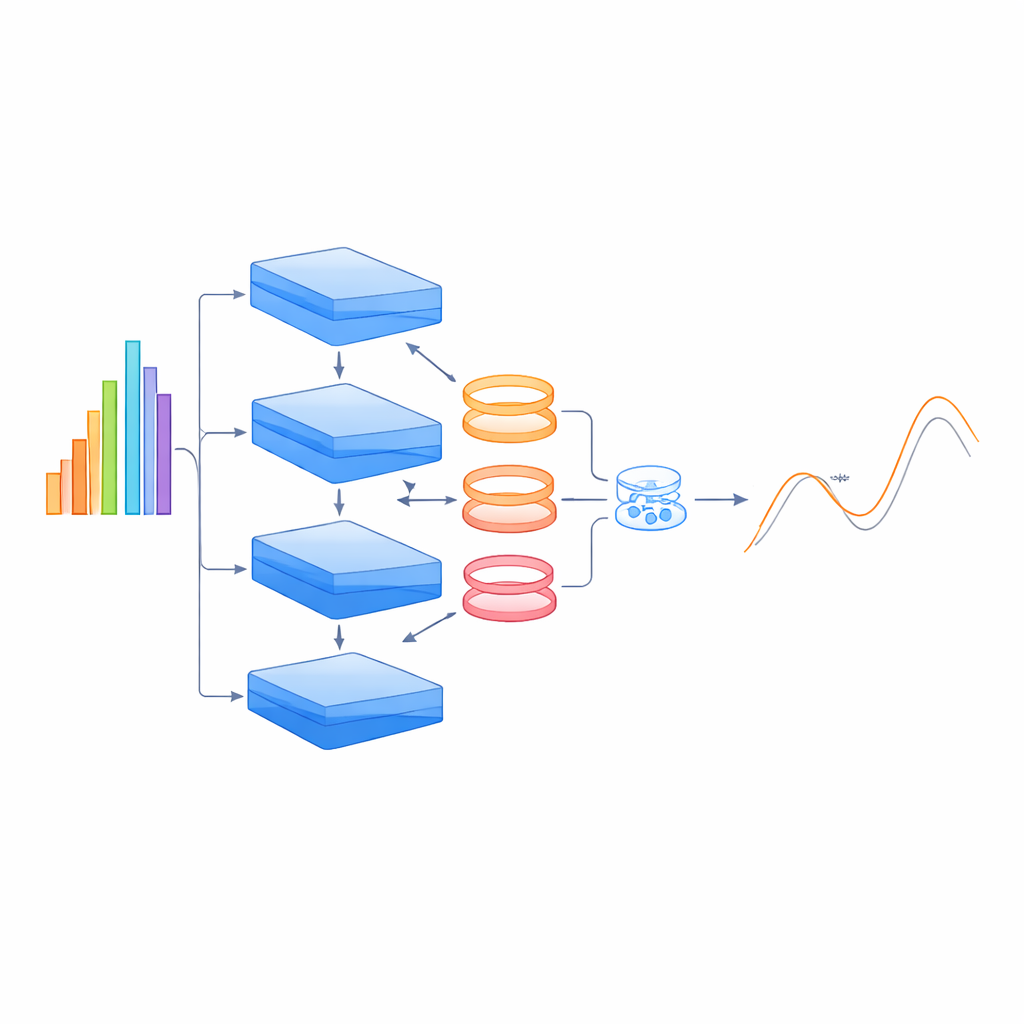
The authors propose a new hybrid deep learning architecture called the Optimal Feature Selection Conv-LSTM (OFSCL) model. It combines two strengths: convolutional layers that sift through many input variables and automatically focus on the most informative patterns, and LSTM layers that track how those patterns evolve over time. In OFSCL, the convolutional part gradually reduces the amount of information it passes forward, filtering out redundancy while preserving key signals. The LSTM part then learns how those refined signals change from hour to hour and day to day. Finally, dense layers convert this compact representation into a single forecast: how much energy the substation will need at the next time step.
Testing the Model on a Real Substation
To see whether OFSCL works in practice, the team collected one year of hourly data from a distribution substation in Ahvaz, along with detailed local weather records that cover extreme summer heat as well as cooler seasons. They compared OFSCL against a spectrum of alternatives, including decision trees, k-nearest neighbors, multilayer perceptrons, pure LSTM and CNN models, and several advanced hybrids such as CNN-LSTM and LSTM with attention. All models used the same training and test sets, and their performance was judged by how closely predictions matched actual energy use. The OFSCL model achieved an R² of about 90 percent and the lowest error scores, while training in less time than many of the other deep learning approaches. Repeated testing across different folds of the data confirmed that these gains were consistent rather than a lucky fluke.
What the Model Learns About Weather and Demand
Beyond accuracy, the authors wanted to understand which inputs the model relied on most. Using a gradient-based sensitivity analysis, they measured how strongly small changes in each feature affected the forecast. Air temperature emerged as the dominant factor, followed by the month of the year and relative humidity, reflecting how cooling needs surge with heat and seasonal conditions. In contrast, whether a day was a weekday or holiday played a much smaller role for this particular substation. The analysis also showed that the model becomes less sensitive to tiny fluctuations as it sees more data, locking onto stable patterns instead of overreacting to noise.
Bringing Smarter Forecasts to the Grid
In everyday terms, the study shows that a carefully designed learning system can not only predict how much electricity a busy substation will need in the next few hours, but also explain which aspects of the local climate matter most. By automatically filtering its inputs and capturing both quick swings and longer trends, the OFSCL model outperforms a range of existing methods while remaining fast enough for real-time use. If extended and tested across more regions and substations, such models could help utilities operate closer to the edge—keeping power flowing reliably, cutting waste, and better preparing cities for hotter, more energy-hungry futures.
Citation: Mehr, M.M., Farzin, H. & Mashhour, E. A hybrid optimal feature selection and Conv-LSTM model (OFSCL) for short-term energy demand forecasting in distribution substations of Ahvaz, Iran. Sci Rep 16, 11537 (2026). https://doi.org/10.1038/s41598-026-41925-1
Keywords: energy demand forecasting, deep learning, electric power grids, weather and electricity use, time-series prediction