Clear Sky Science · en
Thermal analysis of flat plate solar air heater system with radiation reflectors and W-shaped roughness: artificial neural network & machine learning approach
Why hotter air from sunlight matters
Turning sunlight into useful heat is one of the simplest ways to cut fuel use and emissions, yet many common solar air heaters still waste much of the energy that falls on them. This study explores a smarter flat-plate solar air heater that squeezes more warmth out of the same sunshine by reshaping the metal surface that absorbs light and adding mirrors along the sides. The researchers also test whether modern data tools—artificial neural networks and machine learning—can accurately predict how well the system will perform, paving the way for better design without endless trial-and-error experiments.
A smarter way to warm moving air
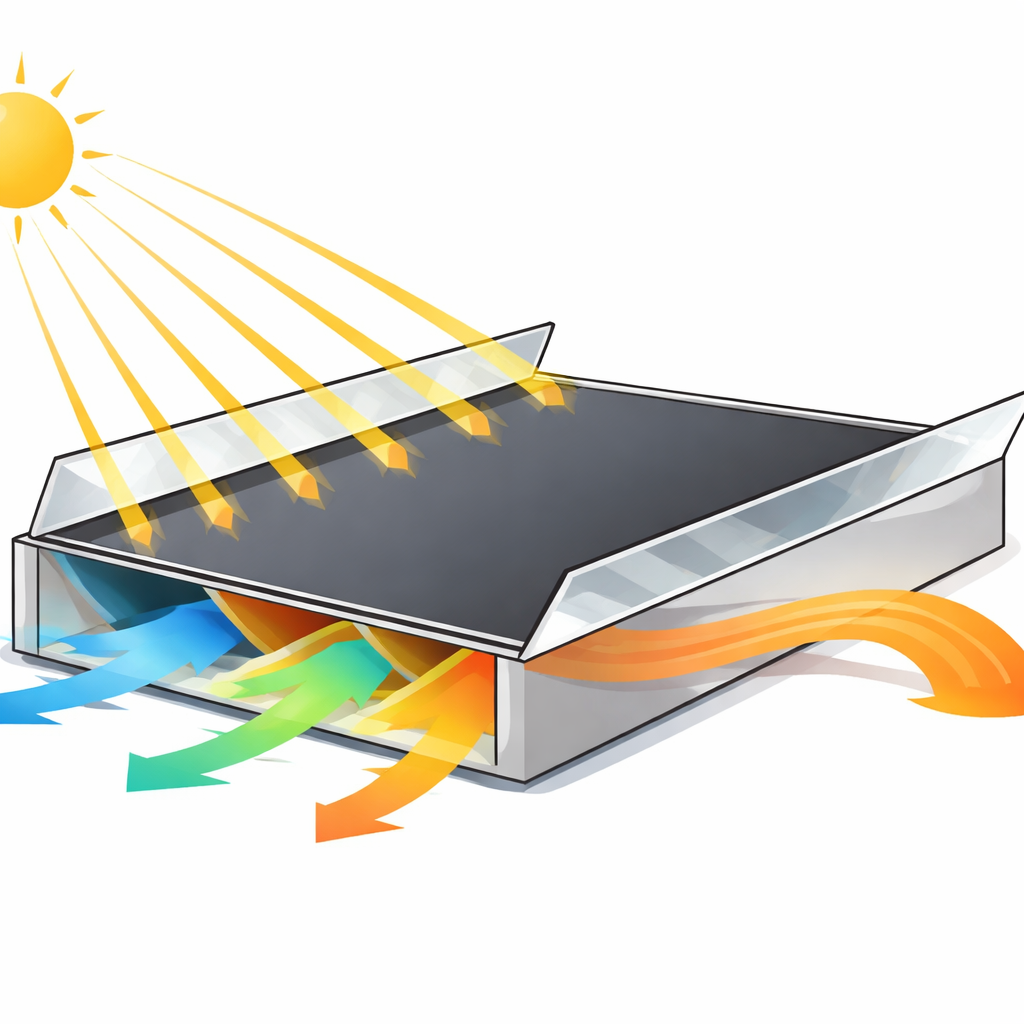
A flat-plate solar air heater is essentially a shallow box: sunlight passes through a glass top and heats a dark metal plate, and air flowing below the plate picks up this heat and carries it away. These devices are attractive for jobs like drying crops or warming buildings because they are cheap, quiet, and easy to maintain. Their main weakness is that heat does not move efficiently from the hot plate into the passing air, so the plate gets very hot and loses energy to the surroundings instead of to the air stream. The authors set out to tackle this weakness by combining two passive tricks—side reflectors and a textured metal surface—into a single “dual mode” design.
More sunlight on target with side mirrors
The first trick is to place mirror-like reflectors along the long edges of the heater. These panels are tilted so that sunlight that would normally miss the absorber plate is bounced back onto it. In the outdoor test rig, the reflectors were adjusted to about 30 degrees and matched in length to the active heating section. This arrangement raises the plate temperature by increasing the solar flux and spreads the heat more evenly across the surface. Measurements showed that simply adding reflectors to an otherwise smooth heater increased a key measure of heat transfer, the Nusselt number, by roughly 18–27 percent and boosted the overall thermal efficiency by up to about 43 percent compared with the plain design without reflectors.
Shaping the surface to stir the air
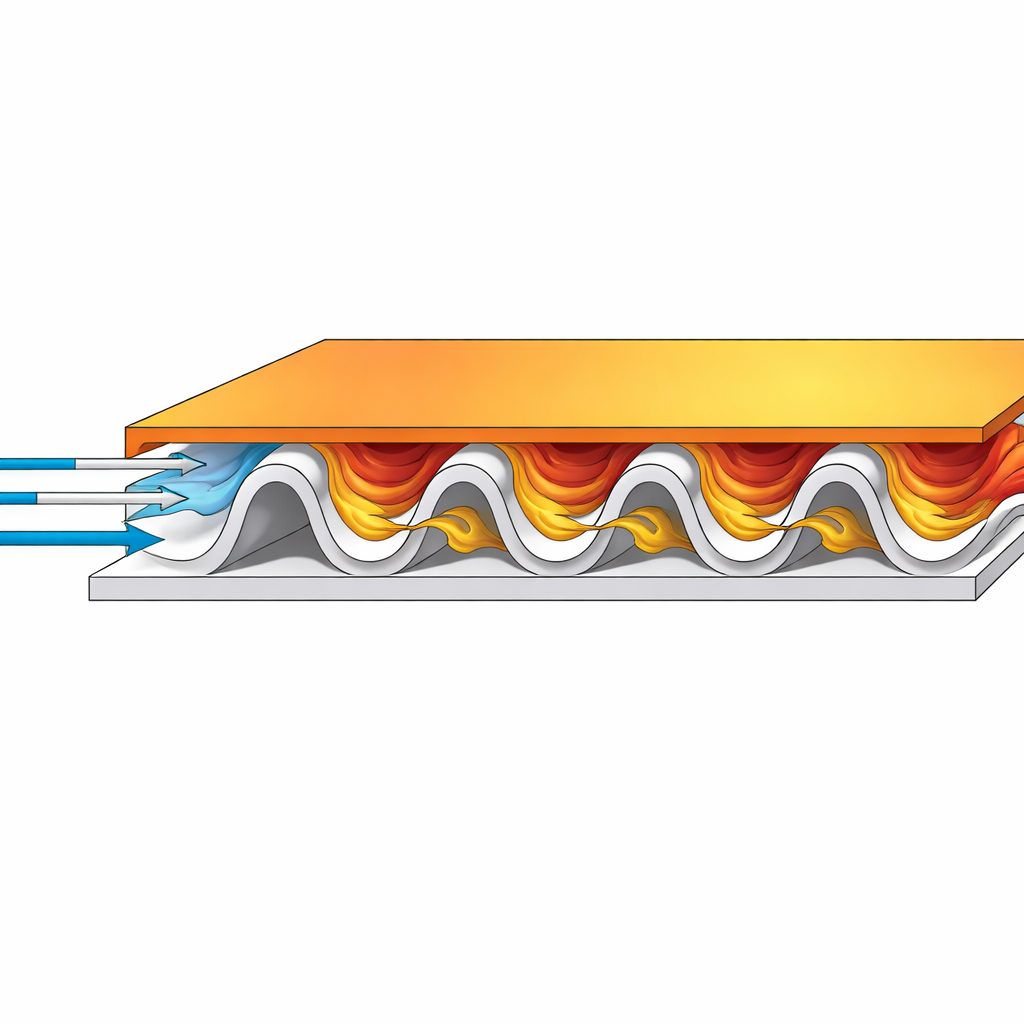
The second trick is to reshape the underside of the absorber plate, where the air flows. Instead of leaving it smooth, the team glued thin copper wires in a repeated W pattern across the surface. These ribs act like tiny speed bumps for the air. As the air passes over each W-shaped ridge, the flow separates, swirls, and then reattaches, constantly disturbing the thin, stagnant layer of air that normally clings to a surface and resists heat transfer. By carefully choosing the spacing, height, and angle of the ribs, the researchers aimed to strengthen this mixing without causing an excessive pressure drop that would demand more fan power.
What the experiments and data tools revealed
The team built and tested several configurations outdoors on clear days: a smooth plate without reflectors, a smooth plate with reflectors, and a W-ribbed plate with reflectors. They monitored air temperatures at the inlet and outlet, plate temperatures, solar intensity, and airflow rates, and from these calculated how effectively each setup moved heat from the plate into the air. The combination of W-shaped roughness and reflectors delivered the strongest performance: the heat-transfer indicator was up to 1.63 times higher than in the basic smooth system, and thermal efficiency improved by as much as 1.84 times. To reduce future experimental effort, the authors also trained machine learning models and a neural network on hundreds of data points. These models were able to predict heat-transfer behavior and flow conditions with very high accuracy, closely matching the experimental trends.
From better test rigs to better solar dryers
For non-specialists, the takeaway is straightforward: by adding simple side mirrors and carefully patterned metal ribs, a flat solar air heater can deliver much more useful warmth from the same patch of sunlight. This means that greenhouses, crop dryers, building heaters, and similar systems could become significantly more compact or powerful without adding moving parts or fuel. The successful use of neural networks and machine learning in this study also shows that designers can increasingly rely on smart data-driven models to fine-tune such devices before building them, speeding up the move toward cleaner, more efficient solar-based heating in homes, farms, and industry.
Citation: Jain, P.K., Kurrey, K.L., Pandey, V. et al. Thermal analysis of flat plate solar air heater system with radiation reflectors and W-shaped roughness: artificial neural network & machine learning approach. Sci Rep 16, 11779 (2026). https://doi.org/10.1038/s41598-026-41922-4
Keywords: solar air heater, waste heat reduction, solar drying, machine learning modeling, thermal efficiency