Clear Sky Science · en
Valorization of coal fly ash into a magnetic Fe₃O₄-decorated composite for Cu(II) removal from aqueous systems
Turning a Problem Waste into a Helpful Tool
Coal-fired power plants around the world generate mountains of fine gray dust known as coal fly ash, which is usually dumped as waste and can pose health and environmental risks. This study explores a different path: turning that troublesome ash into a simple magnetic material that can help clean copper pollution out of water, and then be quickly pulled back out with a magnet. Rather than chasing the highest possible performance, the researchers focus on proving that a low-cost, waste-based material can work reliably and be improved over time.
Why Coal Fly Ash Matters
Coal fly ash is produced in huge quantities, especially in coal-dependent countries such as Indonesia. The tiny particles can be carried by the wind, breathed in by nearby communities, and stored in landfills where they may affect soil and water. At the same time, this ash is rich in mineral ingredients like silica, alumina, iron, and calcium that can be repurposed in cement, bricks, and water treatment materials. The idea behind this work is to “valorize” the ash—that is, convert it from a disposal burden into a useful resource—by using its mineral framework as a scaffold for a new water-cleaning material.
Building a Magnetic Cleaner from Waste
To make the new cleaner, the team first chemically “activates” the fly ash using either a strong base (NaOH) or a strong acid (HCl). This step roughens and restructures the smooth, glassy ash particles, increasing their surface area and exposing more potential attachment sites for metals. They then prepare tiny grains of iron oxide, a magnetic mineral often called magnetite, and mix these with the activated ash and a waxy helper compound (PEG 4000). After heating, the result is a composite in which small iron oxide domains decorate the ash surface, giving the grains both plenty of contact area with water and the ability to be moved by a magnet. 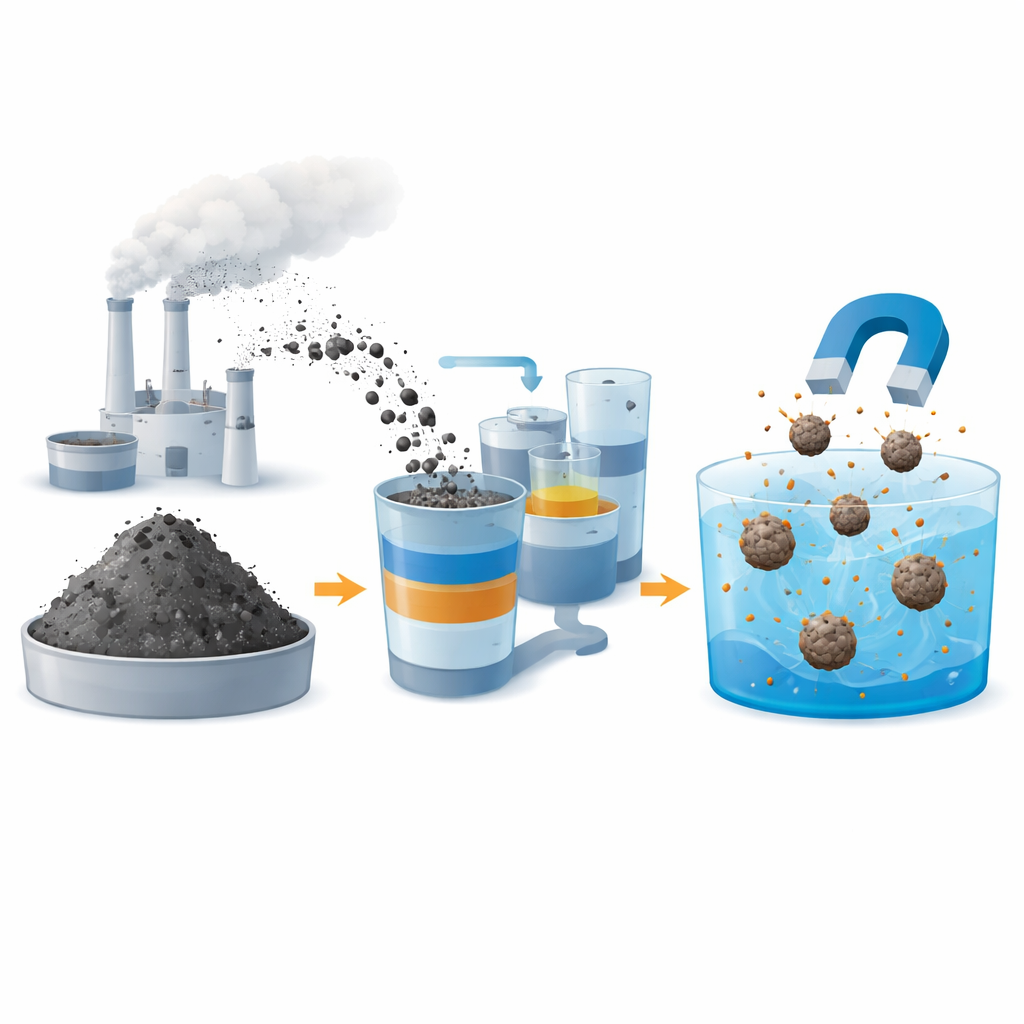
How It Grabs Copper from Water
The researchers then test how well these magnetic ash grains remove Cu(II), a common and potentially harmful form of copper in industrial wastewater. In simple batch tests, they stir a fixed amount of the composite with slightly contaminated water and monitor how copper levels fall over time using atomic absorption spectroscopy. Copper is drawn rapidly to the most accessible outer sites during the first minutes, then more slowly into inner pores as the system approaches equilibrium. The best-performing recipe, made with NaOH-activated ash and a relatively high loading of iron oxide, removes about 80% of the dissolved copper within two hours, corresponding to an uptake of roughly 0.32 milligrams of copper per gram of material under the chosen conditions. Mathematical fitting shows that the uptake follows a so-called pseudo-second-order pattern, which in practical terms points to chemical bonding on the surface rather than mere physical sticking.
Peeking Inside the Grains
Microscopic images reveal how structure underpins this behavior. Scanning electron microscopy shows that raw ash spheres start out smooth, but chemical activation carves them into rougher, more etched particles with extra nooks and crannies. When iron oxide is added, bright, dense spots appear on the ash surfaces, confirming that magnetic nanoparticles are anchored as separate patches rather than as a perfect shell. Transmission electron microscopy zooms in further, showing nanoscale iron-rich clusters decorating a lighter ash matrix. Gas adsorption measurements back this up by revealing a relatively high surface area and a network of pores a few nanometers wide, which help water and copper ions move in and out of the grains during treatment. 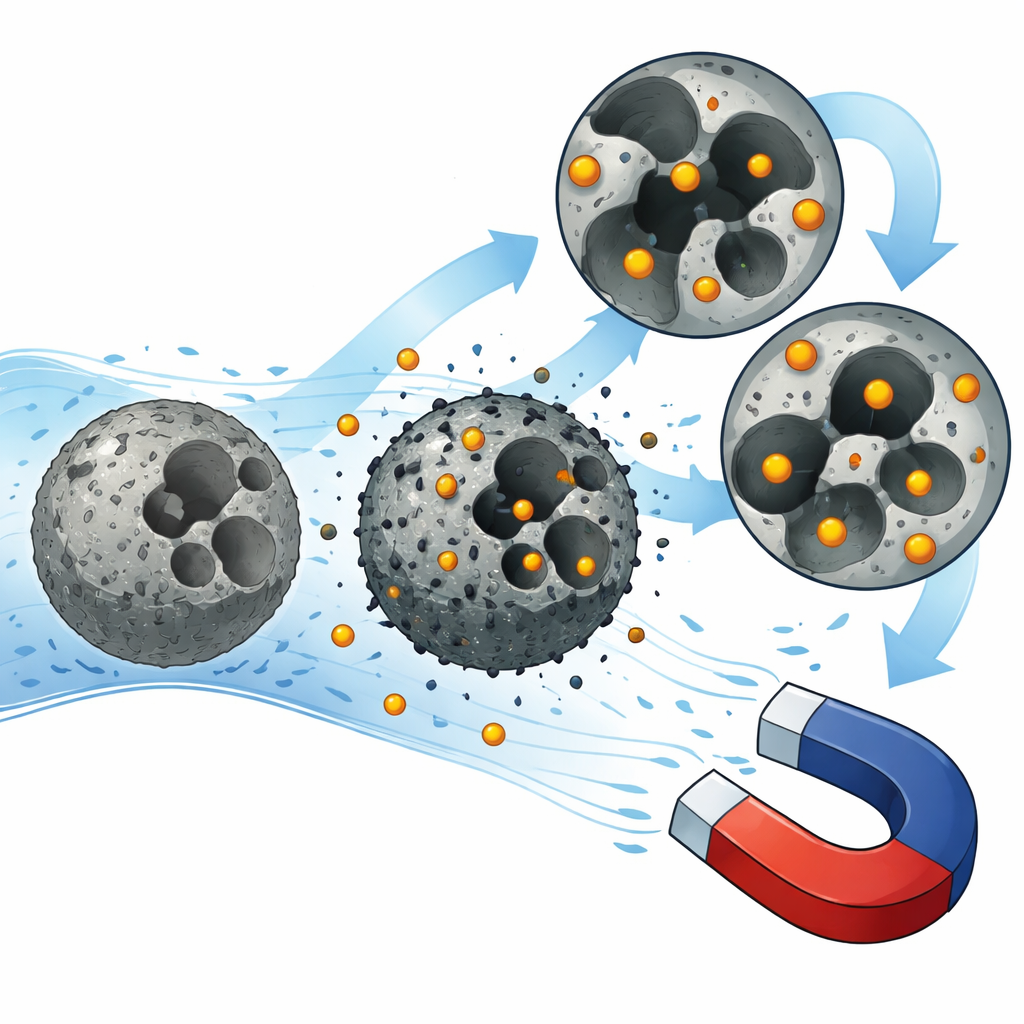
What This Means for Cleaner Water
From a layperson’s perspective, the key message is that a waste material commonly seen as a liability can be upgraded into a practical, magnet-friendly filter for copper-contaminated water. The composite does not rival the very best high-tech adsorbents in how much copper it can hold, but it is cheap, easy to recover with a magnet, and built from an abundant industrial by-product. The work shows that by carefully tweaking surface chemistry, pore structure, and the amount of magnetic material, coal fly ash can become a platform for simple, reusable water-cleaning media. Future improvements in texture and design could boost capacity and extend the approach to other metals and real-world wastewaters, helping close the loop on both pollution control and coal-plant residues.
Citation: Saputro, S., Mahardiani, L., Masykuri, M. et al. Valorization of coal fly ash into a magnetic Fe₃O₄-decorated composite for Cu(II) removal from aqueous systems. Sci Rep 16, 12098 (2026). https://doi.org/10.1038/s41598-026-41916-2
Keywords: coal fly ash, magnetic adsorbent, copper removal, wastewater treatment, waste valorization