Clear Sky Science · en
Lightweight hybrid neural network with physics consistency regularization for lithium-ion battery state of health estimation
Why Smarter Battery Health Matters
As electric cars, home batteries, and portable electronics spread worldwide, knowing how much life is left inside a lithium-ion battery becomes as important as knowing how much fuel is in a gas tank. Yet estimating a battery’s long‑term “health” is tricky: it slowly wears out in ways that depend on temperature, charging habits, and dozens of other factors. This study introduces a new kind of lightweight, physics‑aware neural network that can track battery health more accurately and efficiently, potentially making future vehicles and devices safer, cheaper to maintain, and easier to monitor in real time.
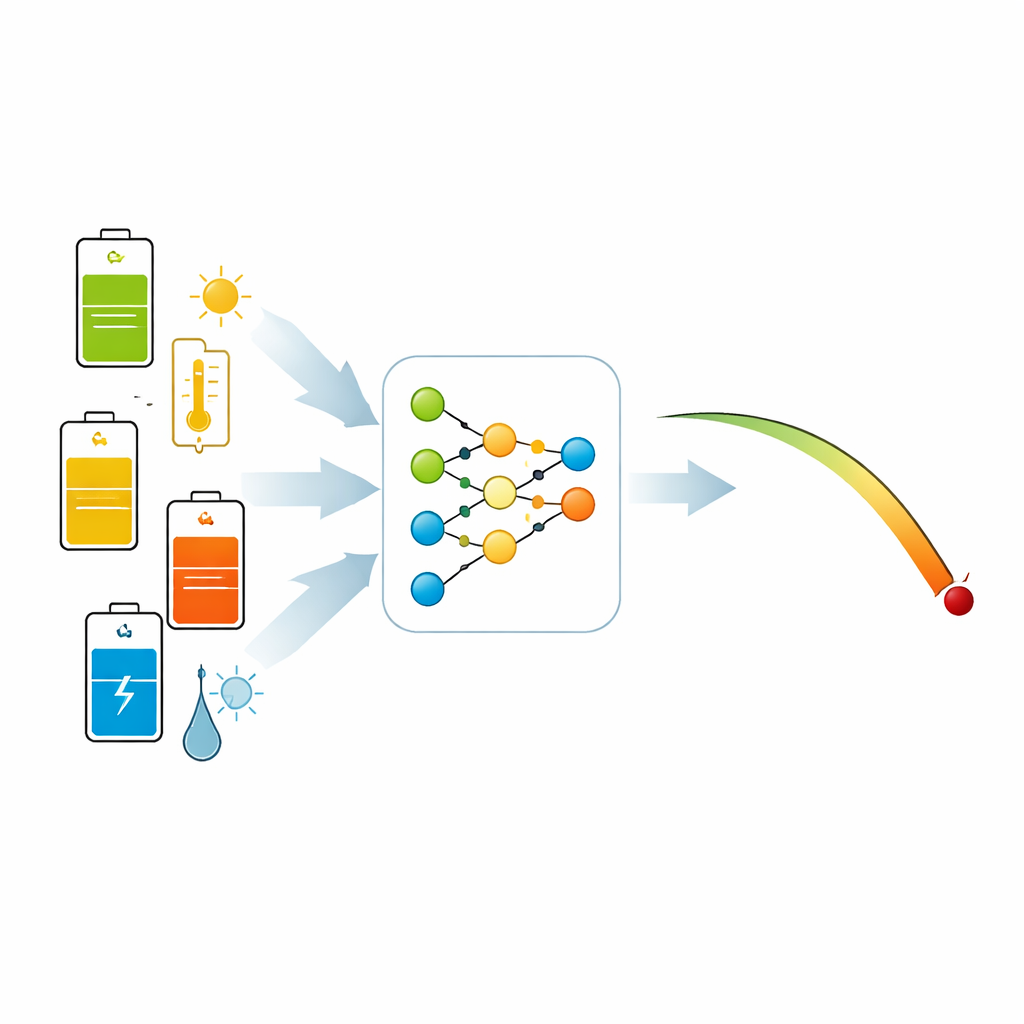
The Challenge of Watching Batteries Age
Battery makers and car companies need to predict how a battery’s capacity will fade over hundreds or thousands of charge–discharge cycles. Existing data‑driven methods, which rely purely on machine learning, can be very accurate but often behave like “black boxes” and may fail when conditions differ from the training data. On the other hand, physics‑based models grounded in electrochemistry are interpretable but slow and computationally heavy, which is problematic for on‑board battery management systems. The authors argue that tomorrow’s solutions must blend data and basic physical intuition while staying light enough to run on modest hardware.
A Hybrid Network That Respects Real‑World Behavior
The researchers propose an Improved Lightweight Hybrid Physics‑Informed Neural Network, or IHPINN, designed specifically for battery state‑of‑health prediction. At its core are two cooperating subnetworks. One “solution” network turns a compact description of battery condition—such as voltage, current, temperature, and cycle index—into a health estimate between 0 and 1. A second “dynamics” network learns how that health value should evolve over time, acting as a kind of guardian that discourages unrealistic jumps or rebounds in the predicted aging curve. Instead of enforcing detailed electrochemical equations, the model encodes simple but powerful principles: battery health should change smoothly and, overall, should not improve as the cell ages.
Lightweight Design for Real‑Time Use
To make this hybrid approach practical, the authors carefully redesign standard neural network components to cut computational cost. They replace large fully connected layers with grouped and low‑rank transformations that reuse parameters, shrinking both the number of weights and the number of mathematical operations. An adaptive activation unit blends two types of nonlinear response and automatically shifts its behavior as the battery progresses through different aging stages, helping the network learn complex patterns without unstable gradients. A shared‑attention module further trims redundancy by using a single projection to decide which features matter most, so the model focuses its effort on the signals most closely tied to degradation. Together, these choices allow the network to stay small while still capturing multi‑scale aging behavior.

Putting the Model to the Test
The team evaluates IHPINN on four widely used battery datasets from different laboratories, chemistries, and usage conditions. Across the board, the new model predicts health more accurately than a conventional physics‑informed neural network baseline while using fewer parameters, less memory, and shorter training time. For example, on one dataset from Huazhong University of Science and Technology, the mean squared error drops by more than half, even as the parameter count shrinks by about one‑fifth and training becomes faster. Similar gains appear for a demanding Massachusetts Institute of Technology dataset that includes varied charging strategies and temperatures, as well as for two other collections probing different cell types and cycling regimes. Ablation experiments, where individual components are removed, show that multi‑scale feature extraction and adaptive activations contribute most to accuracy, while dynamic weighting of loss terms speeds convergence.
What This Means for Everyday Technology
For non‑specialists, the key takeaway is that IHPINN offers a way to watch batteries age that is both smart and frugal. It keeps track of health in a manner consistent with basic expectations—that batteries wear down smoothly over time—without requiring heavy physics simulations or oversized neural networks. In practice, this kind of model could be embedded in electric vehicles, stationary storage systems, or consumer electronics to provide more reliable forecasts of remaining life and to help prevent unexpected failures. Although the current work does not yet fully capture the detailed chemistry inside cells, it demonstrates that carefully built, physics‑aware machine learning can strike a valuable balance between accuracy, transparency, and efficiency, pointing toward more trustworthy battery management in the energy systems of the future.
Citation: Zhang, P., Zhang, H., Zhou, J. et al. Lightweight hybrid neural network with physics consistency regularization for lithium-ion battery state of health estimation. Sci Rep 16, 12780 (2026). https://doi.org/10.1038/s41598-026-41913-5
Keywords: lithium-ion battery health, physics-informed neural networks, battery degradation prediction, energy storage monitoring, lightweight machine learning