Clear Sky Science · en
Physicochemical properties of soy protein isolate–beet polysaccharide mixtures and phase inversion of their emulsion composites
Why this matters for everyday foods
From salad dressings and ice cream to plant-based meats, many familiar foods are really tiny droplets of oil held in water or water held in oil. Keeping these mixtures from separating is a constant challenge for food makers, especially as they look for cleaner labels and more sustainable ingredients. This study explores how two plant-based components—soy protein and a fiber-like substance from sugar beets—can be combined and gently heated to build more stable, tunable emulsions that might one day replace synthetic additives in foods, cosmetics, and even pharmaceuticals.
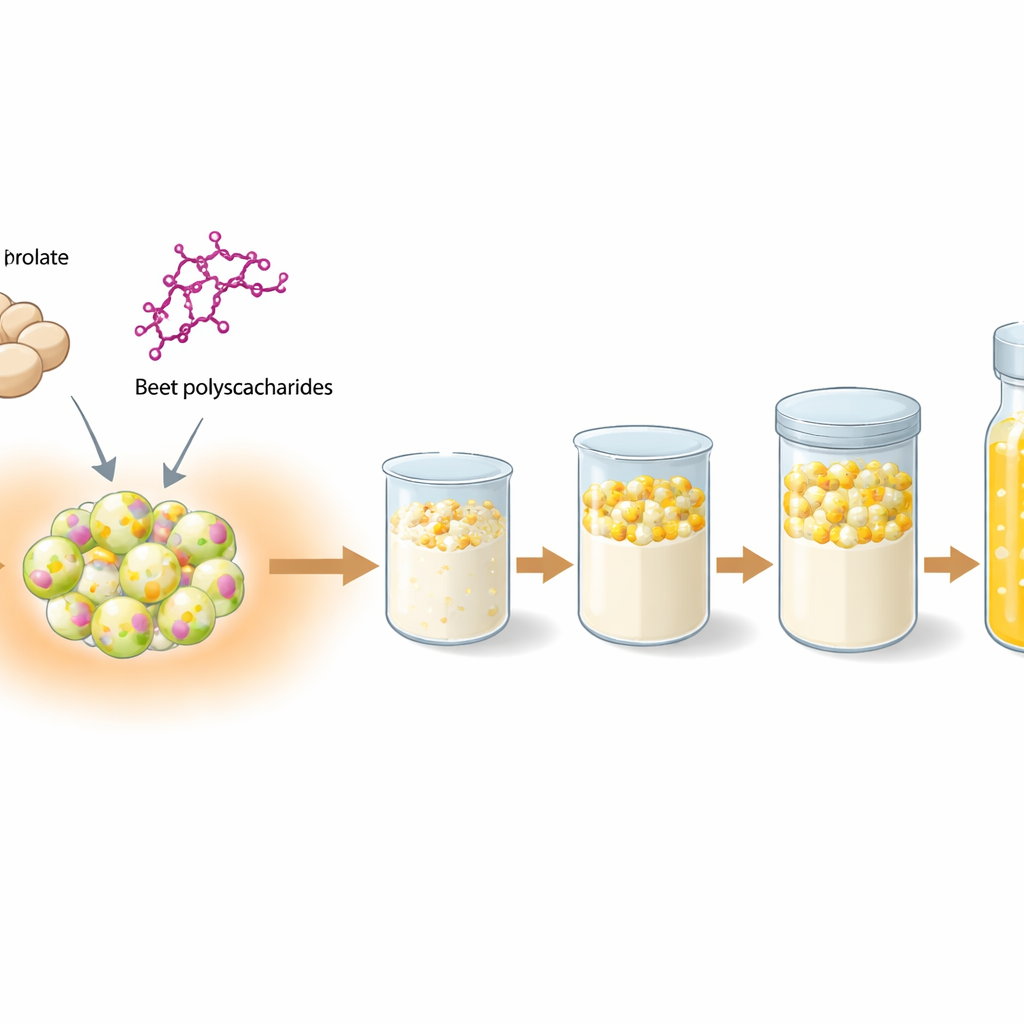
Plant ingredients working together
The researchers focused on soy protein isolate, a concentrated protein powder already widely used in plant-based products, and beet polysaccharides, long sugar chains derived from sugar beets. When these two are mixed in water, they can attract each other and form tiny complexes. The team prepared mixtures with different proportions of soy protein to beet polysaccharide and either left them unheated or gently heated them. By doing so, they mimicked real food processing conditions and asked how this pre-treatment changes the way the ingredients behave once oil is added to form an emulsion.
Heat reshapes the building blocks
To see what was happening at the microscopic level, the scientists measured particle size, surface charge, acidity, and electrical conductivity, and they used imaging and spectroscopy tools to look at structure. Heating the mixtures made the particles larger and reduced their surface charge, which can change how strongly they attract or repel each other in water. Structural measurements suggested that heat and beet polysaccharides together nudged the soy proteins into slightly more ordered shapes rich in so-called sheet-like regions. Under the microscope, unheated mixtures tended to look like sheets or strands, while heated mixtures were more bead-like or spherical, especially at certain mixing ratios. These changes in shape and charge turned out to be crucial for how the mixtures later held oil droplets in place.
From smooth cream to flipped phases
Next, the team blended each mixture with increasing amounts of soybean oil, like slowly adding more oil to a mayonnaise. At low oil levels, all combinations formed smooth, white emulsions with small, even droplets. As more oil was added, however, the behavior diverged. Some mixtures stayed as oil droplets dispersed in water, while others suddenly flipped into the opposite arrangement, with water droplets trapped inside a continuous oil phase. This “phase inversion” could be followed simply by monitoring electrical conductivity: water-rich systems conducted electricity well; once the structure flipped and water became the inner phase, the conductivity dropped nearly to zero. Which path a sample followed depended strongly on both the soy-to-beet ratio and whether the mixture had been heated.
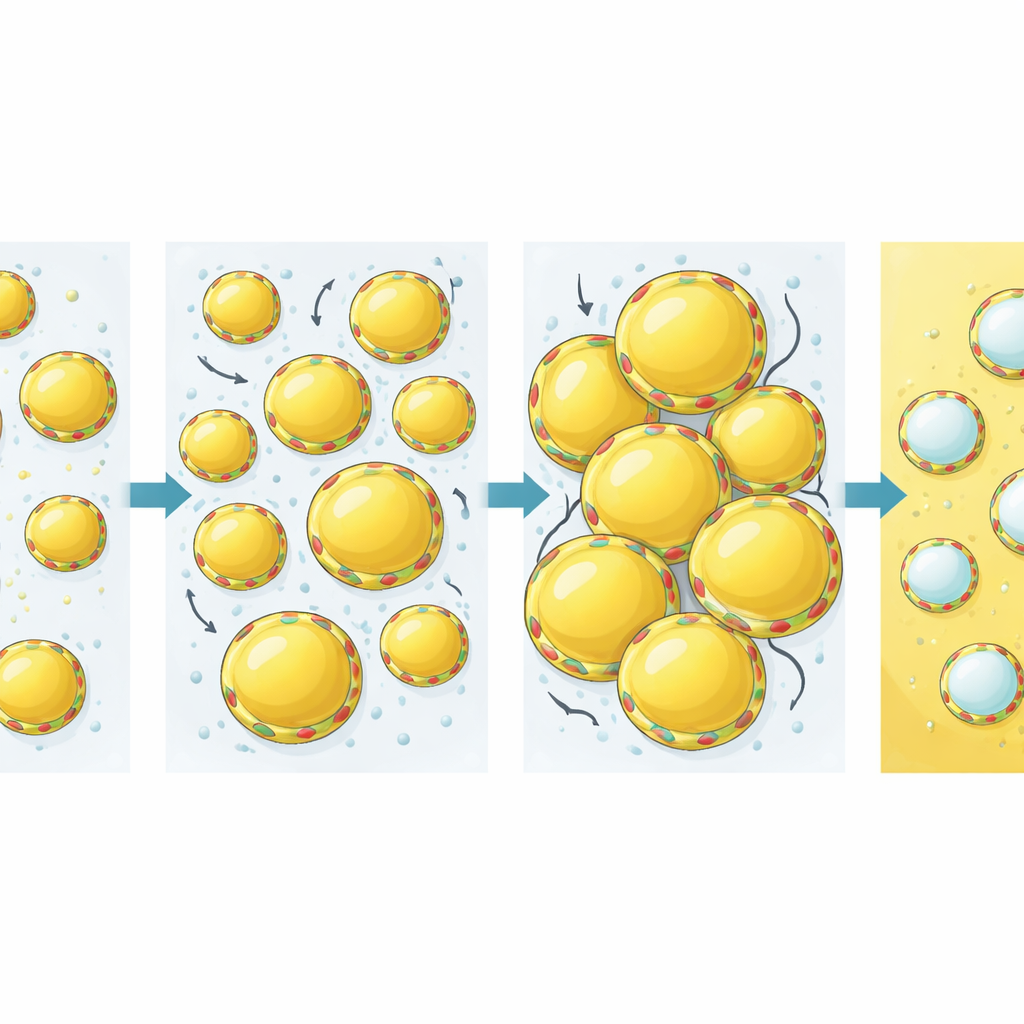
Texture and firmness under gentle stress
When the researchers looked at how these emulsions behaved under gentle shaking or deformation, they found that many of them behaved more like soft gels than simple liquids. Two key measures of firmness, known as storage and loss moduli, increased with the frequency of applied motion, showing that the internal network resisted flow. Heated mixtures generally produced emulsions with higher firmness than unheated ones, especially at intermediate ratios of soy protein to beet polysaccharide. In practical terms, this means that by adjusting recipe and heating step, manufacturers could dial in textures ranging from pourable creams to spoonable gels using only plant-based components.
What this means for future products
Overall, the study shows that carefully choosing the balance of soy protein and beet polysaccharides, and deciding whether to apply a mild heating step, provides a powerful way to control whether an emulsion stays oil-in-water, flips to water-in-oil, and how thick or gel-like it becomes. For a layperson, the takeaway is that two familiar plant ingredients can be coaxed into acting like smart, adjustable “glues” for oil and water. This insight lays groundwork for designing more stable, appealing, and potentially healthier products—from dressings and desserts to creams and lotions—without relying on synthetic stabilizers.
Citation: Dong, S., Guo, S., Xu, W. et al. Physicochemical properties of soy protein isolate–beet polysaccharide mixtures and phase inversion of their emulsion composites. Sci Rep 16, 13289 (2026). https://doi.org/10.1038/s41598-026-41910-8
Keywords: plant-based emulsions, soy protein, sugar beet polysaccharides, food texture, oil-in-water phase inversion