Clear Sky Science · en
Simulation of water-mud-inrush in fault fracture zone of deep and long railway tunnel in mountain area
Why tunnel floods matter to everyday life
Modern railways and highways increasingly rely on long tunnels that cut through mountains and under the sea. While these passages shorten journeys and support booming trade, they also face a hidden threat: sudden floods of water mixed with mud that can burst into the tunnel from fractured rock. These violent inrush events can halt construction, damage equipment, and even endanger lives. This study looks inside the rock around a deep railway tunnel to understand how such bursts form and how engineers might spot danger early and design safer tunnels.
A closer look at hidden cracks in the mountains
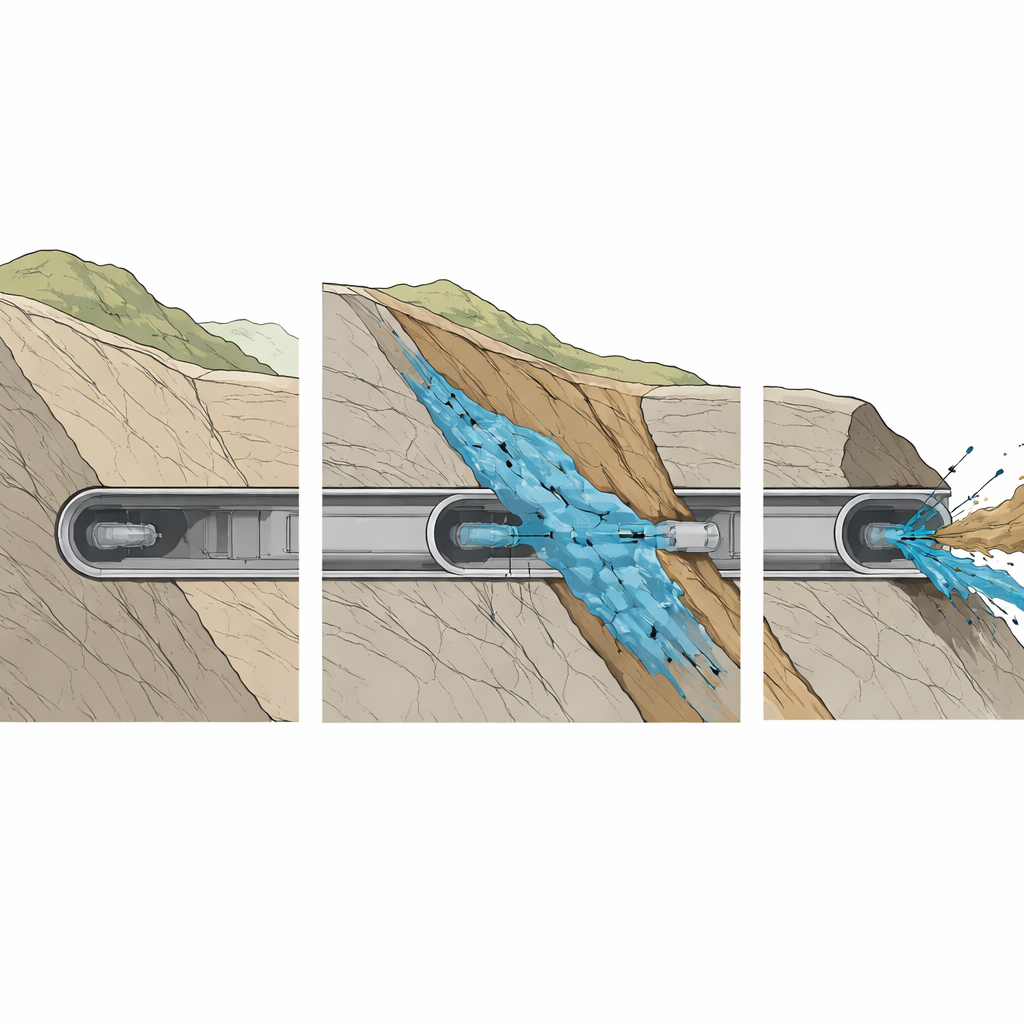
Many long tunnels inevitably cross zones of broken rock known as faults. These zones often store large amounts of pressurized groundwater and loose material. When a tunnel advances into such a region, blasting and excavation disturb both the rock and the underground water. If the rock between the tunnel and the fault weakens too much, the confined water and mud can rapidly rush into the tunnel, much like puncturing a pressurized hose. Real projects in China and elsewhere have suffered repeated water–mud bursts that stopped work for months and even caused the ground surface to sink, underscoring the need to predict and control these disasters before they occur.
Building a virtual tunnel inside the rock
Because full-scale experiments inside real mountains are impossible, the researchers created a detailed three-dimensional computer model of a deep railway tunnel crossing a water-rich fault. In this virtual mountain, the rock and fault were represented with realistic strength, stiffness, and permeability, and the natural weight of overlying rock and groundwater pressure were included. The team simulated tunnel excavation step by step, turning model elements on and off to mimic the face advancing, while allowing rock deformation and groundwater flow to interact. They tested two main situations: a tunnel running below a fault and a tunnel cutting fully through it, and they varied fault thickness, angle, and distance from the tunnel to see how geometry affects risk.
How the rock moves and water responds as the tunnel advances
The simulations revealed that as the tunnel face moves forward, the roof of the tunnel gradually sags, then settles sharply when the face is very close to a given section, before stabilizing as the face moves away. Side walls, especially the arch-shaped ring of rock on the side nearest the fault, show steadily increasing sideways movement. Stresses in the rock concentrate at specific spots: the tunnel arch walls, their feet, and the corners where the fault meets intact rock. At the same time, the pressure of groundwater reorganizes around the opening. Initially, pressure simply increases with depth, but excavation carves out a funnel-shaped low-pressure zone around the tunnel, drawing water toward it. Just ahead of the tunnel face, pore pressure first rises and then drops suddenly as the face passes, signaling a rapid release of stored water.
The most dangerous spot: one side of the tunnel arch
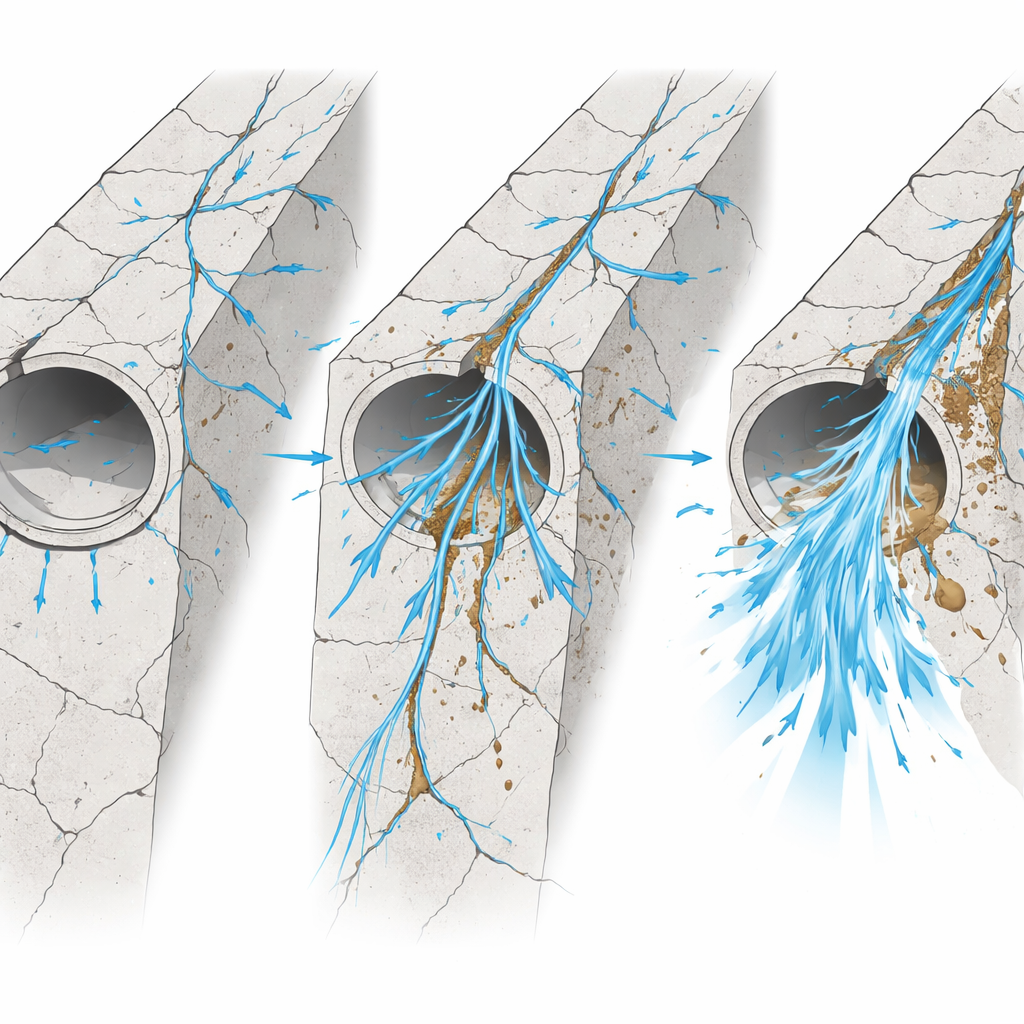
By tracking groundwater speed and direction, the researchers could see where potential inrush channels would form. As the excavation approached the fault, small high-speed flow zones in the fault linked up with the low-pressure region around the tunnel, creating a continuous pathway. The peak flow and strongest changes in pressure and stress consistently focused on the right-hand side of the tunnel arch closest to the fault, rather than uniformly around the opening. Thicker faults and shallower fault angles increased both the stored water and how directly it could connect to the tunnel, raising the risk, while a greater rock “buffer” distance between tunnel and fault reduced it. This overlap of intense rock stress, cracking, and fast water flow marks the likely birthplace of a water–mud inrush.
Turning virtual insights into safer tunnels
Although the model simplifies real rocks and groundwater, it offers a clear picture for engineers: the side of the tunnel arch nearest a water-bearing fault is the prime danger zone for sudden mud and water entry. The study suggests focusing instruments there to watch for sharp changes in pore pressure and deformation as early warning signs. It also shows how the shape and position of a fault can be used to classify risk and to plan extra support and grouting where needed. In everyday terms, the work turns a hidden, complex process inside mountains into a more predictable problem, helping designers build long, deep tunnels that are not only impressive feats of engineering but also safer for the people who use and construct them.
Citation: Yang, S., Han, H., Chen, G. et al. Simulation of water-mud-inrush in fault fracture zone of deep and long railway tunnel in mountain area. Sci Rep 16, 13370 (2026). https://doi.org/10.1038/s41598-026-41909-1
Keywords: tunnel water inrush, fault fracture zone, underground excavation, numerical simulation, geotechnical safety