Clear Sky Science · en
Stable nitrogen-doped carbon quantum dots with pH-controlled fluorescence response for Fe3+ detection
Glowing dots that help spot hidden metal
Many of the liquids we rely on—from drinking water to industrial waste streams—contain metal ions that are invisible to the naked eye. Iron, for example, is essential in small amounts but can cause problems when its levels are too high. This study describes tiny glowing particles, called carbon quantum dots, that light up under ultraviolet (UV) lamps and dim in the presence of certain forms of iron. By tailoring how these dots are made and understanding how acidity affects their behavior, the researchers show how to turn them into simple and reliable detectors for iron in water, while also exploring their use in security inks and flexible glowing films.
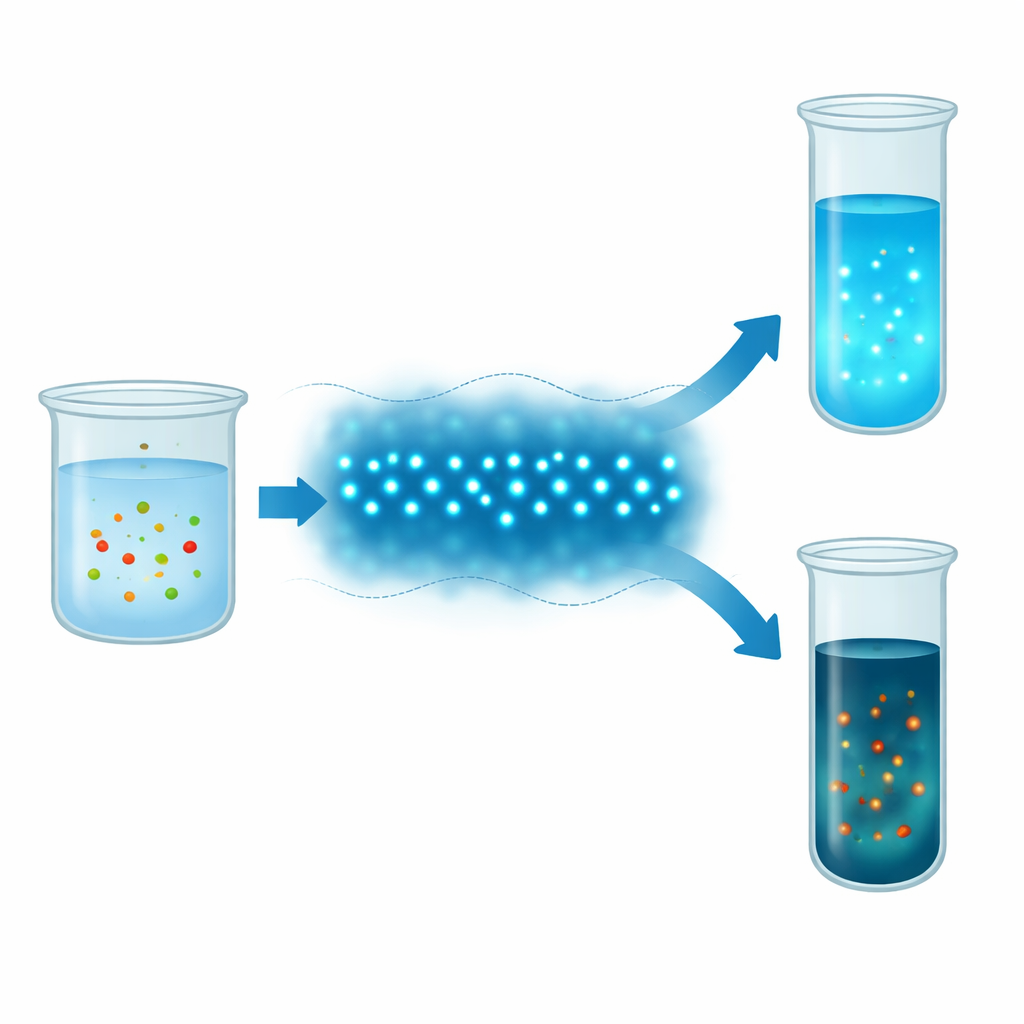
Tiny specks that shine in water
The work centers on nitrogen-doped carbon quantum dots—nanometer-sized specks of carbon whose surfaces are enriched with nitrogen atoms. The team produced these dots using a relatively simple “pressure cooker” style water-based process that heats citric acid (a common food additive) with urea (a nitrogen-rich compound). Careful control of the temperature, reaction time, and ingredient ratios yielded particles only a few billionths of a meter across, small enough to stay evenly dispersed in water. Under a UV lamp, their solutions emit a strong blue glow, with the color remaining stable even if the excitation conditions are changed. These bright, stable emissions make the dots attractive for applications where a clear optical signal is needed.
Building a sturdy light source
To check that their nanodots would stand up to real-world conditions, the researchers examined their structure and composition in detail and then tested how robust their glow is. Microscopy images showed nearly spherical particles built from tiny graphitic domains, while spectroscopy confirmed the presence of many nitrogen- and oxygen-based chemical groups on their surfaces. These groups help the dots mix well with water and influence how they interact with their surroundings. The team then probed how the blue emission changes when the solution’s acidity, salt content, or solvent is varied. Despite strong dimming in extremely acidic solutions, the dots remained brightly fluorescent and kept the same emission color over a wide range from mildly acidic to strongly alkaline conditions, and even at very high salt concentrations.
When iron and acidity team up
A key part of the study explores how these glowing dots respond to iron in its highly charged Fe3+ form, which is common in environmental and industrial settings. Many earlier reports claimed that iron simply “quenches” the light by binding to the dot surfaces, but the chemistry of iron in water is more complicated than that. At alkaline pH, the researchers found that Fe3+ quickly turns into rust-like solid particles, which cloud the solution but remove most of the free iron from the liquid. Under these conditions, the dots’ emission hardly changes once this cloudiness is removed, showing that any apparent dimming seen in cloudy samples can be misleading. In contrast, in strongly acidic solutions where Fe3+ stays fully dissolved, increasing iron concentration caused a clear and predictable decrease in the dots’ brightness over a broad range of concentrations.

From test tubes to inks and films
Because the dots are strongly fluorescent and well behaved in water, they can be used directly as a glowing ink. The authors demonstrated that simple writing on paper with the dot solution appears nearly invisible under normal lighting but shines intensely under UV, a feature attractive for anti-counterfeiting patterns or invisible markings. They also blended the dots into a flexible polyvinyl alcohol (PVA) film, creating a uniform sheet that looks green in room light but emits bright blue under UV. This shows that the dots keep their optical properties even when embedded in a solid material, opening possibilities for flexible optical devices, security labels, or responsive coatings.
Why this matters for safe water and smart materials
In everyday terms, the study shows how to make a reliable “light switch” for iron in water using tiny glowing particles. The authors demonstrate that the dots they designed can detect Fe3+ at useful concentration levels, provided the solution is strongly acidic so the iron stays in a form that can genuinely interact with the dots. They argue that paying attention to acidity is essential for correctly interpreting measurements, since ignoring it can produce false results when iron forms invisible precipitates instead of staying dissolved. At the same time, the dots’ strong, stable glow and easy processing into inks and films highlight their broader potential in security printing and low-cost optical technologies, where simple UV lamps can reveal hidden messages or patterns.
Citation: Juha, R., Alghoraibi, I. Stable nitrogen-doped carbon quantum dots with pH-controlled fluorescence response for Fe3+ detection. Sci Rep 16, 11816 (2026). https://doi.org/10.1038/s41598-026-41900-w
Keywords: carbon quantum dots, fluorescent sensors, iron detection, nanomaterials, anti-counterfeiting