Clear Sky Science · en
Chemical investigation of polycyclic aromatic hydrocarbon sources and associated health risks in PM2.5 from Eastern India
Why These Invisible Particles Matter to You
Tiny particles in city air can slip deep into our lungs without us ever seeing them. Clinging to some of these specks are chemicals called polycyclic aromatic hydrocarbons, or PAHs, several of which are known to cause cancer. This study tracks how much of these PAH-laden fine particles (PM2.5) people in two fast-growing cities of eastern India are breathing, where they come from, how they change with the seasons, and what they may mean for long-term health. Its findings are relevant not only for residents of Durgapur and Raniganj, but for anyone living in polluted urban–industrial corridors across South Asia and beyond.
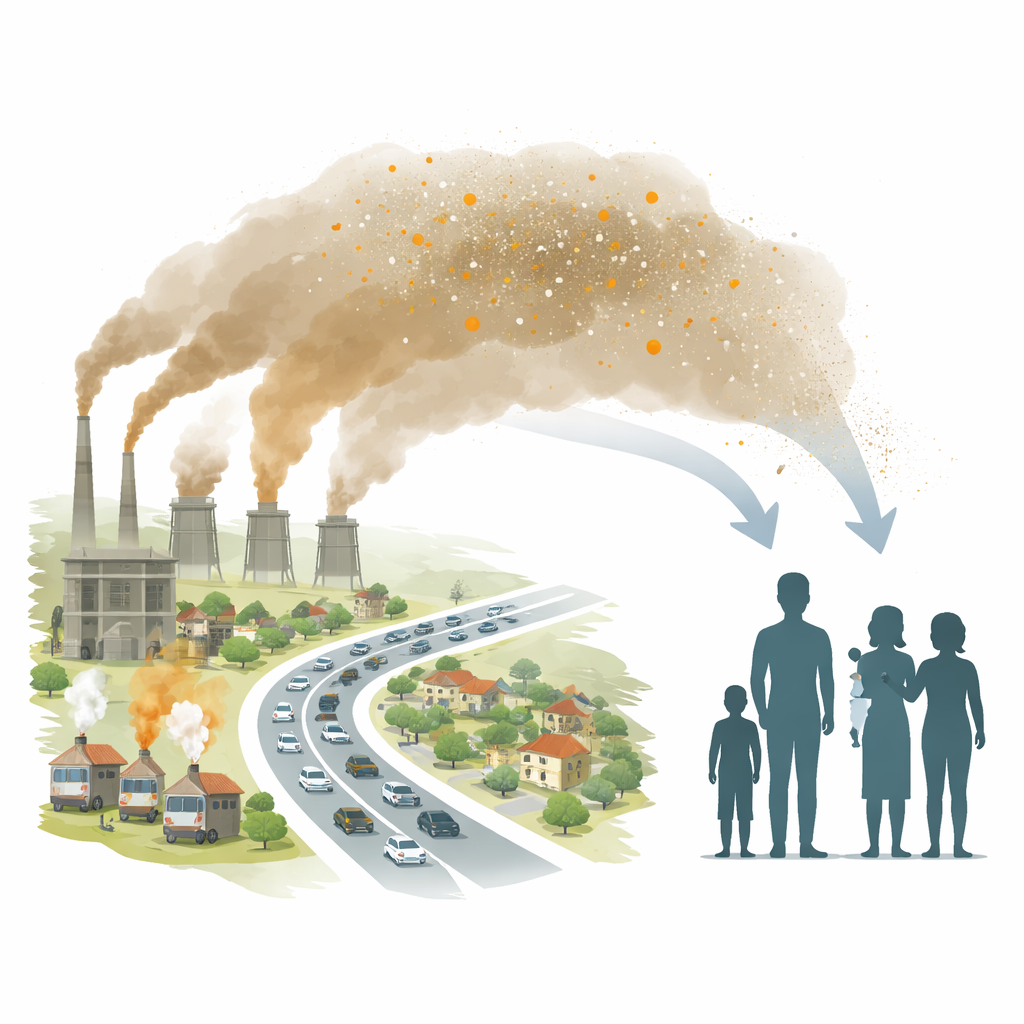
Following Dirty Air Through a Busy Industrial Belt
Researchers monitored air in four neighborhoods over an entire year: industrial, commercial, and residential areas in Durgapur, and an industrial area in nearby Raniganj. All sites lie on the Indo‑Gangetic Plain, one of the world’s most polluted regions. They collected fine particles (PM2.5) every three days and analyzed them for 13 different PAH compounds, along with carbon-based components and local weather data. This long, uninterrupted record let them see how pollution varied from season to season—winter, pre‑monsoon, monsoon, and post‑monsoon—under the changing mix of traffic, industry, household fuel use, and shifting winds and temperatures.
How Much Pollution and When It Peaks
The amounts of PAHs stuck to PM2.5 were strikingly high, especially in the industrial zones. Average annual levels ranged from about 186 nanograms per cubic meter of air in Durgapur’s commercial area up to nearly 500 nanograms per cubic meter in Raniganj’s industrial area. Winter and the post‑monsoon months were consistently the dirtiest, while the monsoon months, with heavier rains and taller mixing layers, showed the lowest levels. The PAH mix was dominated by heavier, more complex molecules with four to six rings, which tend to ride on solid particles and are more resistant to breakdown in air. These heavy PAHs—particularly compounds labeled IcP, BgP, and B(b+k)F—are closely associated with high‑temperature burning and are of greatest concern for health.
What the Chemical Fingerprints Reveal About Sources
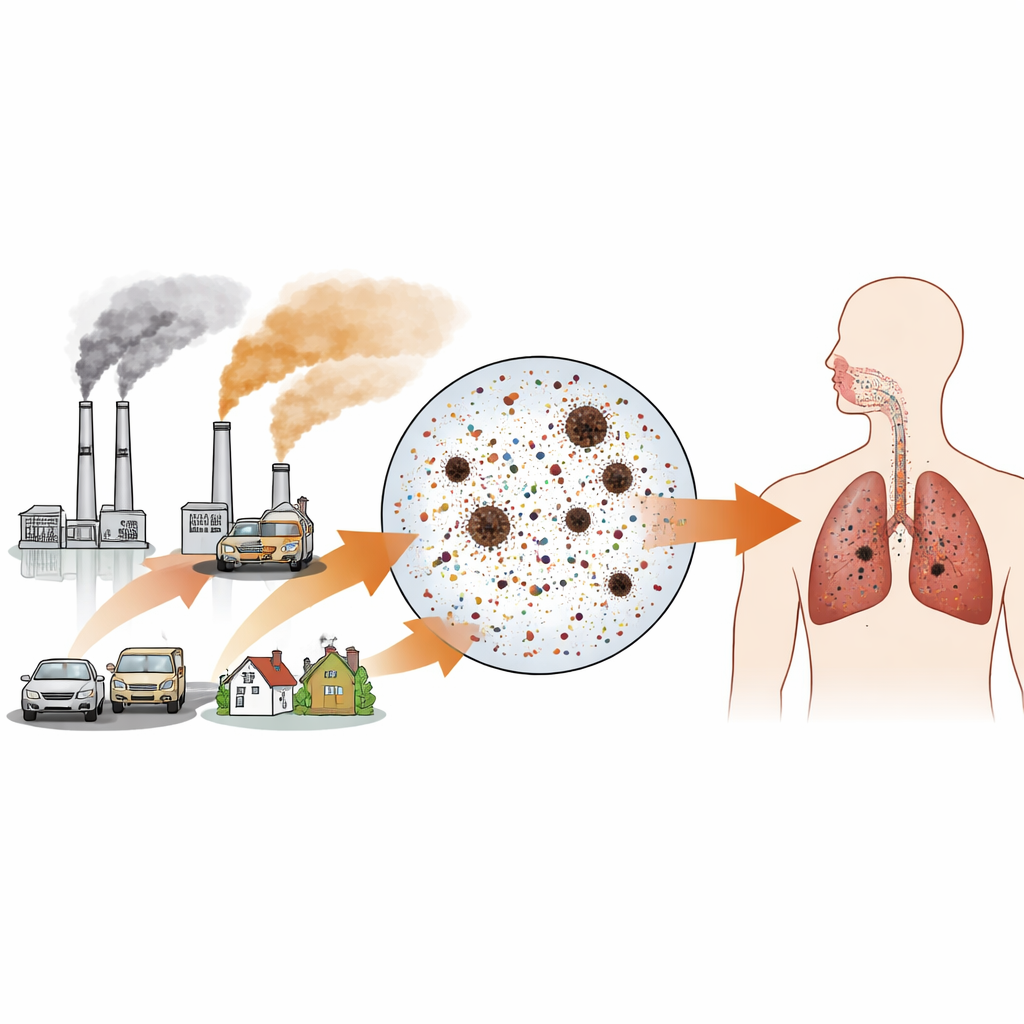
To uncover where these PAHs were coming from, the team used two complementary approaches. They examined simple ratios between pairs of PAH compounds, and they applied statistical techniques that group together pollutants that rise and fall in tandem. Both lines of evidence pointed to combustion as the overwhelming source: burning of coal and coke in industries and power plants, diesel and gasoline from traffic, and biomass and coal used in homes for cooking and heating. In industrial Raniganj, coal combustion and vehicle fuels together explained most of the PAH load. In commercial and residential parts of Durgapur, vehicle exhaust combined with wood, crop waste, and other solid fuels burned in homes played a larger role. Natural or oil-leak sources made only a minor contribution by comparison.
From City Smoke to Cancer Risk
The study then translated complex chemical measurements into a more intuitive metric: cancer risk over a lifetime. Each PAH was converted into a “benzo[a]pyrene equivalent,” a way of expressing how potent the mixture is compared with a well‑studied cancer‑causing compound. The resulting toxic equivalent levels at all sites—roughly 34 to 110 nanograms per cubic meter—far exceeded the World Health Organization’s guideline for this reference chemical. Using United States Environmental Protection Agency methods, the authors estimated incremental lifetime cancer risks for adults and children who continuously breathe this air. At every site and in every season, the calculated risks were above the usual “acceptable” range, and often in the agency’s “high risk” category, with adults facing greater risks because of higher inhalation rates and longer exposure times.
What It Means for People and Policy
In simple terms, the air in these eastern Indian cities contains fine particles coated with a mix of combustion‑derived chemicals that are likely to increase lifetime cancer risk, especially in industrial neighborhoods and during winter. The work shows that tackling a few key sources—coal‑fired industrial processes, diesel and gasoline vehicles, and household burning of solid fuels—would bring the biggest health gains. The authors argue that routine tracking of a marker chemical such as benzo[a]pyrene alongside PM2.5 could help identify hot spots and monitor progress as cleaner technologies and stricter emission controls are rolled out. While the details are specific to Durgapur and Raniganj, the message is broadly applicable: in rapidly urbanizing regions, controlling how we burn fuel is central to making the air safer to breathe.
Citation: Subair, M.Y., Karigowda, Habib, G. et al. Chemical investigation of polycyclic aromatic hydrocarbon sources and associated health risks in PM2.5 from Eastern India. Sci Rep 16, 11986 (2026). https://doi.org/10.1038/s41598-026-41899-0
Keywords: air pollution, polycyclic aromatic hydrocarbons, PM2.5, urban industrial emissions, cancer risk