Clear Sky Science · en
Industrial internet data management framework with blockchain integration for data integrity assurance and access control resolution
Why trustworthy factory data matters
Modern factories run on data as much as on steel and electricity. Every sensor reading, maintenance record, or shipment update helps decide how machines are tuned, when parts are replaced, and whether products are safe. When that data is missing, delayed, or quietly altered, the result can be wasted materials, production stoppages, or even accidents. This paper explores how to make industrial data both highly reliable and easy to share across companies by marrying two big ideas: the Industrial Internet (the web of connected machines) and blockchain (a tamper-resistant shared record).
A new map for following industrial data
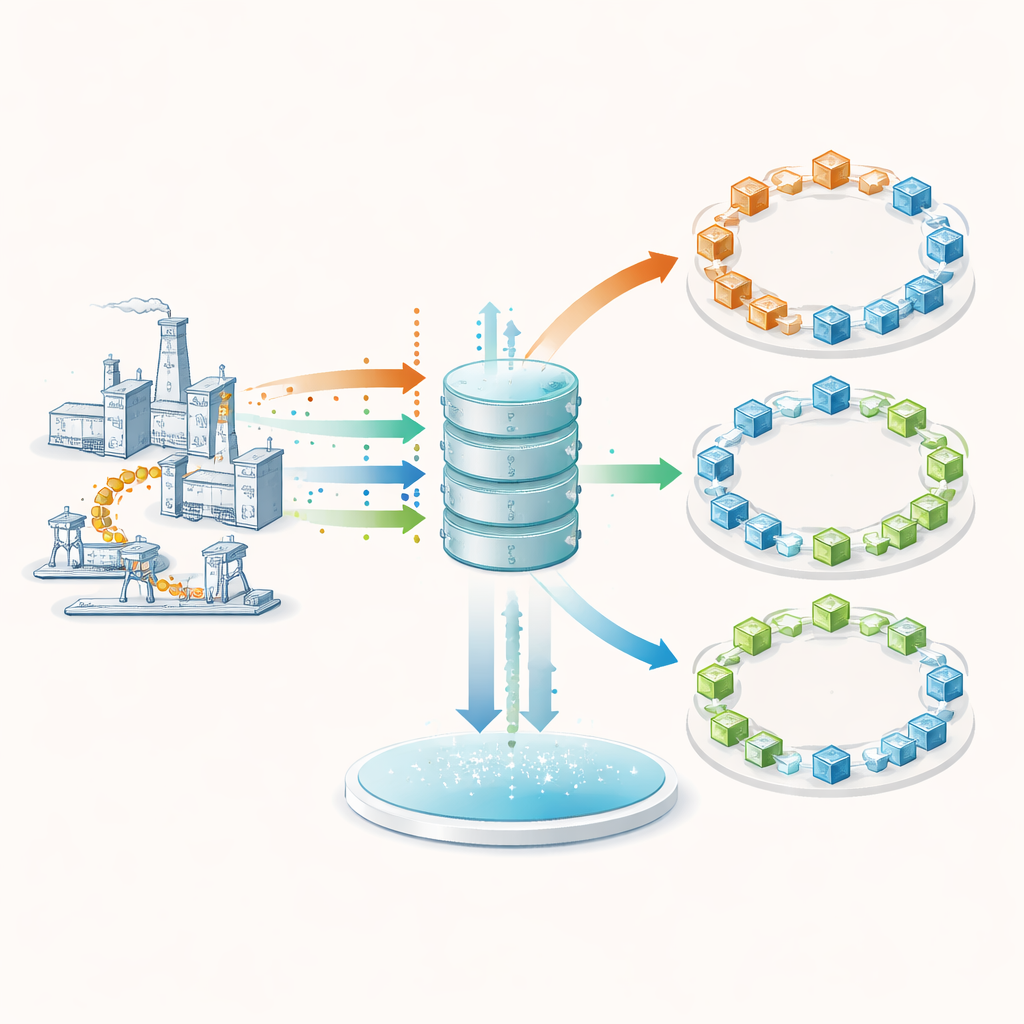
The authors start by showing why today’s industrial data systems fall short. Information often sits in isolated company databases, so-called “data silos,” where it is hard to verify and slow to access. Even when data is shared, it may be incomplete or vulnerable to quiet editing. To fix this, the paper proposes a data management framework that links the Industrial Internet’s identification-and-resolution system (which can treat every machine, product, or batch as a uniquely tagged object) with several cooperating blockchains. As data flows from sensors and enterprise systems, it receives a unique identifier, and the key fingerprints of that data are written to blockchain, where they can no longer be invisibly changed.
Connecting factories, identifiers, and chains
At the heart of the framework is a special connector, called the CBII, that sits on each participating blockchain. The overall architecture has layers: at the bottom, an identification network with global, national, industry, and enterprise nodes routes requests for data tied to specific IDs. Above that, several separate blockchains maintain tamper-resistant records. Each CBII node bridges between its chain and the identification network, handling data uploads, queries, and cross-chain exchanges. This design lets different industries or companies run their own blockchains while still sharing trusted data when needed, reducing the risk of isolated “blockchain islands.”
Who uses the system and how
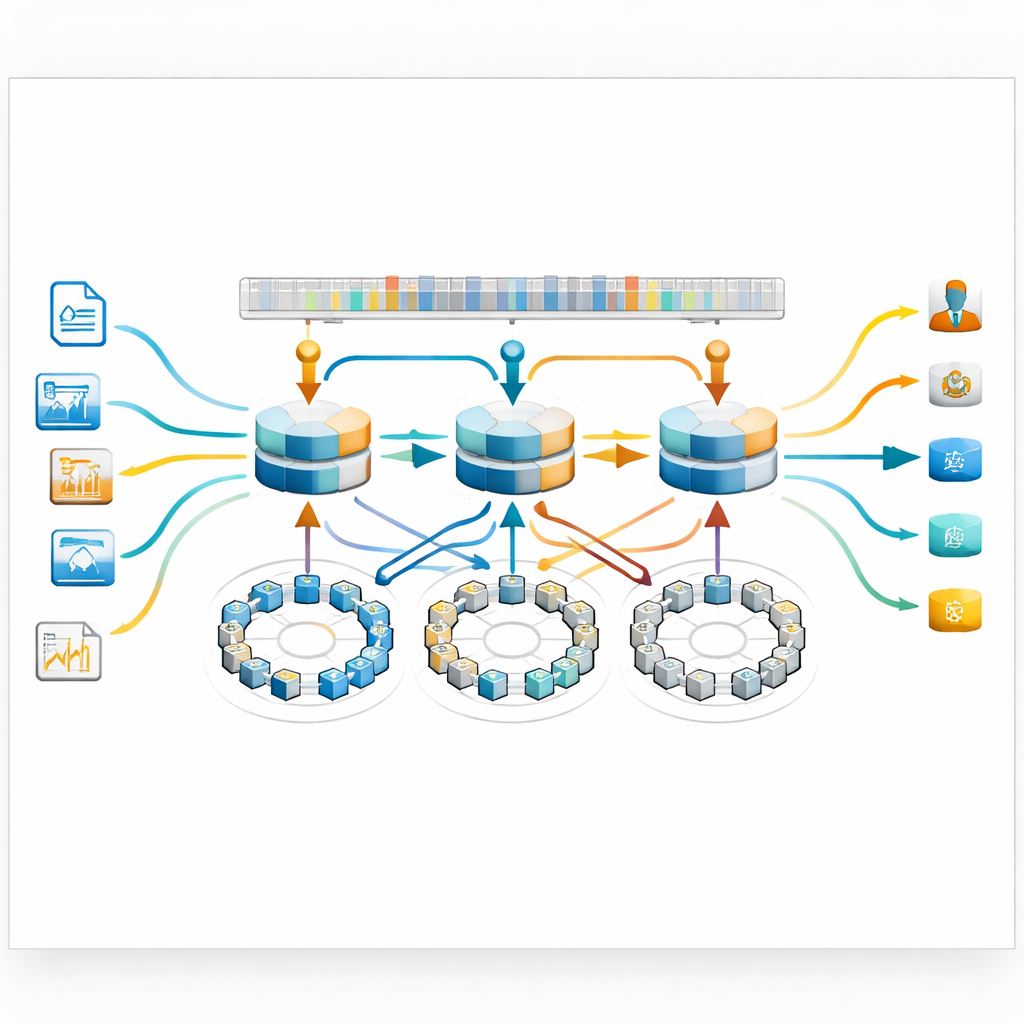
The framework supports three kinds of users. First, “off-chain” users, such as consumers scanning a product tag or regulators checking records, access data through the identification network; the CBII compares what it finds there with what is stored on blockchain and flags any mismatch. Second, “single-chain” users, like a company working entirely within its own consortium blockchain, query and verify data locally while still relying on identifiers for ownership checks. Third, “cross-chain” users can request data stored on another company’s blockchain. Here, a cross-chain mechanism listens for key events on one chain, carries cryptographic proofs off-chain, and verifies them on a target chain using a lightweight client and Merkle proofs, ensuring that data copied or referenced across chains remains authentic without a central gatekeeper.
Making uploads and queries faster and smarter
Because real factories generate huge amounts of data, the authors focus not only on trust but also on speed and efficiency. Multiple CBII nodes may run at once, each with different strengths in network speed, computation, or communication. For a single data task, the team uses a decision method called the Analytic Hierarchy Process to weigh these factors and choose how to split work among three CBII nodes so they all finish together with minimal delay. For many tasks at once, they apply the Hungarian Algorithm, a classic way to optimally assign jobs to workers, so that different data uploads are matched to the CBII nodes that can handle them fastest. On top of this, carefully designed smart contracts manage permissions, uploads, queries, and cross-system exchanges, with built-in protections against common blockchain attacks and formally checked rules for integrity and privacy.
From theory to working prototype
To test their ideas, the authors build a prototype system using the Hyperledger Fabric blockchain, modern back-end services, and a web interface. They feed in more than fifty thousand real industrial data records from a partner company and measure security and performance. Only a tiny fraction of records show any integrity issues, and transaction throughput and query times improve markedly as more CBII nodes are deployed, outperforming both traditional databases and simpler blockchain-based systems in side-by-side comparisons. Black-box tests with different user roles confirm that regulators can see everything they need, companies can share and protect their data selectively, and ordinary users cannot overstep their access rights.
What this means for future factories
In plain terms, this work offers a blueprint for factories and supply chains to treat data like a shared but trustworthy utility. By combining the precise tagging of the Industrial Internet with the tamper-resistance of blockchain and intelligent task scheduling, the framework helps ensure that critical industrial information is complete, hard to fake, and quickly available to those who are allowed to see it. If adopted widely, such systems could cut the hidden costs of bad data, support safer and more efficient production, and smooth cooperation among companies while preserving oversight and trade secrets.
Citation: Han, J., Wang, B., Han, J. et al. Industrial internet data management framework with blockchain integration for data integrity assurance and access control resolution. Sci Rep 16, 12292 (2026). https://doi.org/10.1038/s41598-026-41895-4
Keywords: industrial internet, blockchain data integrity, smart manufacturing, access control, industrial data sharing