Clear Sky Science · en
Spatiotemporal bidding for multi-energy systems with photovoltaic dominance: a scenario-based Stackelberg–Nash game formulation
Why smarter energy trading matters
As solar panels spread from rooftops to entire neighborhoods, our energy system is becoming cleaner—but also harder to manage. Sunshine comes and goes with the weather, yet homes, industries, and transport expect reliable power, heat, and increasingly hydrogen fuel at every hour. This paper explores how many independent energy players, each with their own solar panels, batteries, and conversion devices, can trade across electricity, hydrogen, and heating markets in a coordinated way that keeps lights on, costs down, and waste to a minimum.
From one-way grids to many-player energy systems
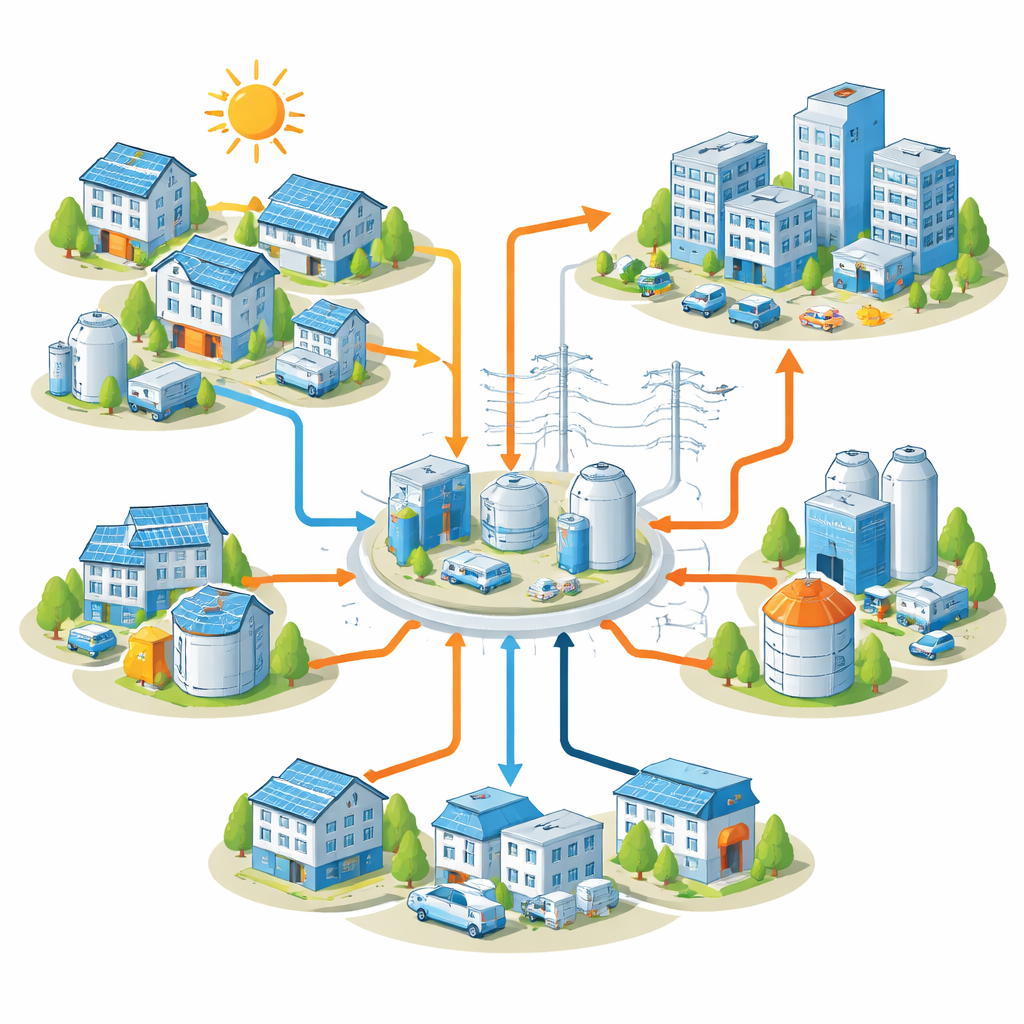
Traditional power systems were built around a few big plants sending electricity one way to passive consumers. Today, countless smaller actors—such as building owners, communities, and companies—own solar panels, batteries, and devices that turn electricity into hydrogen or heat. These actors do not just consume; they also produce and trade. The authors focus on this new "multi-energy" world, where choices in one area, like electricity, ripple into others, like hydrogen supply or district heating. They argue that existing planning tools, which assume a single central planner with perfect information, are no longer enough when many self-interested players are bidding in several markets at once under uncertain sunshine and prices.
Letting agents play a fair game
To capture this complexity, the study frames the interactions as a game between many agents and a market operator. Each agent can sell electricity, hydrogen, and heat, or shift energy between these forms using devices such as batteries, electrolyzers, and boilers. At the same time, an independent system operator must ensure the physical network remains safe and balanced. The authors use a structure known as a Stackelberg–Nash game: the operator acts as a leader enforcing grid and market rules, while the agents act as followers who respond by choosing bids that maximize their own profits. Because sun and demand are uncertain, the agents plan not for a single future, but for a set of possible scenarios that unfold over time.
Planning for many possible futures
Instead of relying on a single forecast, the model represents uncertainty using a scenario tree—a branching set of plausible paths for solar output, demand, and prices over the day. Each agent crafts a bidding strategy that stretches across time and across these branches, choosing how much to offer in each market, when to charge or discharge batteries, and when to convert electricity into hydrogen or heat. The framework includes penalties for wasting solar energy, for inefficient conversions, and for failing to match promised deliveries. This encourages agents to use their flexible assets wisely, smoothing out the ups and downs of solar power while still chasing profit opportunities.
What happens when many flexible players interact
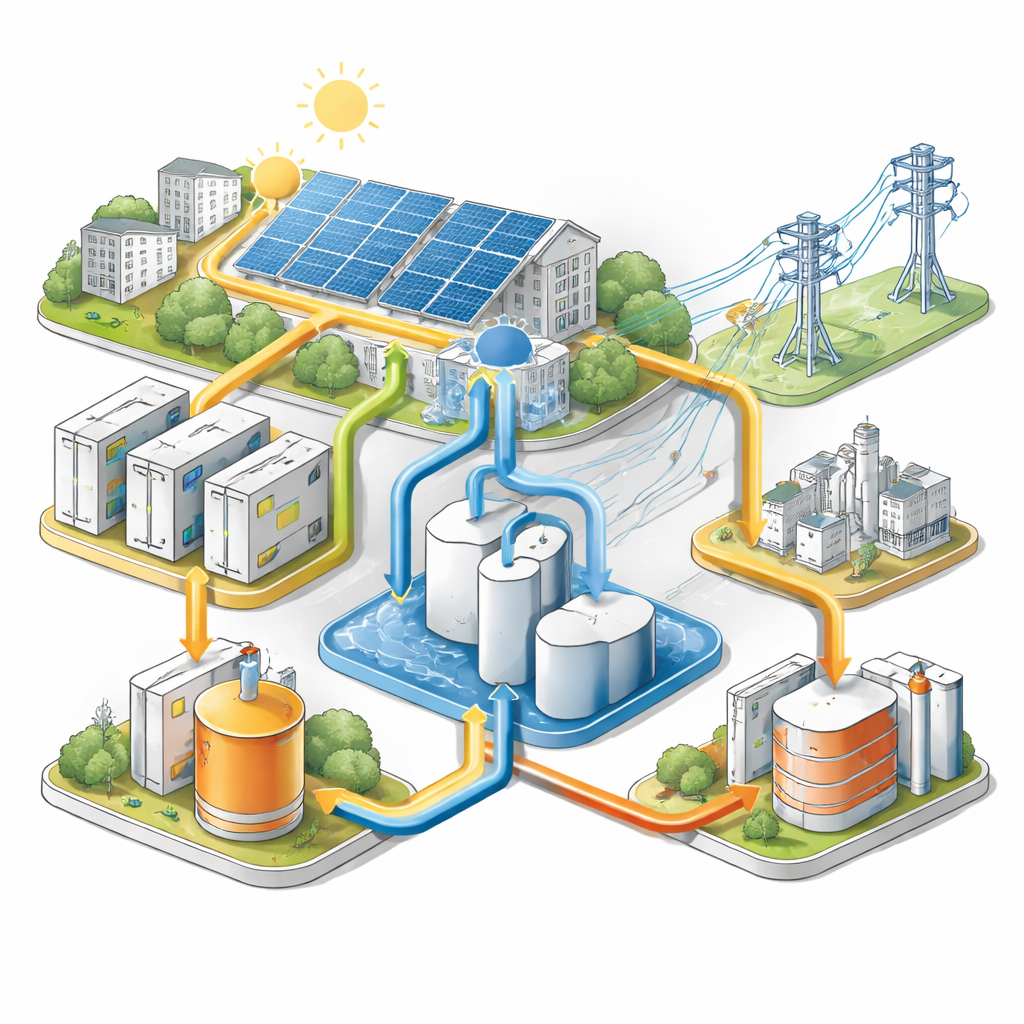
The authors test their framework on a standard benchmark distribution network populated with several different agents. Some own large solar and battery systems; others have stronger hydrogen or heat facilities. The simulations show that when agents can shift energy between markets and over time, they become more resilient to solar swings and price shocks. Profits are more stable, fewer bids are rejected, and less energy is wasted. Agents with well-balanced portfolios—mixing storage with conversion devices—emerge as especially effective at arbitrage, helping to stabilize prices and acting as bridges between energy sectors. Meanwhile, the overall system needs fewer costly reserves to handle uncertainty, yet reliability is maintained or improved.
What this means for future energy markets
For non-specialists, the main conclusion is that smart coordination rules and flexible technology can turn the challenge of variable solar power into an advantage. By treating bidding as a structured game under uncertainty, this framework shows how many independent players can both compete and cooperate across electricity, hydrogen, and heat. When markets are designed to recognize conversions and storage, the system uses more of the available renewable energy, spends less on backup, and spreads economic benefits more evenly among participants. In short, the paper points toward future market designs where solar-heavy, multi-energy systems are not just technically feasible, but also efficient, fair, and robust.
Citation: Qiao, H., Wen, S., Zhang, Y. et al. Spatiotemporal bidding for multi-energy systems with photovoltaic dominance: a scenario-based Stackelberg–Nash game formulation. Sci Rep 16, 14362 (2026). https://doi.org/10.1038/s41598-026-41892-7
Keywords: multi-energy markets, photovoltaic integration, strategic bidding, hydrogen and heat coupling, energy storage flexibility