Clear Sky Science · en
Comparative effects of reactive and planned agility training on physical performance, internal load and enjoyment in youth soccer players
Why quick thinking on the field matters
For many parents, coaches, and young players, soccer training still means sprints, cone drills, and endless laps. But modern matches demand more than straight-line speed: players must read the game, react to opponents, and change direction in a split second. This study asks a practical question with real relevance for youth soccer: when time and training volume are limited during the season, is it better to focus on traditional pre-planned agility drills, or on more game-like, reactive exercises that force players to respond to unexpected cues? And how do these choices affect performance, effort, and—crucially—enjoyment?
Two ways to train quick feet and quick minds
The researchers worked with 18 under-16 male soccer players from the same club and randomly split them into two groups for an 8-week in-season program. Both groups kept their usual four team practices and weekly match, but added two short agility sessions per week that were carefully matched for total work, rest, and movement patterns. One group performed planned agility drills, such as fixed changes of direction through cones and hurdles, where the path was known in advance. The other group did reactive agility drills using light-based cues: instead of following a preset route, players had to read sudden visual signals and instantly cut left or right, sometimes with a ball at their feet. 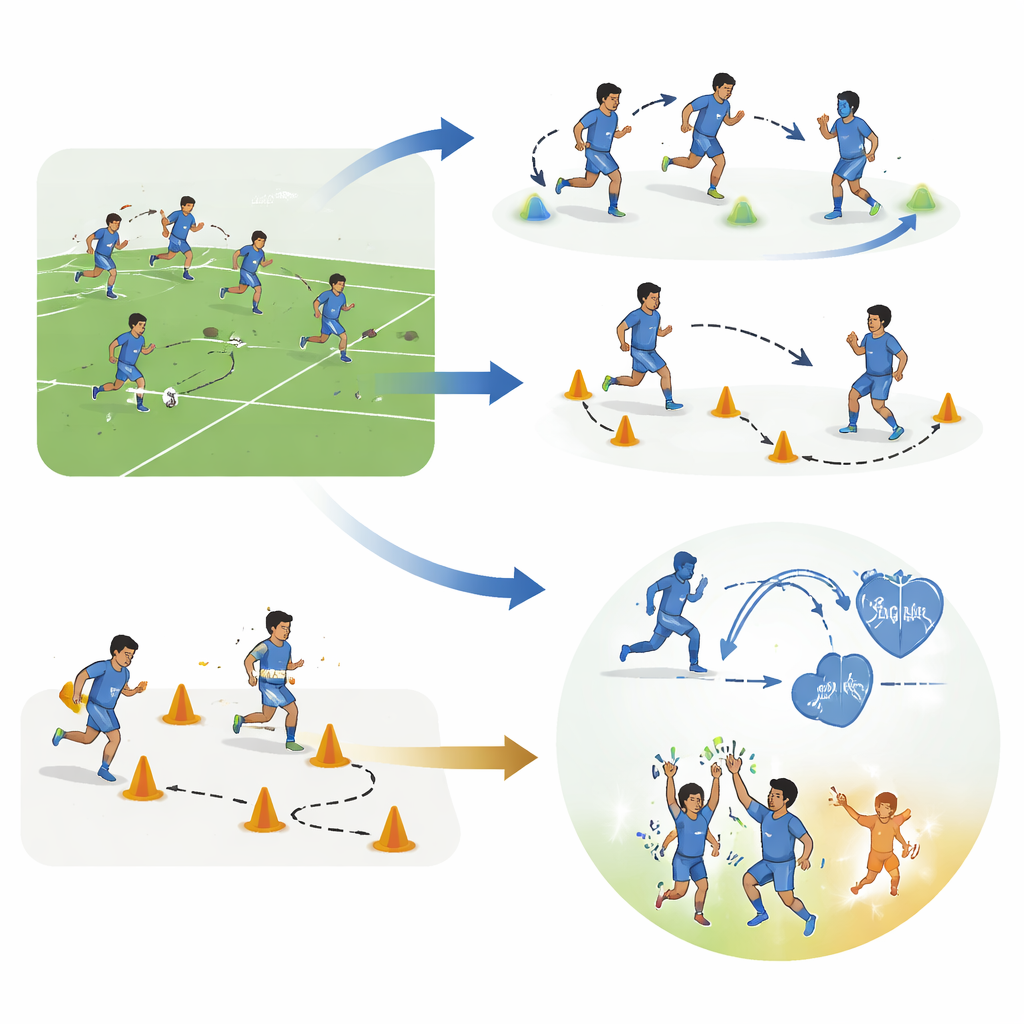
How performance and effort were put to the test
Before and after the 8-week period, all players completed a comprehensive set of field tests. These covered straight-line sprints over 10 and 20 meters, change-of-direction runs with and without the ball, reactive agility tests that mimicked game-like unpredictability (again, with and without the ball), vertical jumps, dynamic balance, and a shuttle run to gauge endurance. Throughout the intervention, players also rated how hard each agility session felt using a standard exertion scale, and how much they enjoyed the sessions using a well-known enjoyment questionnaire adapted to their language. This design allowed the team to compare not just physical changes, but also how tolerable and engaging each style of training was for the teenagers.
Shared gains in fitness, but a clear edge in reacting fast
Both training approaches worked well for building general physical qualities. Over eight weeks, players in both groups became faster over 10 and 20 meters, improved their change-of-direction times with and without the ball, jumped higher, balanced better, and showed higher estimated aerobic fitness. In other words, when the total amount and intensity of running and cutting were the same, planned and reactive agility drills produced similar improvements in fundamental athletic skills. However, important differences appeared when the tasks required fast decision-making. Only the reactive training group made clearly larger gains in the reactive agility tests, both when running without the ball and when dribbling. These tests required players to read an opponent-like cue and choose the correct direction almost instantly, closely mirroring real match situations. The reactive group ended the study about two to three percent faster than the planned group in these game-like tasks, despite doing the same overall volume of work.
Fun factor: why enjoyment may matter as much as speed
Beyond raw performance, the study sheds light on how young players feel about different kinds of training. Session-by-session ratings showed that both groups experienced similar physical strain—the exercises felt equally hard. Yet, the players in the reactive group consistently reported much higher enjoyment scores than those in the planned group. The unpredictable, “gamified” nature of reacting to lights and changing directions on the fly may have made the drills feel more like play than like repetitive conditioning. While the study did not directly measure psychological mechanisms, the findings suggest that adding uncertainty and decision-making to drills can boost motivation and keep teenagers more engaged without increasing perceived effort. 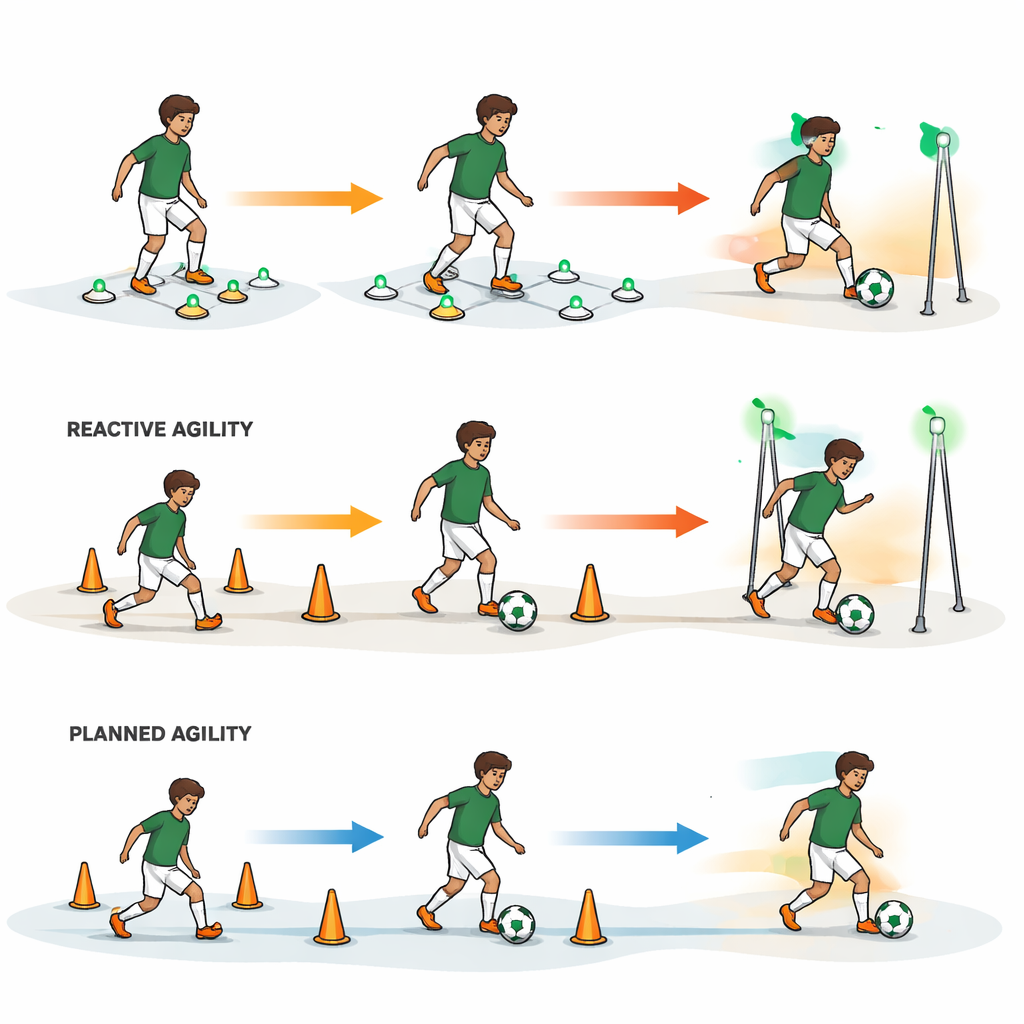
What this means for coaches, parents, and players
To a lay observer, the takeaway is straightforward. Traditional cone drills and pre-planned sprints still have an important role: they build the strength, speed, and technique needed to move efficiently. But when the goal is to help young players react quickly to the chaos of a real match—and to keep them enjoying their training—reactive agility work appears to offer something extra. Short, weekly blocks of cue-based, game-like drills, both with and without the ball, can be layered on top of standard planned exercises to sharpen real-world responsiveness and maintain enthusiasm, all without making sessions feel harder. In practical terms, mixing planned and reactive agility into a weekly routine may give youth players both the physical foundation and the quick-thinking edge that modern soccer demands.
Citation: Doua, N., Marzouki, H., Selmi, O. et al. Comparative effects of reactive and planned agility training on physical performance, internal load and enjoyment in youth soccer players. Sci Rep 16, 11302 (2026). https://doi.org/10.1038/s41598-026-41891-8
Keywords: youth soccer training, reactive agility, change of direction, player enjoyment, in-season conditioning