Clear Sky Science · en
Mitochondrial density and cell area changes in the ciliate Paramecium bursaria under constant darkness: effects of symbiotic Chlorella variabilis and nutrient availability
A Tiny Partnership in the Dark
Many single-celled organisms survive by teaming up with microscopic partners. This study looks at one such alliance between a slipper-shaped freshwater microbe, Paramecium bursaria, and the green algae that live inside it. The researchers asked a simple but important question: when light disappears for a long time and food is scarce, does this partnership help the host cell keep its internal “power stations,” the mitochondria, running—or does the relationship start to fall apart?
The Green Roommates Inside a Single Cell
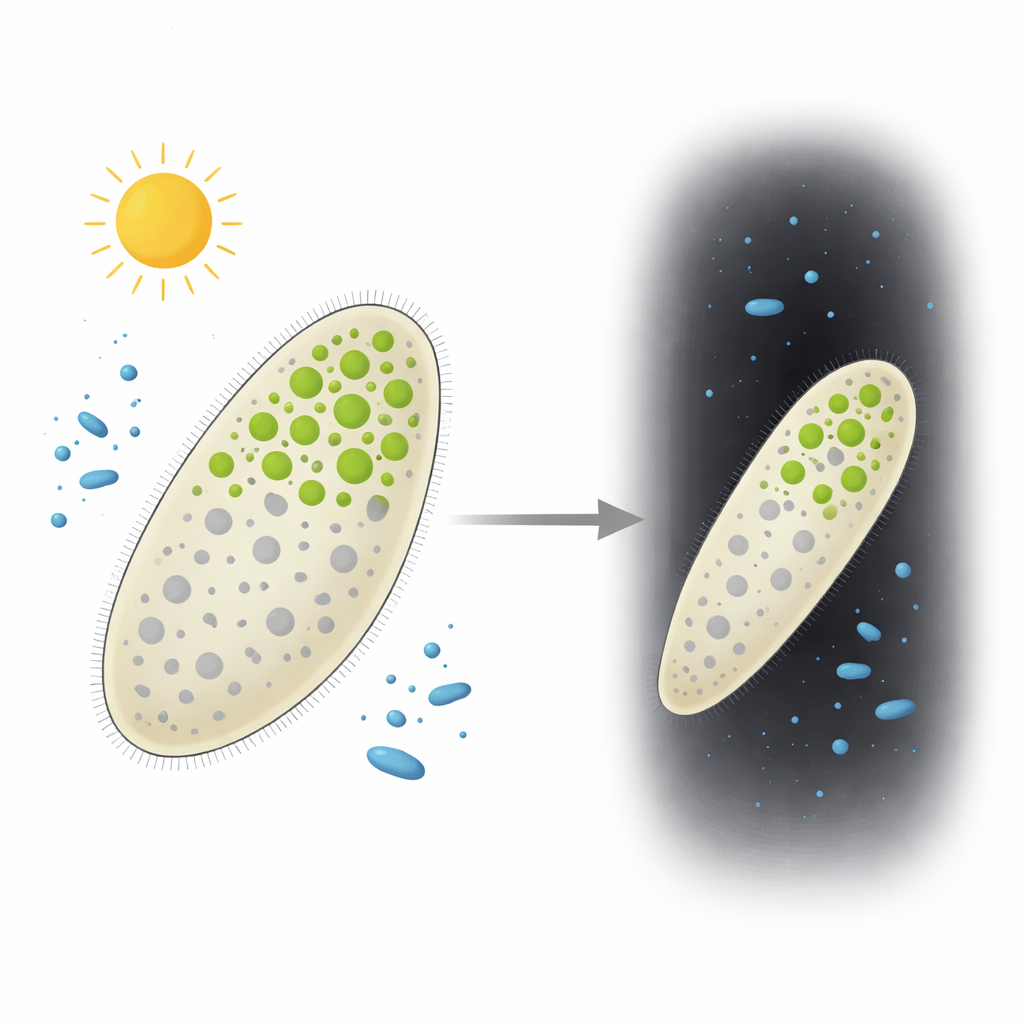
Paramecium bursaria normally houses hundreds of tiny green algae called Chlorella variabilis just beneath its surface. In the light, the algae use photosynthesis to make sugars and oxygen, which they share with the host. In return, the paramecium supplies the algae with nitrogen and carbon dioxide. This exchange allows the partners to thrive together and even helps the host resist infections and endure periods without external food—as long as there is light. But in constant darkness, the algae cannot photosynthesize, and earlier work showed that the host may start digesting them for nutrients. How this affects the host’s own organelles, especially mitochondria, has been unclear.
Putting the Partnership Under Stress
The researchers grew two kinds of paramecia: ones that still carried algae and ones from which the algae had been removed. They then kept both types in unbroken darkness for several weeks, either supplying them with food bacteria (feeding) or withholding food (starvation). To follow what happened inside the cells, they used microscopes and special imaging methods. The density of green algae was estimated from how bright the cell interior appeared under a contrast-enhancing microscope, while mitochondria were labeled with a fluorescent dye that glows where these structures are present. They also measured cell area as a simple indicator of overall health and nutritional status.
What Happens to Algae, Mitochondria, and Cell Size
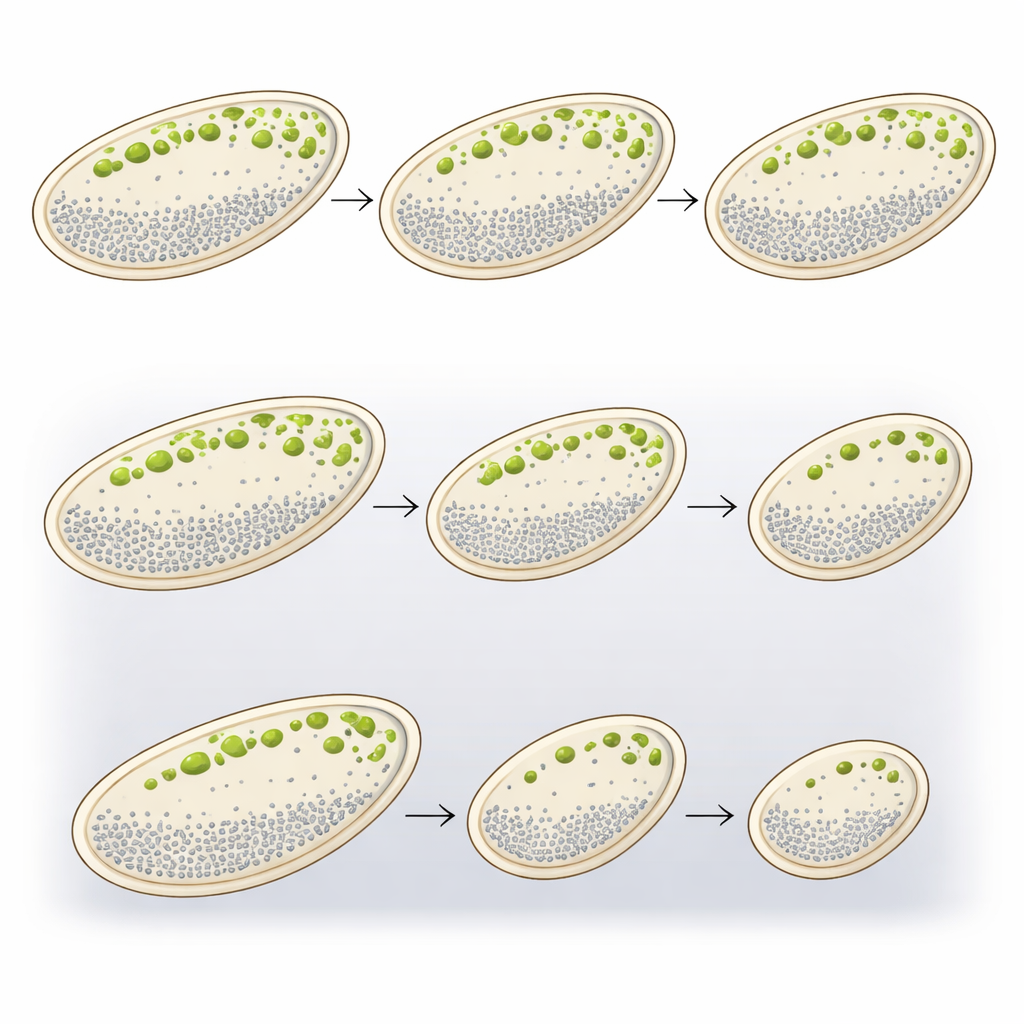
Under starvation in the dark, algae-bearing cells quickly lost their green partners, and their overall cell area shrank significantly. Yet, the brightness of mitochondrial fluorescence stayed largely steady, meaning that the host’s mitochondrial density did not rise to compensate for algal loss, nor did it dramatically collapse in the surviving cells. When food was supplied but light was still absent, the algae gradually disappeared over a longer period, but the host cell area remained larger and mitochondrial density stayed stable. In contrast, cells that started out without algae were more fragile under starvation: their mitochondria declined early on and then partially recovered, while their size fluctuated and many cells died. When these alga-free cells were fed, both cell area and mitochondrial density were maintained or even slightly enhanced.
Why Food Matters More Than Missing Algae
By comparing all these conditions, the study revealed that the number of mitochondria in the host does not simply rebound when symbiotic algae are lost. Instead, the crucial factor for keeping mitochondria and cell size stable was nutrient availability from the outside. Feeding helped both algae-bearing and alga-free cells preserve their internal structure under constant darkness, even as the algal partners were slowly digested or disappeared. Starvation, in contrast, led to strong cell shrinkage and more serious mitochondrial changes, especially in paramecia lacking algae from the start. The close physical connections between algae and host mitochondria likely shape how energy and materials flow between partners, but losing the algae does not automatically trigger a surge in host mitochondria.
What This Means for Life in a Changing World
For a non-specialist, the key message is that this tiny partnership is tougher than it first appears, but it has limits. When light vanishes, the host can digest its algae for a while, yet that alone is not enough to fully protect its own power systems or size; ongoing access to nutrients is still vital. The study shows that the stability of this mutualism depends not only on the presence of the partner but also on the broader environment, especially food supply. Understanding how such microscopic alliances withstand stress helps scientists grasp how larger ecosystems might respond as conditions shift, because these small-scale partnerships form part of the foundation of food webs and nutrient cycles.
Citation: Asari, S., Kodama, Y. Mitochondrial density and cell area changes in the ciliate Paramecium bursaria under constant darkness: effects of symbiotic Chlorella variabilis and nutrient availability. Sci Rep 16, 11279 (2026). https://doi.org/10.1038/s41598-026-41878-5
Keywords: endosymbiosis, Paramecium bursaria, mitochondria, symbiotic algae, nutrient stress