Clear Sky Science · en
Universal empirical scaling of low-temperature heat capacity van Hove signature in classical and quantum cryocrystals
Why cold crystals matter
Most of us think of crystals as pretty but simple solids. Yet when they are cooled to just a few degrees above absolute zero, their atoms vibrate in surprisingly intricate ways that reveal the rules of quantum mechanics. This paper shows that a puzzling bump seen in the low-temperature heat capacity of many different crystals is not a quirk of individual materials, but a universal fingerprint of how vibrations are organized in a solid.
A common bump in many cold solids
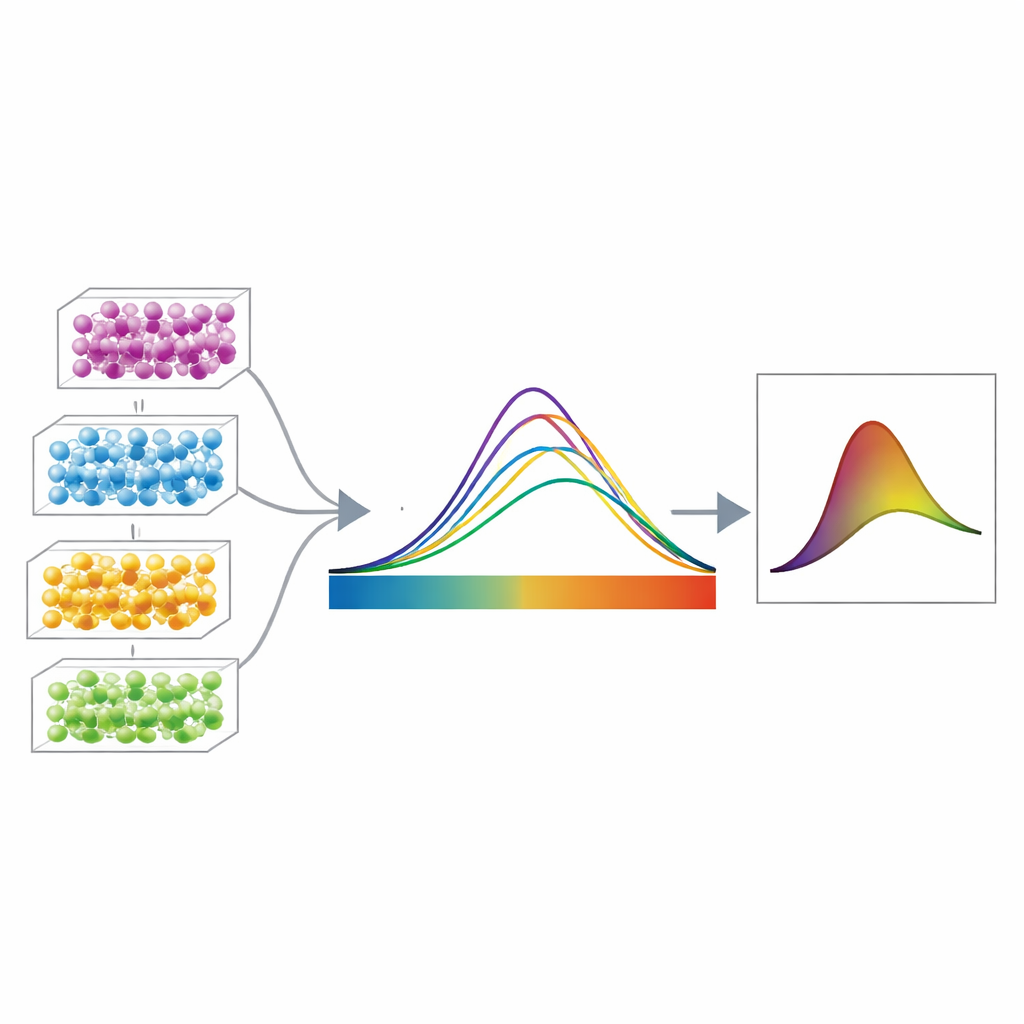
When scientists measure how much heat a crystal can store as it warms from near absolute zero, they often divide the heat capacity by the cube of the temperature. Instead of a smooth curve, they see a distinct hump at a few kelvin in many materials. This feature appears in simple atomic solids made from rare gases like neon and argon, in molecular crystals such as nitrogen and carbon dioxide, and even in strongly quantum solids like helium and hydrogen. Despite decades of measurements, the underlying reason why this hump looks so similar across such different systems has not been fully clear.
The hidden structure of atomic vibrations
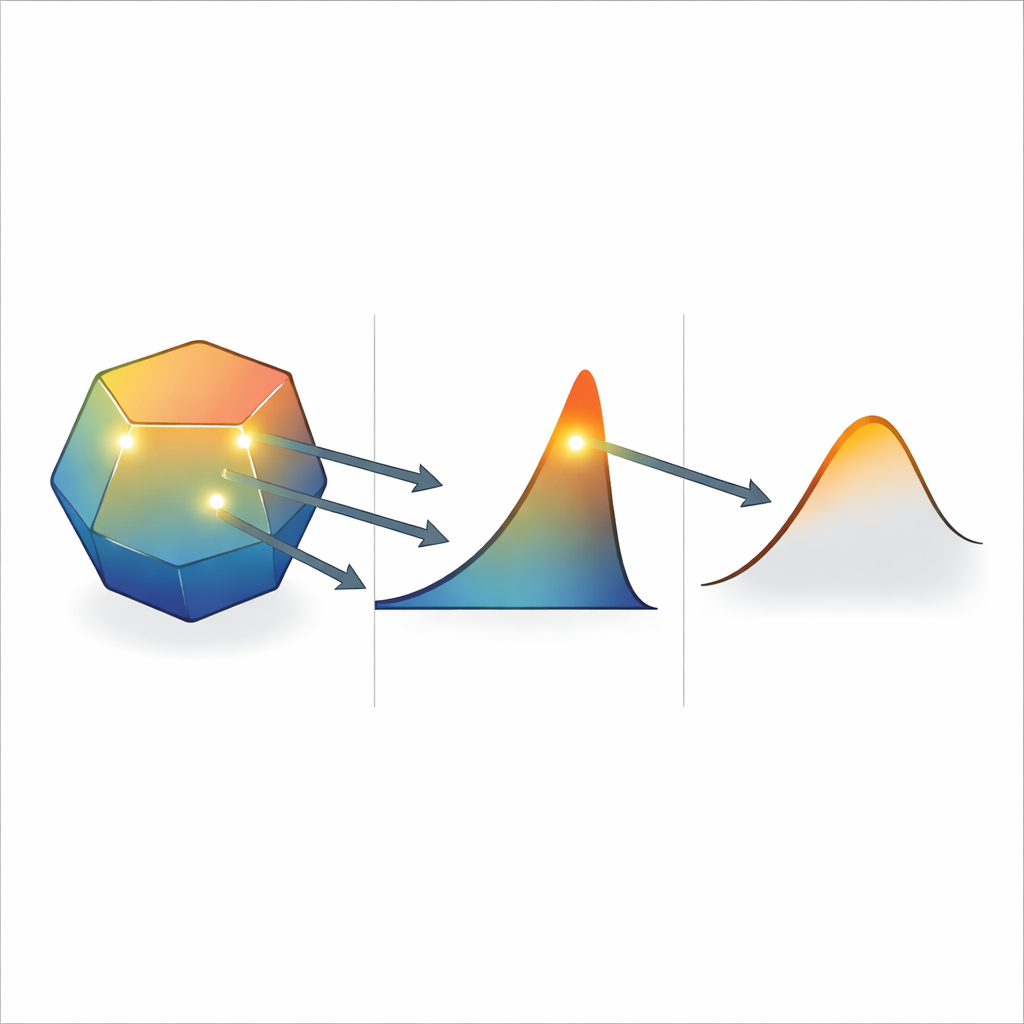
Inside any crystal, heat is carried by quantized vibrations of the atoms, often pictured as waves rippling through the lattice. These waves come in many frequencies, and the pattern of how many vibrations exist at each frequency is called the vibrational spectrum. In real crystals that spectrum is not smooth: there are special frequencies where vibrational waves slow down or pile up because of the crystal’s internal geometry. These accumulation points, known in physics as van Hove features, show up as peaks in the spectrum. The authors show that the low-temperature heat-capacity hump is a direct reflection of the first of these peaks, and that its position and height are tied to how this feature shifts when the crystal is compressed or expanded.
A universal curve that fits many crystals
The key idea of the work is to rescale the heat-capacity data so that differences among materials are factored out. The authors introduce a dimensionless function, called Δ*, that uses only two experimental inputs: the temperature where the hump is highest and the size of that maximum. When the heat-capacity curves of a wide range of crystals are rewritten in terms of this scaled temperature and Δ*, data from neon, argon, krypton, xenon, parahydrogen, and both isotopes of helium all collapse onto nearly the same simple quadratic shape near the hump. A second ratio comparing the basic low-temperature trend to the hump height also turns out to hover around a single value for almost all systems. Together, these findings reveal a striking regularity that does not depend on chemical composition or bonding strength.
Quantum solids still follow the same script
Quantum crystals such as solid helium and hydrogen are extreme cases where atoms are so light and their zero-point motion so large that classical pictures of a rigid lattice begin to fail. In these systems additional effects, like vacancies and strong anharmonic vibrations, distort the details of the heat-capacity curve and make the hump more asymmetric. Yet even here, when the data are properly rescaled, the same universal pattern reappears on the low-temperature side of the hump. The way the hump shifts as the crystal density changes can be described by standard elastic parameters, tying the behavior back to how the overall vibrational frequencies scale with volume.
What this means in simple terms
In everyday language, the authors show that very different cold crystals all “ring” in such a similar way that their ability to store heat near a few kelvin can be summarized by a single master curve. This curve is controlled by a particular crowding of vibrational modes inside the crystal, not by exotic new physics. Even in strongly quantum materials, where atoms fluctuate wildly and defects matter, the same basic vibrational pattern governs the main anomaly. This makes Δ* a practical tool: with only a few measurements, researchers can estimate and compare low-temperature heat capacities across many solids, and more easily spot truly unusual behavior that goes beyond the standard vibrational picture.
Citation: Barabashko, M., Jeżowski, A. & Krivchikov, A. Universal empirical scaling of low-temperature heat capacity van Hove signature in classical and quantum cryocrystals. Sci Rep 16, 12395 (2026). https://doi.org/10.1038/s41598-026-41858-9
Keywords: cryocrystals, low-temperature heat capacity, phonons, van Hove singularity, quantum solids