Clear Sky Science · en
Identifying time-lag effects of temperature and precipitation on vegetation growth variation in the lower Yellow River of east China
Why waiting matters for growing green
When it rains or the air heats up, plants do not respond like a light switch. Instead, they take time to soak up water, adjust to new temperatures and turn that new energy into leaves and growth. This study looks closely at that “waiting time” for vegetation along the lower Yellow River in eastern China, a region that feeds millions of people and acts as an important ecological shield. By figuring out how long it takes plants there to respond to changes in rain and temperature, the authors hope to improve how we predict harvests, manage water and plan for a changing climate. 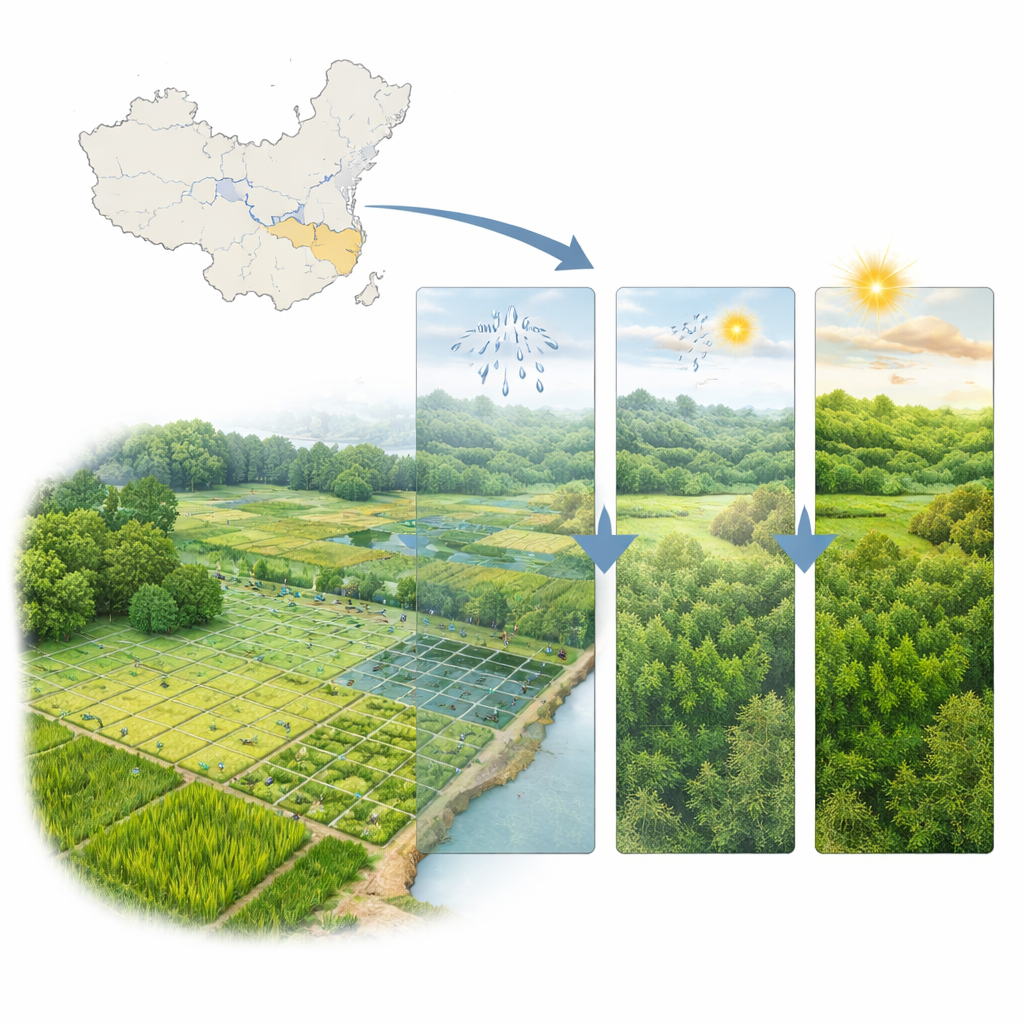
A river plain under climate pressure
The lower Yellow River winds across a broad, flat plain in Shandong Province, where farmland dominates alongside smaller patches of forests, grasslands and wetlands. This region has hot, wet summers and cold, dry winters, and depends heavily on seasonal rains for its crops and natural vegetation. Because the area is both a major grain producer and an ecological buffer against floods and dust storms, understanding how its plants react to shifting weather patterns is crucial for food security and environmental protection.
Watching plant health from space
To track vegetation over time, the researchers used a satellite-derived measure called the Normalized Difference Vegetation Index, or NDVI, which essentially acts as a “greenness” score: higher NDVI means denser, healthier plant cover. They gathered monthly NDVI data from 2001 to 2021, along with matching maps of temperature and rainfall, all at a resolution of one kilometer. Using geographic software, they turned these layers into a grid across nine cities in the lower Yellow River area and applied a suite of statistical tools to ask two key questions for each grid cell: how strongly does plant greenness relate to climate, and how many months does it take plants to respond to changes in temperature and rain? 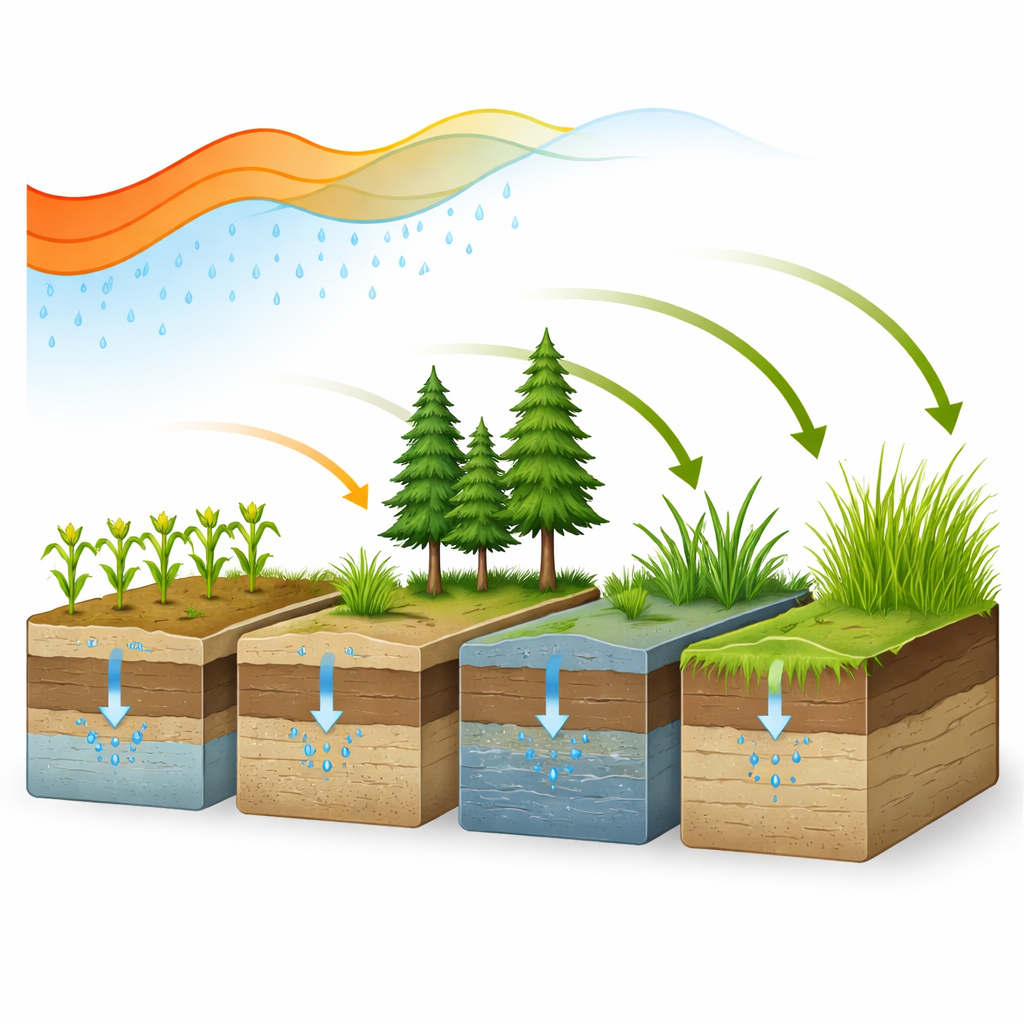
Plants remember past weather
The analysis revealed that vegetation in this region does not respond instantly to the weather of the same month. Instead, greenness during the growing season (roughly May to September) reflects temperature and rainfall from earlier months. For temperature, the most common lag was one to two months; for rainfall, the main delays were one and three months, depending on location. In many places, a burst of rain would influence plant growth not just right away but well into the following months, as water moved through the soil and became accessible to roots. Different vegetation types showed different lag patterns: for example, croplands tended to react more quickly to rainfall, while swamp vegetation and coniferous forests often showed longer delays, likely because of how they store water and manage moisture.
Rain helps, heat can hurt
Beyond timing, the study also examined whether warmer or wetter conditions generally help or hinder plant growth. After carefully separating the overlapping effects of temperature and rainfall, the authors found that, across most of the area, higher rainfall was associated with greener vegetation, while higher temperatures tended to be linked with reduced greenness during the growing season. In other words, water availability is the main driver of healthy vegetation here, while heat often pushes plants toward stress, particularly when it is not matched by enough rain. This pattern held across most vegetation types, with croplands and broadleaf forests especially sensitive to changes in rainfall.
Seeing more clearly by including the delay
When the researchers compared models that ignored time lags to models that explicitly included them, the improvement was striking. Accounting for the delay between climate changes and plant responses increased the ability of temperature and rainfall together to explain vegetation changes by about 129 percent on average. In some vegetation types, such as grasslands, the improvement was even larger. This means that if we only look at climate and vegetation from the same month, we miss much of the true relationship; plants are still reacting to what the weather was like one, two or even three months earlier.
What this means for people and planning
For farmers, water managers and climate planners in the lower Yellow River basin, the study’s take-home message is that vegetation carries a memory of past weather. Rainfall, more than heat, supports healthy growth in this region, and the benefits or harms of a given spell of weather may only become visible weeks or months later. By building these delays into forecasts and management plans, authorities can better time irrigation, anticipate crop performance and design strategies to buffer the landscape against climate extremes. In simple terms, the paper shows that to understand how green the land will be tomorrow, we must pay close attention not only to today’s weather, but also to what happened in the sky a few months ago.
Citation: Lu, X., Xiao, Y., Duan, Y. et al. Identifying time-lag effects of temperature and precipitation on vegetation growth variation in the lower Yellow River of east China. Sci Rep 16, 12524 (2026). https://doi.org/10.1038/s41598-026-41853-0
Keywords: vegetation greenness, Yellow River basin, climate impacts, rainfall and temperature, remote sensing