Clear Sky Science · en
Optimized wheat seed classification using YOLO with morphological image feature enhancement
Why better wheat grading matters
Wheat is a daily food for billions of people, and tiny flaws in individual grains can quietly influence everything from farmers’ income to the quality of bread on the table. Today, most wheat quality checks still rely on people visually inspecting samples by eye, a slow and subjective process that struggles with subtle defects. This paper explores a new, faster way to grade wheat seeds automatically by using smart cameras and algorithms that can see faint cracks, shriveling, and infections that human inspectors often miss.
The problem with looking by hand
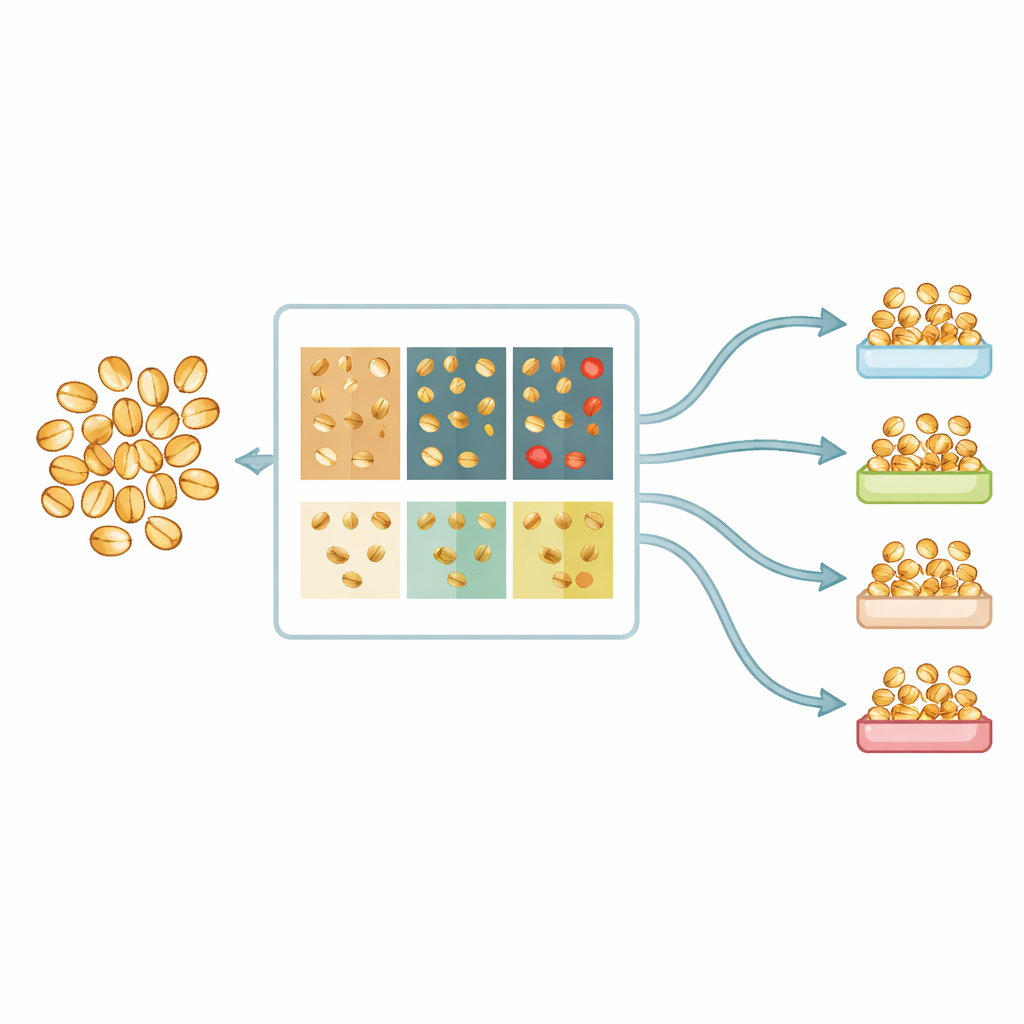
On the surface, one wheat seed looks much like another. Yet small differences in shape, surface smoothness, and tiny cracks distinguish healthy kernels from broken, shriveled, or diseased ones. Under real-world conditions—dim or uneven lighting, dust, overlapping seeds—these details are hard to see, even for trained staff. Earlier computer systems tried to help using simple measurements of size and color, or by training machine-learning models on carefully prepared images. While promising, these systems often failed when seeds were poorly lit, partly hidden, or when defects were very small and low in contrast.
Teaching computers to see fine details
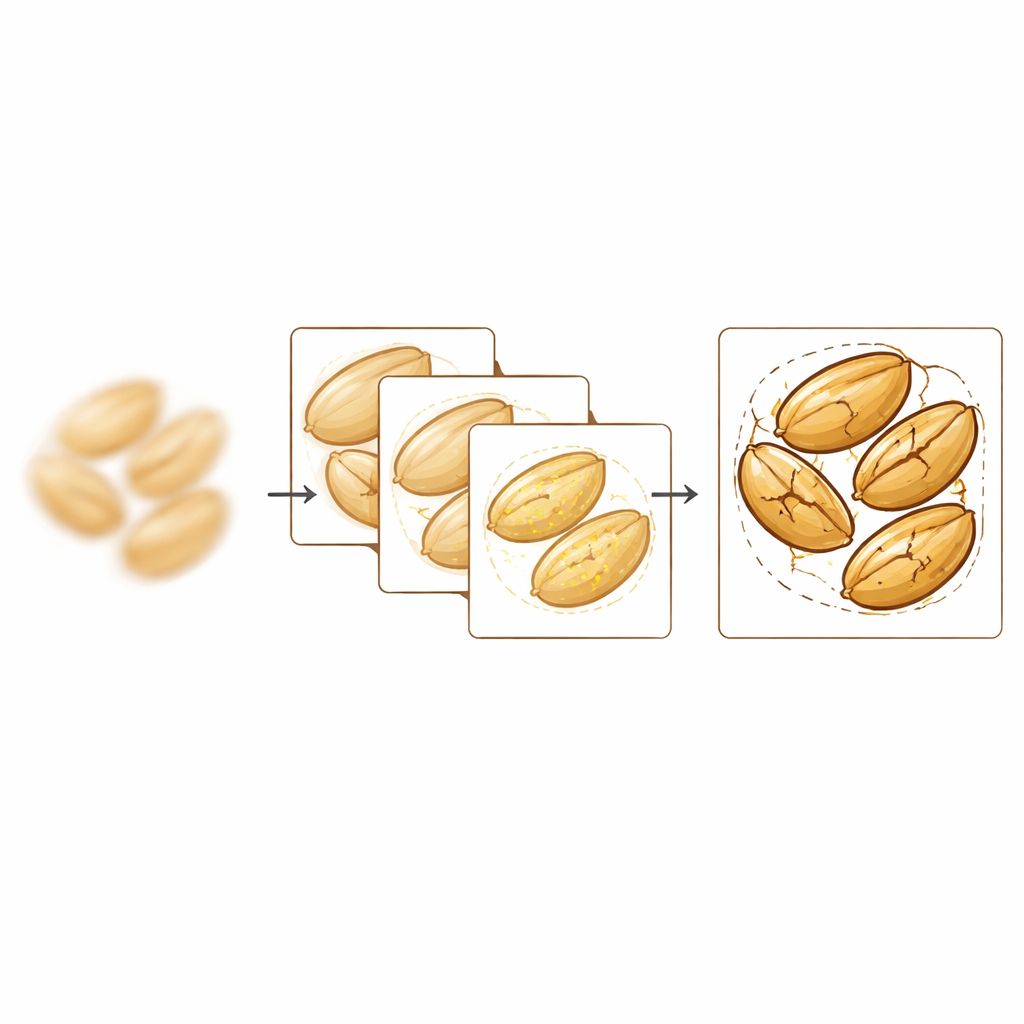
The authors propose an upgraded vision pipeline called Y-MFEP that combines two worlds: classic image cleanup tricks and a modern object-detection engine known as YOLO, which is widely used to spot everyday objects in photos and video. Before the detection step, each image of wheat seeds is passed through a series of operations that subtly reshape how the seeds appear. These operations enhance edges, smooth away noise, fill small gaps, and spotlight tiny bright spots on the kernel surface where cracks, grooves, or fungal spots tend to appear. By carefully tuning the shapes and sizes of these operations to match typical wheat-kernel geometry, the system boosts the visibility of defects without distorting the seeds themselves.
Blending original and enhanced views
Rather than throwing away the original picture, the system fuses it with the enhanced version into a richer multi-channel image. This blended view contains both natural color and texture information as well as sharpened structural cues. YOLO then processes this combined input to locate each individual seed, assess whether it is healthy or defective, and estimate the type and severity of the flaw. Behind the scenes, the detector uses multiple scales to handle small and large grains and a streamlined way of merging feature maps so that the entire process remains fast enough for real-time use on an ordinary computer, without a graphics card.
Putting the system to the test
To understand whether this approach truly helps, the authors compare Y-MFEP with several established methods, including support vector machines, nearest-neighbor classifiers, and an optimized shallow neural network. They evaluate not just overall accuracy, but also how sharply seed edges appear, how reliably defects are spotted, how well each method handles small or overlapping kernels, and how sensitive it is to noise. Across these measures, the new pipeline shows clear gains: it improves edge clarity, detects more defective seeds while keeping false alarms low, and maintains strong performance even when images are noisy or defects are extremely small. Importantly, it achieves processing speeds on the order of a few milliseconds per image, suggesting that it can keep up with high-throughput grain-sorting lines.
What this means for farms and food
For a non-specialist, the takeaway is straightforward: this research delivers a smarter “mechanical eye” for wheat. By teaching a detection network to look at subtly enhanced images, the system can distinguish fit, broken, shriveled, and infected kernels more reliably than many existing tools, and do so at industrial speeds. While the study uses a relatively modest dataset and points to the need for larger collections of real-world images, the results suggest that such hybrid methods can make automated grading both more accurate and more practical. In time, approaches like Y-MFEP could help grain buyers and farmers make fairer, quicker decisions, reduce waste, and ensure that the wheat entering the food chain is consistently high in quality.
Citation: Deepika, B., Shanmugapriya, N. & Gopi, R. Optimized wheat seed classification using YOLO with morphological image feature enhancement. Sci Rep 16, 11448 (2026). https://doi.org/10.1038/s41598-026-41846-z
Keywords: wheat seed quality, computer vision, YOLO detection, image enhancement, automated grain grading