Clear Sky Science · en
A BIM-simulated annealing approach to optimize cost, size, and environmental impact of building water networks
Why smarter water pipes matter
Inside every modern building runs a hidden network of pipes that quietly delivers clean water to taps, showers, and equipment. These water networks are usually designed to keep costs down and meet basic plumbing rules, but their impact on climate and resource use is rarely questioned. This study shows that by combining detailed 3D digital models of buildings with an intelligent search algorithm, engineers can redesign these invisible systems to use less material, cut environmental impact, and still deliver reliable water service.
Hidden costs of everyday plumbing
The construction industry is a major consumer of energy, raw materials, and fresh water worldwide. While many studies have examined the environmental footprint of concrete, steel, and insulation, the pipes that move water inside buildings have received far less attention. Plumbing is often treated as a secondary system, sized with rule-of-thumb tables that prioritize safety and low upfront cost. Yet mechanical, electrical, and plumbing systems can account for a significant share of a building’s embodied carbon, and those impacts grow over decades of operation, maintenance, and replacement. The authors argue that if we want truly sustainable buildings, we must pay closer attention to how we design these internal water networks.
Turning a building into a data-rich model
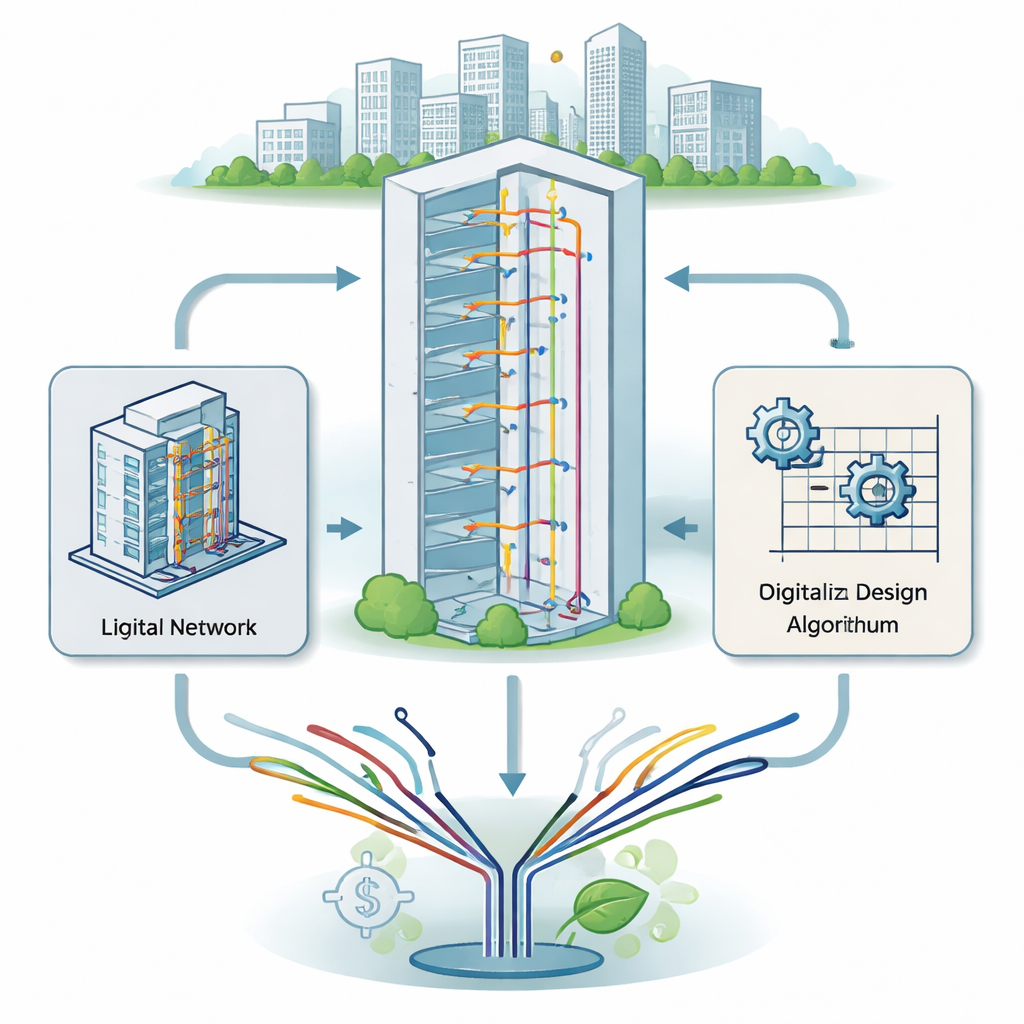
To tackle this challenge, the researchers rely on Building Information Modelling, or BIM—a detailed digital representation of a building that includes the geometry, materials, and properties of each component. In this work, the team used Autodesk Revit to create realistic models of two real buildings in Mexico and the United States, capturing every pipe’s length, diameter, material, and expected flow. They then used custom scripts to automatically extract this information, clean it with Python, and convert it into a structured dataset. This digital pipeline replaces manual spreadsheets and allows the water network to be analyzed and modified repeatedly without redrawing the building each time.
Letting an algorithm search for better pipes
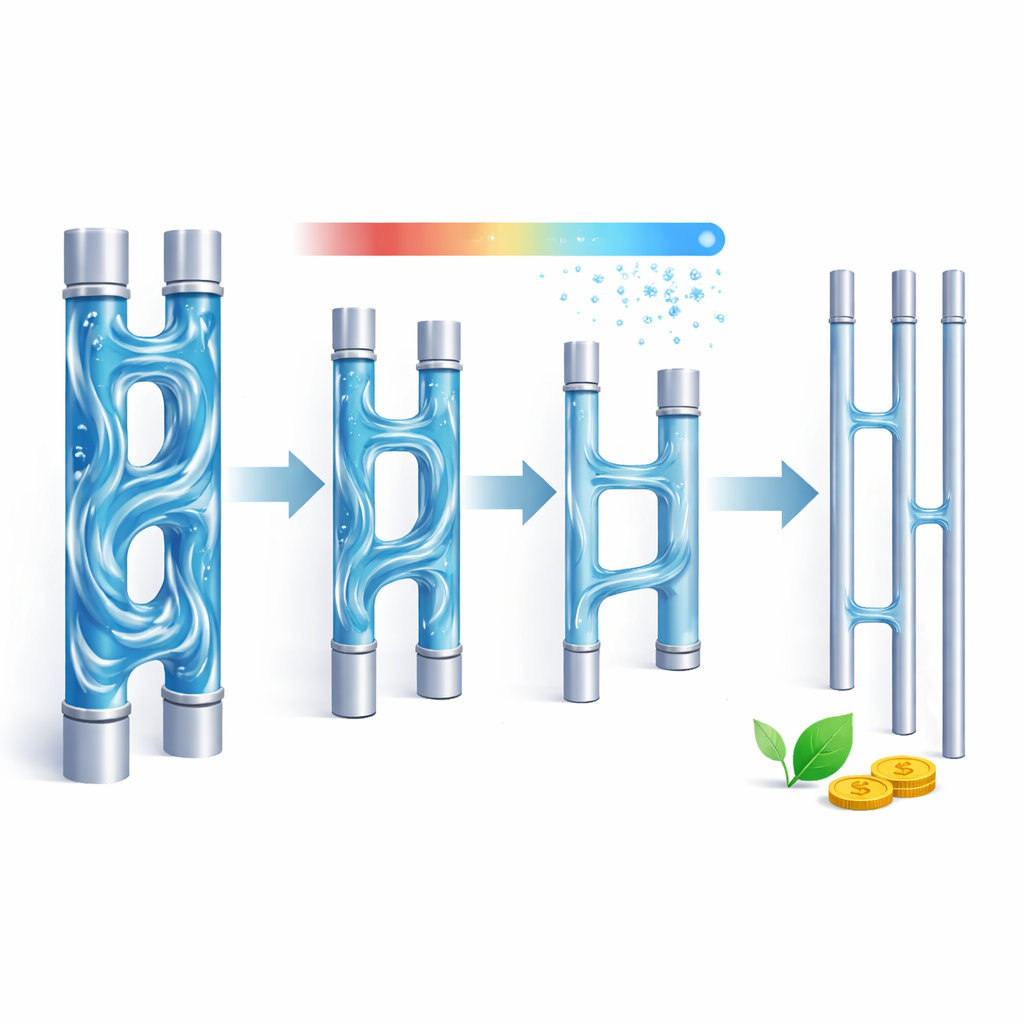
With the digital model prepared, the authors applied a search method known as simulated annealing. Inspired by the way metals are slowly cooled to reach a stable crystal structure, this algorithm explores many different combinations of pipe sizes across the network. Each candidate design is scored using a single objective that blends two competing goals: keeping pipe costs low and reducing environmental impact. Environmental factors include embodied carbon, ease of installation, expected lifespan, ability to be recycled, and resistance to pressure. At the same time, the algorithm checks that water speed and pressure stay within comfortable limits so that taps work properly and noise and energy waste are kept in check.
Testing the approach in real buildings
The framework was tested on two case study buildings: a five-story residential and coworking project in Mexico City with plastic pipes, and a mixed-use development in Pennsylvania with copper pipes. In both cases, the original designs followed standard plumbing methods and used relatively large commercial pipe sizes. When the simulated annealing routine was run, it repeatedly adjusted diameters, penalizing options that caused excessive friction losses or water speeds, and favoring those that balanced performance, cost, and environmental metrics. The optimized solutions typically reduced pipe diameters by one commercial step—and in some cases by two—without violating hydraulic constraints. Across repeated trials, the algorithm reached stable solutions in only a few hundred iterations while using negligible computing power compared with more complex population-based methods such as genetic algorithms or particle swarm optimization.
What the findings reveal about materials and performance
The results also shed light on how different pipe materials behave when cost and environmental criteria are considered together. For the studied conditions, common options like copper and a type of polypropylene plastic often led to oversized systems with higher embodied carbon and material use. A standard plastic pipe used in many buildings showed comparatively lower environmental burdens for the same hydraulic performance, though the authors note that issues such as chemical durability still need careful evaluation. The study emphasizes that practical design is constrained by discrete commercial sizes—engineers cannot simply choose any diameter they want—so even small shifts in the objective function can jump the solution from one standard size to another.
What this means for future buildings
For non-specialists, the main takeaway is that the “right” pipe sizes are not just about making water flow; they also shape how much material we dig from the ground, how much carbon we emit, and how much money we spend over a building’s life. This research shows that by linking rich digital building models with a relatively simple optimization algorithm, designers can automatically find pipe layouts that are cheaper and gentler on the planet while still meeting comfort and safety standards. Although the study focuses on cold-water pipes in two buildings, the same approach could be extended to hot water, drainage, and even future technologies such as custom 3D-printed pipes. In short, smarter digital tools can turn an overlooked part of buildings into an active lever for sustainability.
Citation: Cortez-Lara, P., Sanchez, B. & Barrios-Piña, H.A. A BIM-simulated annealing approach to optimize cost, size, and environmental impact of building water networks. Sci Rep 16, 11345 (2026). https://doi.org/10.1038/s41598-026-41841-4
Keywords: building water networks, BIM optimization, simulated annealing, embodied carbon, sustainable plumbing design