Clear Sky Science · en
Optimization of sporulation of Trametes sanguinea ZHSJ and untargeted metabolomics of spores, mycelium and fruiting body
Why a woodland mushroom matters for medicine
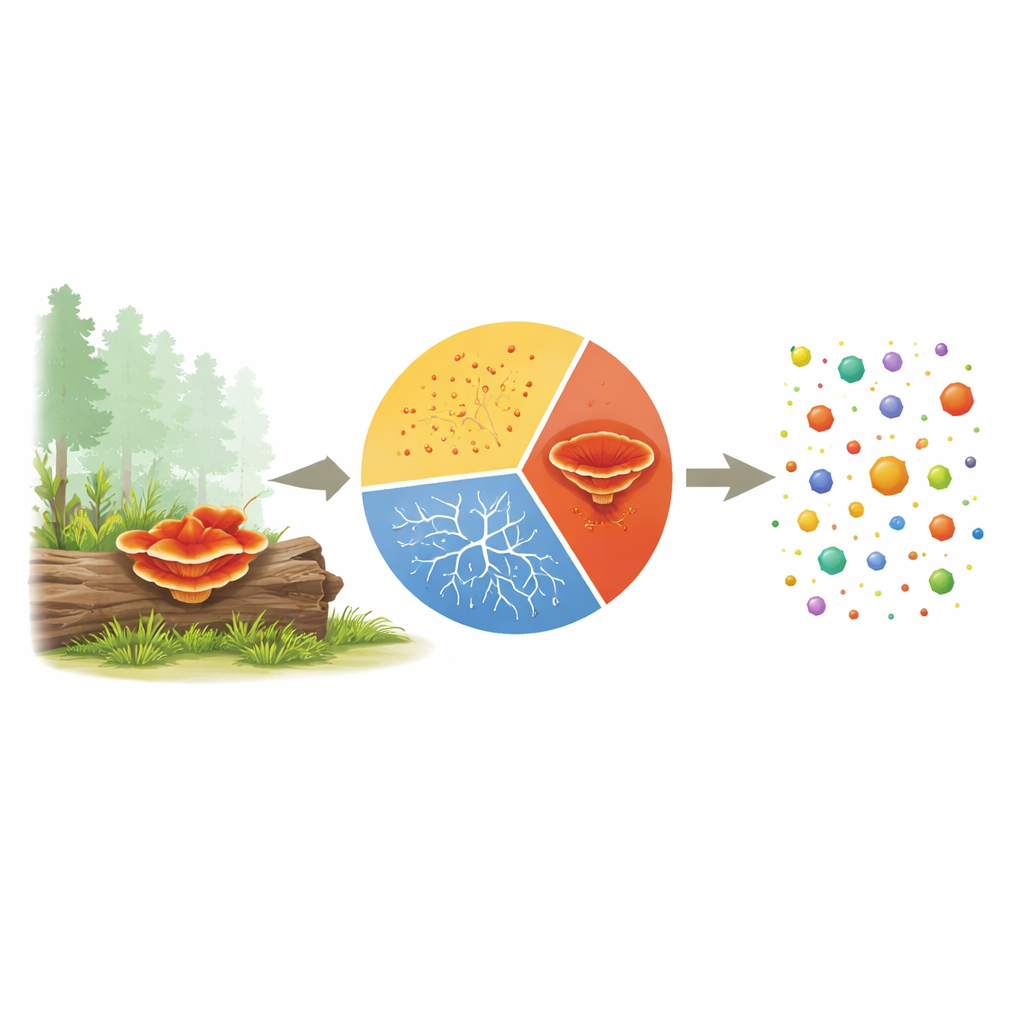
Deep in forest clearings, the bright orange shelves of the fungus Trametes sanguinea cling to fallen logs. Long valued in East Asian cooking and traditional remedies, this mushroom is now drawing scientific attention as a potential source of new drugs. The study summarized here asks a simple but powerful question: what hidden chemistry lies inside its tiny spores, and how does that differ from the better‑studied fuzzy growth (mycelium) and tough fruiting bodies we see on wood?
From wild tree stumps to a lab fungus
Researchers began by collecting wild Trametes sanguinea in a scenic area of Shandong Province, China. In the lab, they carefully cleaned small pieces of the fruiting body and grew them on nutrient gel to obtain a pure strain, named T. sanguinea ZHSJ. They documented its appearance at several scales—from the fan‑shaped caps in the forest to microscopic views of its branching threads and smooth, white spores. DNA sequencing of a standard genetic region confirmed that the isolate indeed belonged to Trametes sanguinea, anchoring the work in both visible traits and genetic identity.
Tuning growth conditions for spore production
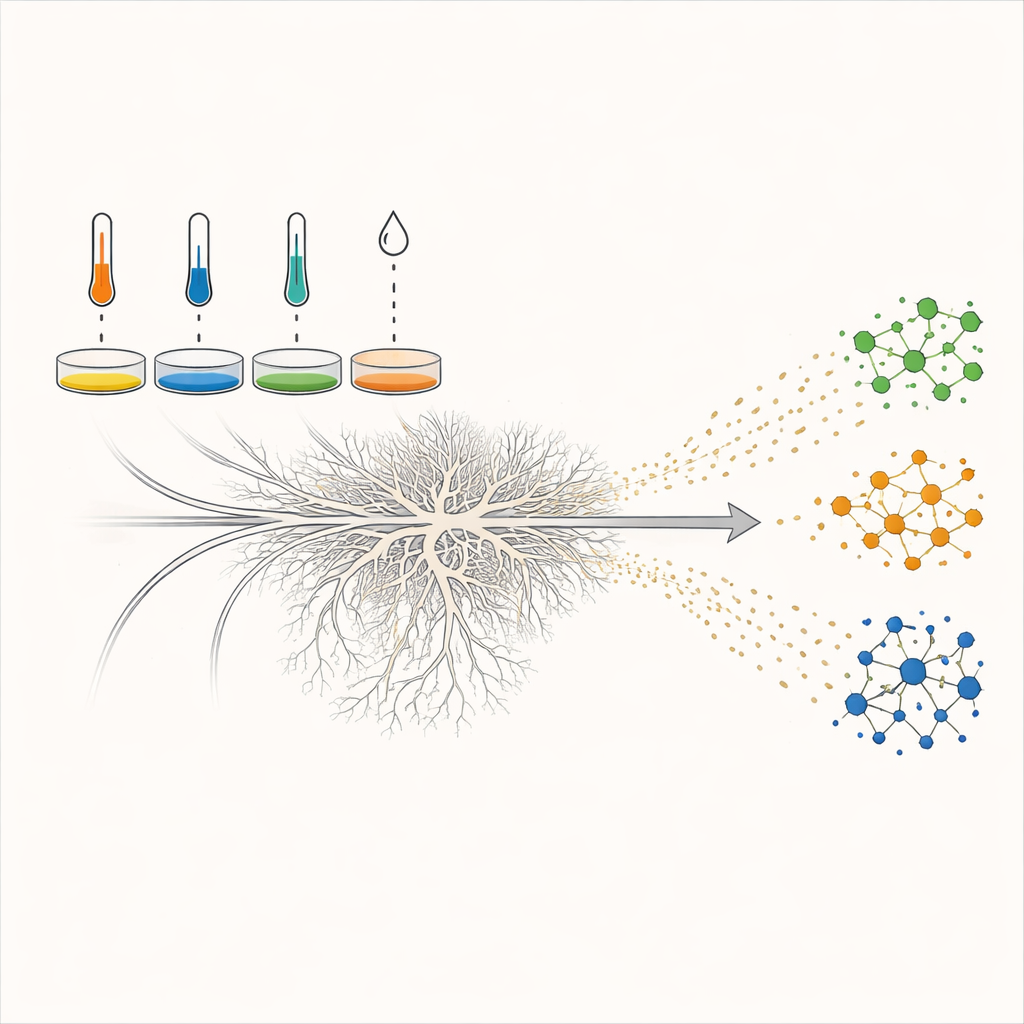
To study spores in bulk, the team first had to persuade the fungus to make them reliably. They tested its growth across a range of acidity (pH 4–8), temperatures (15–37 °C), and food sources. The fungus thrived in slightly acidic conditions: pH 5 produced the largest colonies and the heaviest mycelium. It also preferred warmth, growing best at 30 °C, in line with what is known for many wood‑rotting fungi from temperate regions. Among sugars, maltose at 20 g/L gave the strongest growth, and among nitrogen sources, yeast extract at 4 g/L was ideal. With this recipe, dense orange mycelium spread rapidly and then, as nutrients were used up, switched into spore production.
Collecting and testing living spores
Harvesting spores without damaging them is tricky. Instead of scraping, the researchers used a gentle silicone‑based wash to lift spores from the culture surface in stages, then filtered and freeze‑dried them. They checked that the spores were alive by tracking how cloudy a spore suspension became over time and by watching individual spores under an electron microscope. Within hours, tiny germination tubes emerged and lengthened, and when spores were plated back on nutrient gel they gave rise to new colonies. This confirmed that the collection method produced abundant, viable spores suitable for chemical analysis.
Peeking into the fungus’s chemical toolkit
With spores, mycelium, and fruiting bodies in hand, the team used a powerful technique called untargeted metabolomics. Instead of looking for a few known compounds, they used liquid chromatography coupled to mass spectrometry to detect thousands of small molecules at once, in both positive and negative ion modes. Altogether, they found 6,715 distinct metabolic signals. Statistical tools then mapped how similar or different the three stages were from each other. Spores, mycelium, and fruiting bodies formed clearly separated clusters, showing that each stage has its own characteristic chemical fingerprint. Some 4,098 metabolites were shared, but spores alone contained 124 unique compounds, mycelium 154, and fruiting bodies 252.
Distinct chemistry across life stages
To understand these differences, the researchers grouped metabolites into broad families such as lipids (fat‑like molecules), organic acids, amino‑acid‑related compounds, and nucleic‑acid‑related molecules. All three stages were rich in these categories, but their detailed patterns varied. Further analysis highlighted which molecules were strongly increased or decreased between stages. Many of the key differences involved pathways for making cofactors—helper molecules that support enzymes—and, for comparisons involving the mycelium and fruiting body, pathways related to specialized plant‑like substances called diterpenoids. These shifts suggest that as the fungus moves from growth to reproduction, it rewires its chemistry to deal with stress, survival, and interaction with its environment.
What this means for future medicines
For non‑specialists, the main message is that a familiar shelf fungus hides a sophisticated, stage‑dependent chemical factory. By carefully optimizing how Trametes sanguinea is grown, the researchers were able to produce large numbers of healthy spores and show that these tiny particles contain dozens of metabolites not found in the mushroom’s other forms. Many belong to families already linked to antitumor, antioxidant, antimicrobial, and immune‑modulating effects in related fungi. While this study did not test biological activity directly, it lays the groundwork: the newly mapped spore‑specific chemicals of T. sanguinea are promising leads in the search for future natural medicines.
Citation: Li, Y., Su, Y., Yang, P. et al. Optimization of sporulation of Trametes sanguinea ZHSJ and untargeted metabolomics of spores, mycelium and fruiting body. Sci Rep 16, 11563 (2026). https://doi.org/10.1038/s41598-026-41835-2
Keywords: medicinal mushrooms, fungal spores, metabolomics, natural products, Trametes sanguinea