Clear Sky Science · en
Mapping global bee research with traits and plant-pollinator interaction networks
Why this matters beyond the beehive
Bees are linchpins of both wild nature and our food supply, yet most of what we "know" about them comes from just a few familiar species, especially the European honey bee and common bumblebees. This study asks a surprisingly simple but far-reaching question: are scientists focusing on the bee species that matter most for keeping ecosystems and crops functioning, or mainly on the ones that are easiest to manage and market? The answer has big implications for how well we can protect pollinators, biodiversity, and global food security.
Many bees, few favorites
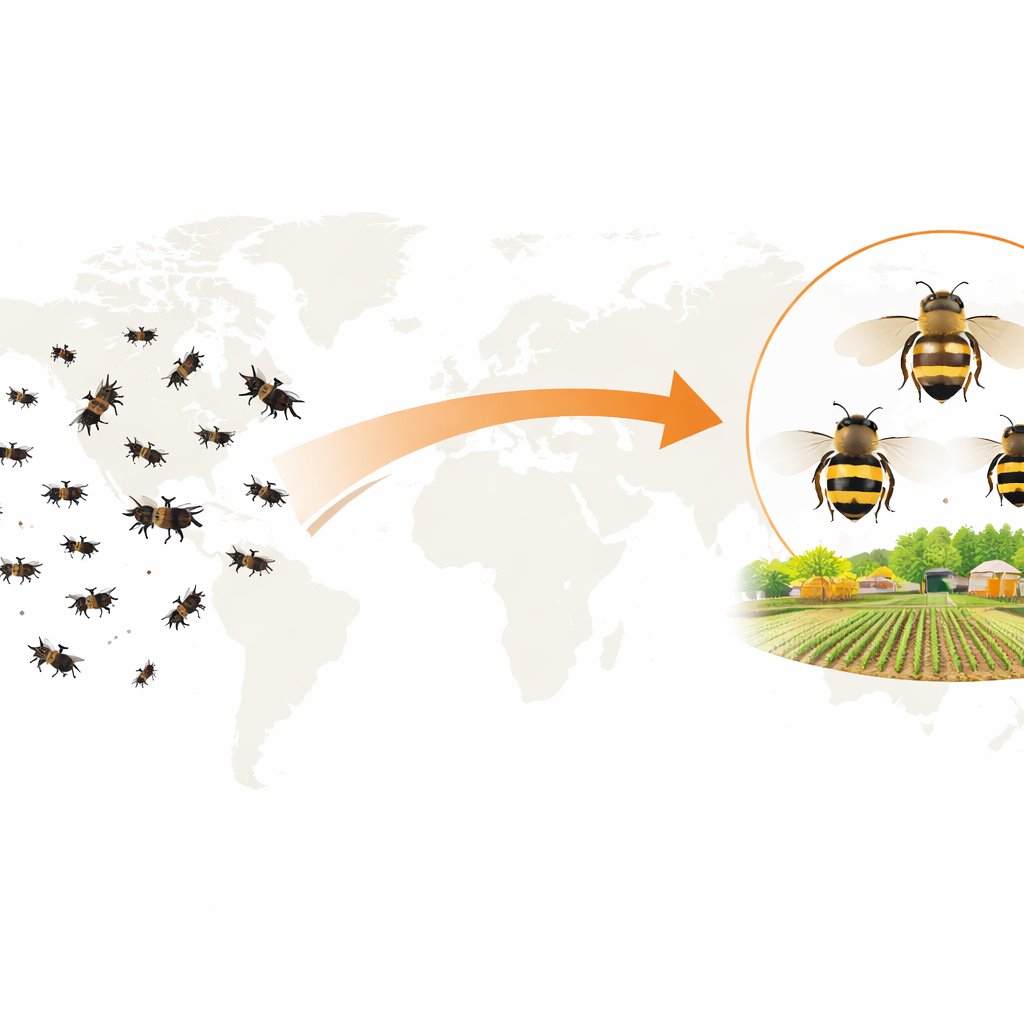
There are more than 20,000 bee species worldwide, but the authors show that research attention is highly skewed. They mined 69,682 bee-related publications from 1975 to 2023 and tracked which bee genera (groups of related species) were mentioned in each paper. Across this enormous record, a tiny group of managed bees dominates. Honey bees (Apis) and bumblebees (Bombus) alone account for the vast majority of work on the most-studied genera, and that dominance has actually intensified over time, even as total bee research has boomed. When the authors adjust for how many species exist in each genus and how interested the public seems to be (using a web-based popularity index), Apis still receives far more papers than expected, while many other genera—some also well known and widely distributed—are under-studied.
Network hubs hiding in plain sight
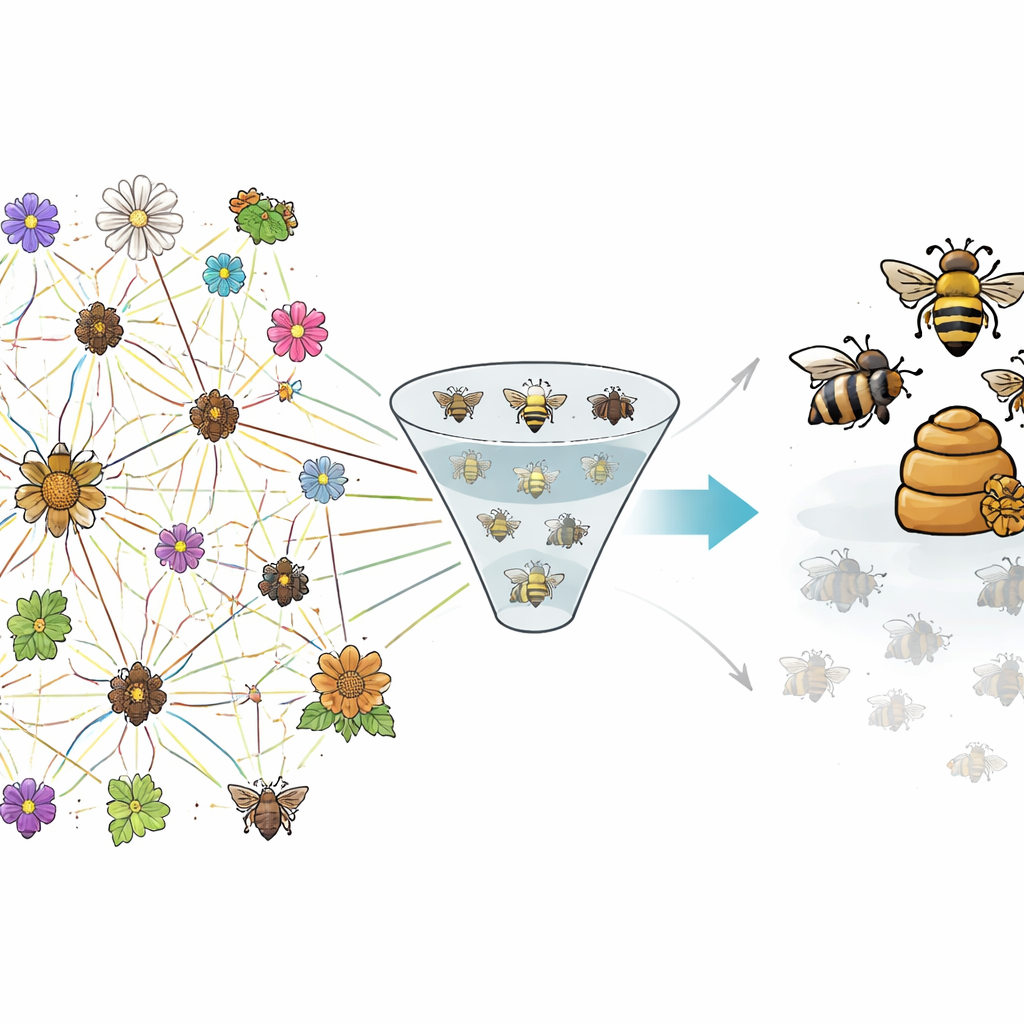
To find out whether this attention matches ecological importance, the researchers turned to maps of who visits which flowers, known as plant–pollinator interaction networks. In these diagrams, bees and plants are nodes linked by visitation records, and a bee’s “centrality” reflects how many different plants it connects to and how strongly those plants depend on it. Species with high centrality can act as hubs that keep pollination services running even when other species decline. By comparing these network roles with publication counts, the authors discovered a disconnect: the bee genera that are most central in these networks are often not the ones that get the most scientific attention. They identify a set of “low-effort, high-centrality” genera—wild lineages that appear structurally crucial in networks but are barely represented in the literature, making them prime targets for future study.
Missing pieces in the trait puzzle
Ecologists also care about bee traits that shape how bees interact with their environment, such as body size (which influences how far they can fly) and tongue length (which flowers they can reach). Here too, the picture is incomplete and biased. Only about 8% of known bee species have measurements for key traits, and those data are far more common for managed bees than for wild ones. When the authors plot species in a two-dimensional “trait space” using body size and tongue length, they find that the under-studied but network-central genera occupy distinct regions—functional types of bees that the field largely overlooks. Even the best-studied cluster of genera covers less trait diversity than random sampling would suggest. In short, research is not just taxonomically narrow; it is functionally narrow, leaving big gaps in our understanding of how different kinds of bees support ecosystems.
How human choices shape the bee bookshelf
What actually predicts whether a genus is well studied? Using statistical models that account for geography, national wealth, and the overall growth of scientific publishing, the study finds that management status is the strongest driver: genera that include managed species receive several times more papers than purely wild genera. Social bees with large colonies, often nesting in cavities, gain attention, while solitary and ground-nesting bees steadily lose share. These patterns persist even when honey bees and bumblebees are removed from the analysis, showing that the bias is not just about two celebrity groups but a broader shift toward bees that are commercially useful, easy to keep in boxes, and culturally charismatic.
Rethinking how we study and protect bees
For non-specialists, the takeaway is that our scientific picture of "bees" is heavily filtered through the lens of a few farmable, familiar species. This matters because conservation policies, pesticide regulations, and risk assessments often rely on data from honey bees or commercial bumblebees and implicitly assume that other bees respond similarly. The study argues that this assumption is shaky: many wild bees occupy different ecological roles, live in different ways, and face different threats, yet we have little data on them. The authors call for funding agencies, researchers, and monitoring programs to deliberately widen their focus—collecting basic trait and interaction data on neglected but network-central genera and on solitary, ground-nesting species worldwide. Doing so would give us a more realistic view of pollinator health and make efforts to safeguard food production and biodiversity more robust.
Citation: Nesbit, M.L., Montauban, C., Windram, F. et al. Mapping global bee research with traits and plant-pollinator interaction networks. Sci Rep 16, 12844 (2026). https://doi.org/10.1038/s41598-026-41830-7
Keywords: bee biodiversity, pollinator conservation, research bias, plant–pollinator networks, wild bees