Clear Sky Science · en
Multi-scale hybrid composites of erythritol/diatomite/GNP for enhanced thermal energy storage: experimental and machine learning optimization
Storing Heat for When We Need It
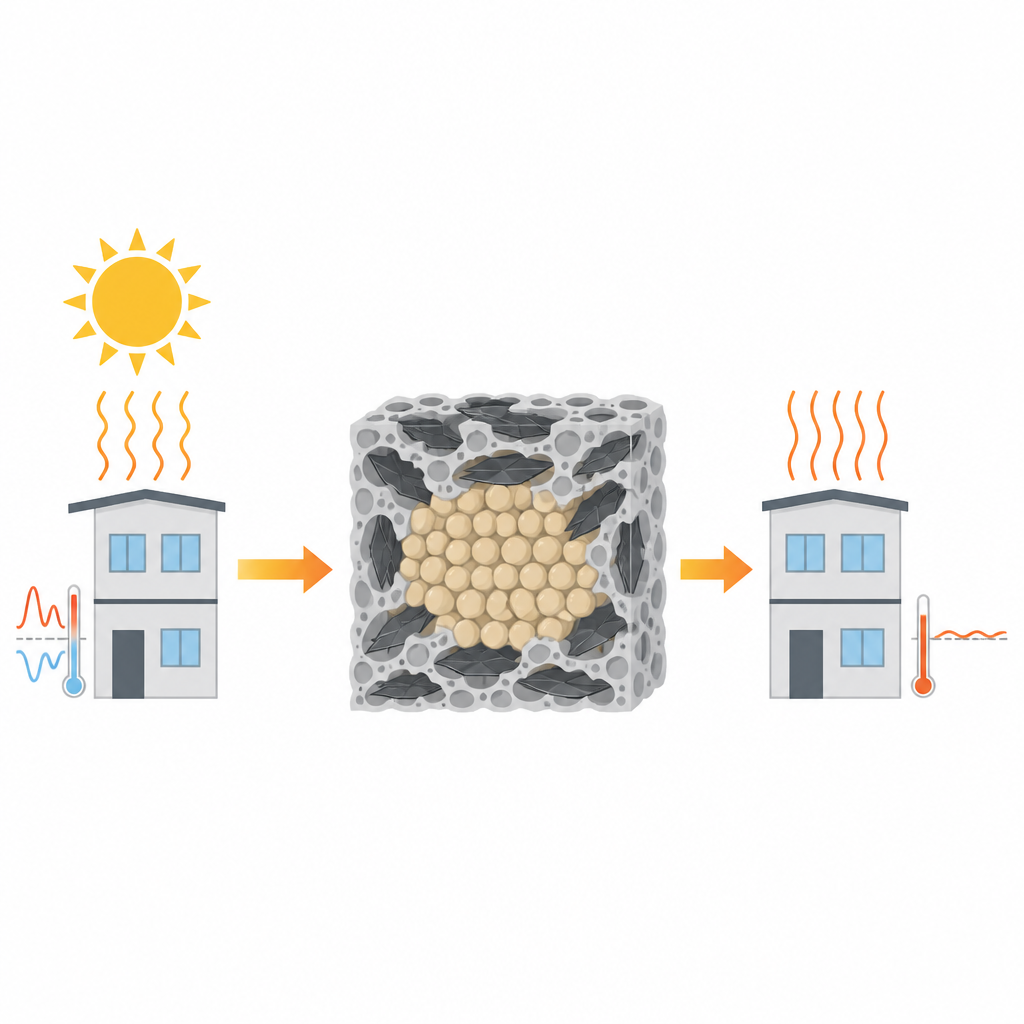
Modern life increasingly depends on energy sources like the sun that do not always shine when we want power. One way to smooth out these ups and downs is to store heat when it is plentiful and release it later. This study explores a new way to build solid blocks that can soak up large amounts of heat, hold their shape as they melt inside, and then give that heat back on demand, helping buildings and devices use energy more efficiently.
A Sweet Material with Hidden Limits
At the heart of the research is erythritol, a familiar sugar substitute that also happens to be very good at storing heat as it melts and solidifies. When it changes from solid to liquid, it absorbs a lot of energy, and when it freezes again, it releases that energy. This makes it attractive for use in heat storage systems that work at moderate temperatures, such as solar water heating or temperature control in buildings. However, pure erythritol conducts heat poorly and tends to leak when it melts, so it cannot simply be poured into a tank and expected to behave.
Turning Powder and Flakes into a Solid Sponge
To tame erythritol’s weaknesses, the team built a kind of mineral sponge. They used diatomite, a naturally occurring, highly porous rock formed from ancient microscopic algae. Its tiny channels act like a rigid framework that can soak up melted erythritol and hold it in place. Under a vacuum, the researchers drew the liquid sugar alcohol into the pores of diatomite, then let the mixture harden into solid pieces. Tests showed that higher diatomite levels greatly improved shape stability at high temperature, cutting mass loss during heating from several percent down to just above one percent, although this extra mineral also reduced how much heat the composite could store per gram.
Graphene Pathways for Faster Heat Flow
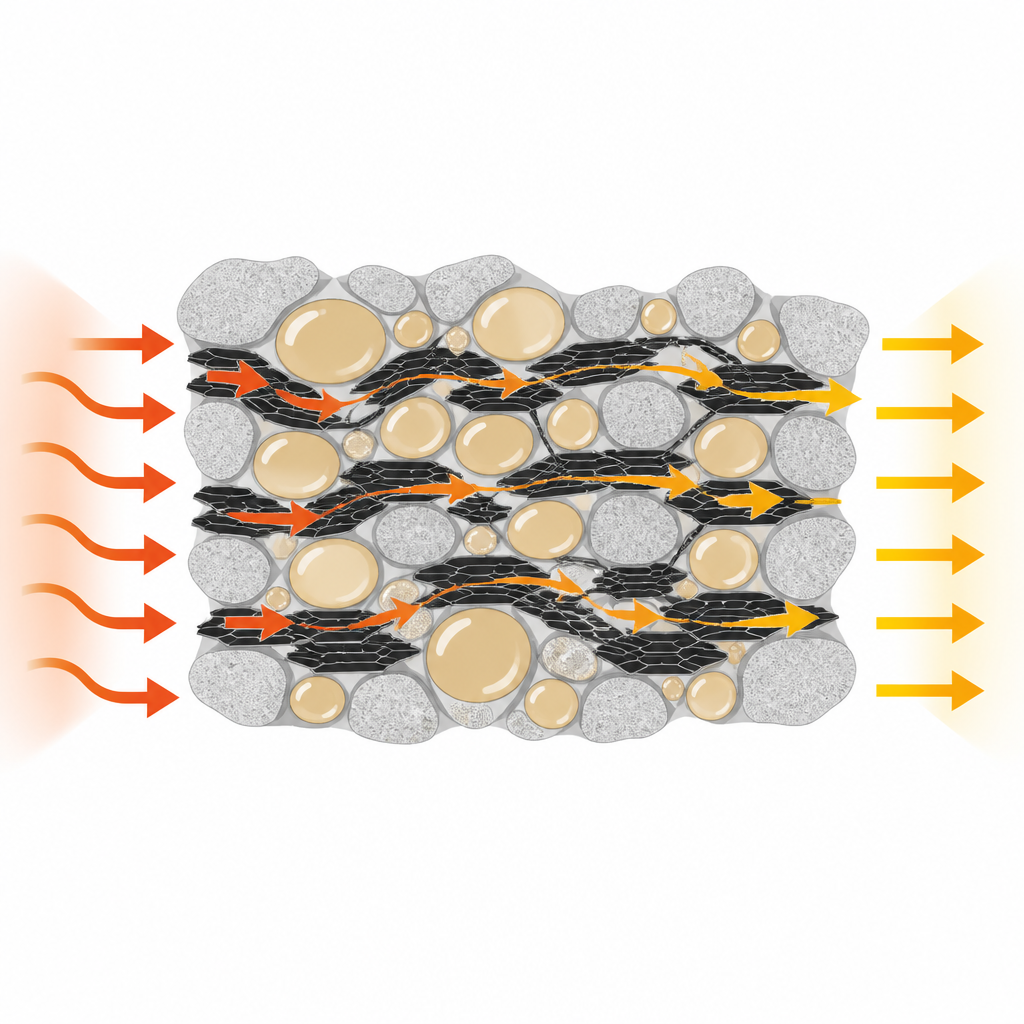
Good storage is not enough if heat cannot move in and out quickly. For this, the team added tiny sheets of carbon called graphene nanoplatelets, known for their excellent ability to carry heat. Scanning electron microscope images revealed thin, plate-like flakes well spread through the diatomite and erythritol mixture, forming continuous paths that help heat move across the material. With only 4 percent graphene by weight and 40 percent diatomite, the composite’s thermal conductivity rose by about 261 percent compared with pure erythritol, reaching values more typical of engineered solids while still keeping the material leak-free during melting.
Letting Algorithms Tune the Recipe
Because more mineral and more graphene do not always mean better performance, the authors turned to computer modeling to find the best recipe. They built two kinds of models: a statistical one that fits a curved surface through the data and a simple artificial neural network that mimics how combinations of inputs affect an output. Using measurements from 27 different mixtures, both models learned how the amounts of graphene and diatomite changed heat flow, and both could predict conductivity for new mixes with high accuracy. This allowed the researchers to map out a practical range of compositions that balance fast heat transfer, good storage capacity, and low weight.
Why This Matters for Everyday Energy Use
The result is a family of solid, leak-free blocks that can store large amounts of heat at mid-range temperatures while moving that heat in and out much more quickly than the base material alone. In plain terms, the study shows how a sugar-like compound, a porous natural rock, and carbon flakes can be combined and tuned with the help of machine learning to build smarter thermal batteries. Such materials could be built into solar heaters, building walls, or thermal tanks to capture warmth when the sun is shining and release it later, helping make future energy systems steadier and more efficient.
Citation: Nassar, A., Nassar, E., Rivilla, I. et al. Multi-scale hybrid composites of erythritol/diatomite/GNP for enhanced thermal energy storage: experimental and machine learning optimization. Sci Rep 16, 15458 (2026). https://doi.org/10.1038/s41598-026-41825-4
Keywords: thermal energy storage, phase change materials, erythritol composite, graphene nanoplatelets, machine learning optimization