Clear Sky Science · en
Quantum inspired feature engineering for explainable EEG signal classification
Listening to the Brain with New Eyes
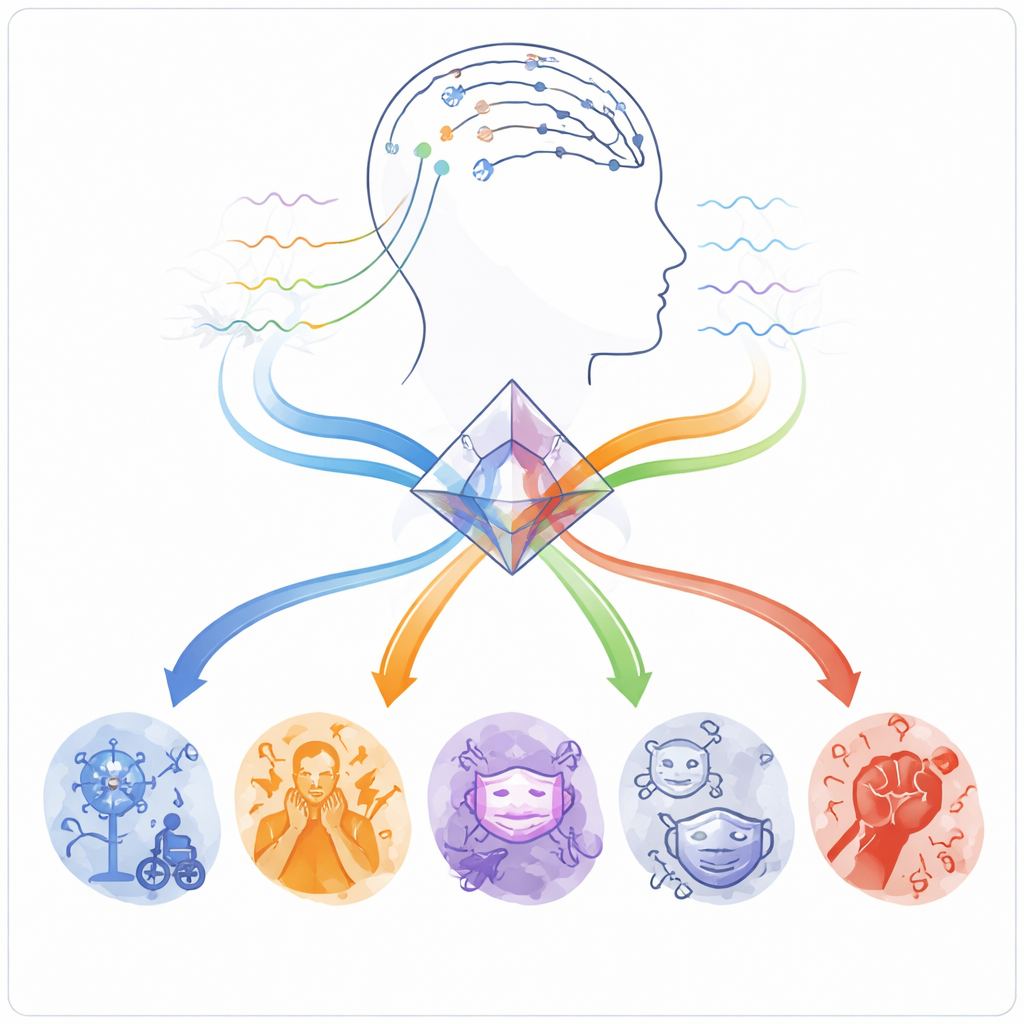
Doctors and researchers increasingly rely on electroencephalography (EEG) to monitor brain health, from epilepsy and stress to severe disorders like amyotrophic lateral sclerosis (ALS) and psychosis. But EEG recordings are messy, complex, and hard to interpret, which limits how quickly and reliably they can guide real-world decisions. This paper introduces a new, lightweight way to read EEG patterns that borrows ideas from quantum physics and still explains what is happening in the brain, offering a potential path to faster, more transparent brain diagnostics.
Why Brainwaves Are Hard to Read
EEG measures tiny electrical signals from many points on the scalp. These signals change from moment to moment, are easily contaminated by eye blinks and muscle movements, and differ widely between people. Modern deep learning systems can classify such data with high accuracy, but often require large datasets, powerful computers, and behave like black boxes, giving little insight into why they reached a decision. For medical use, however, clinicians need both strong performance and clear, biologically meaningful explanations—especially when diagnosing serious conditions such as epilepsy, ALS, stress-related problems, or psychotic disorders.
A Quantum-Inspired View of Brain Activity
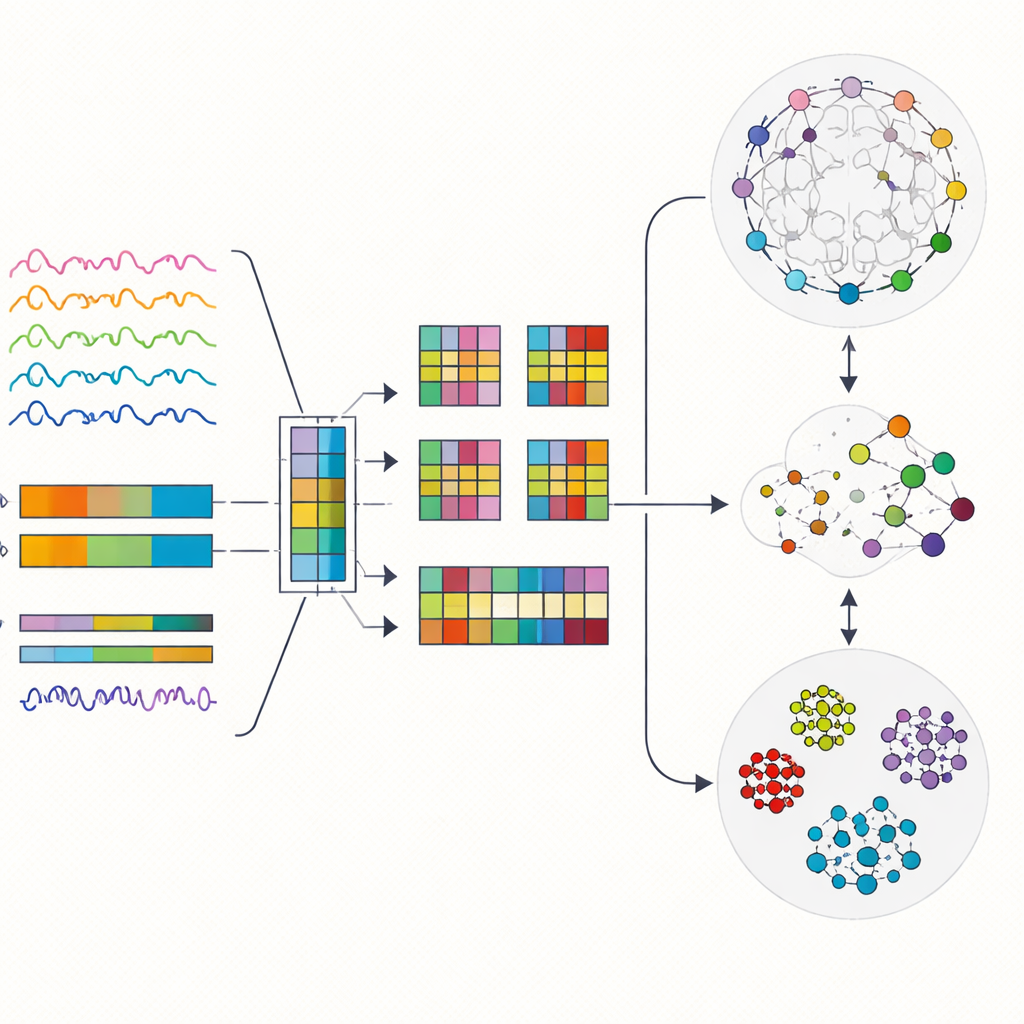
The authors propose a fresh way of extracting information from EEG signals called the Quantum Entangled Particle Pattern (QEPP). Rather than treating each EEG channel separately, QEPP takes pairs of channels and also looks at the difference between them, echoing how "entangled" particles in quantum mechanics are defined by their joint state, not by each one alone. These three signals—the two originals and their difference—are then transformed by reordering their values, emphasizing how they relate to each other rather than their exact amplitudes. A second step, called the Sequential and Combinational Transition Table, counts how these reordered states change over time and across pairs, building compact features that summarize the cooperation and competition of brain regions. This design is meant to capture complex, network-like behavior in the brain without needing heavy deep learning models.
From Features to Decisions and Explanations
To turn these quantum-inspired features into practical decisions, the authors wrap QEPP inside an explainable feature engineering framework. First, an automatic selector called CWINCA searches for the most informative features by iteratively testing subsets and keeping those that best separate clinical groups. Next, a tuned k-nearest neighbor classifier (tkNN) experiments with different distance measures and settings, then chooses the configuration that gives the most accurate predictions. Crucially, the method also tracks which EEG channels contribute to the selected features and maps them onto symbolic regions of the brain, such as frontal, temporal, or occipital lobes. Using a symbolic scheme called Directed Lobish, the system builds simple “sentences” and connectome diagrams that show which lobes most strongly participate in each task, along with measures of how complex or predictable the resulting patterns are.
Putting the Method to the Test
The researchers evaluated their framework on six very different EEG problems: detecting ALS, removing artifacts, recognizing stress, distinguishing violence-related brain states, identifying psychosis, and classifying epilepsy. These datasets vary in size, number of channels, and class balance, providing a tough test of generality. Using ten-fold cross-validation, the model exceeded 90% accuracy on all six tasks and reached 100% on four of them (stress, violence, psychosis, and epilepsy), while maintaining strong performance even when tested in stricter subject-wise schemes. Comparisons with traditional wavelet, connectivity, and time–frequency features showed that QEPP’s features were consistently more informative. Against deep learning baselines, the new method achieved similar or better accuracy with far less computation time and memory, and it can run comfortably on an ordinary desktop computer.
What the Brain Maps Reveal
The interpretability layer reveals patterns that align with current neuroscientific knowledge. For ALS detection, central and frontal regions associated with movement and planning are heavily involved, hinting at both motor degeneration and compensatory control. In stress detection, right frontal areas dominate, consistent with emotional regulation and executive control. Violence-related signals engage frontal, parietal, and occipital areas together, reflecting combined decision-making, sensory processing, and visual attention. Psychosis shows the most complex and widely dispersed connectivity, echoing ideas that it stems from disrupted communication between brain networks rather than a single faulty spot. Epilepsy, by contrast, displays highly predictable patterns centered in the temporal lobe, matching the typical origin of many seizures. These results suggest that the model is not just memorizing labels, but picking up meaningful network signatures of different conditions.
Why This Matters for Future Brain Health Tools
For a lay reader, the main message is that it may be possible to build simple, fast, and transparent tools that read brainwaves almost as well as, or better than, heavyweight deep learning systems. By looking at EEG channels in pairs and focusing on their relationships, this quantum-inspired method finds patterns that generalize across disorders while still pointing to specific brain regions and networks. If further validated, such approaches could support real-time monitoring in clinics or even home settings, helping detect seizures, track stress, or follow the progression of neurological diseases, all while giving clinicians intuitive maps of what is happening inside the brain.
Citation: Alotaibi, F.A., Yagmahan, M.S.N., Alobaid, K.A. et al. Quantum inspired feature engineering for explainable EEG signal classification. Sci Rep 16, 12424 (2026). https://doi.org/10.1038/s41598-026-41821-8
Keywords: EEG signal classification, quantum-inspired features, explainable AI, brain connectivity, neurological disorder detection