Clear Sky Science · en
Types identification, patterns characterize and pathway optimization of synergistic development between urbanization and pollution control in Chinese urban agglomerations
Why City Growth and Clean Air Matter Together
As China’s cities grow at remarkable speed, they are also under pressure to clean up air and water and to cut carbon emissions. This paper asks a simple but crucial question: can city clusters continue to urbanize while also getting cleaner, and if so, where is this already happening and where is it stuck? By studying how groups of neighboring cities develop together, the authors reveal hidden patterns of who is leading, who is lagging, and which parts of the urban system most often hold back progress toward healthier, lower‑carbon city life.
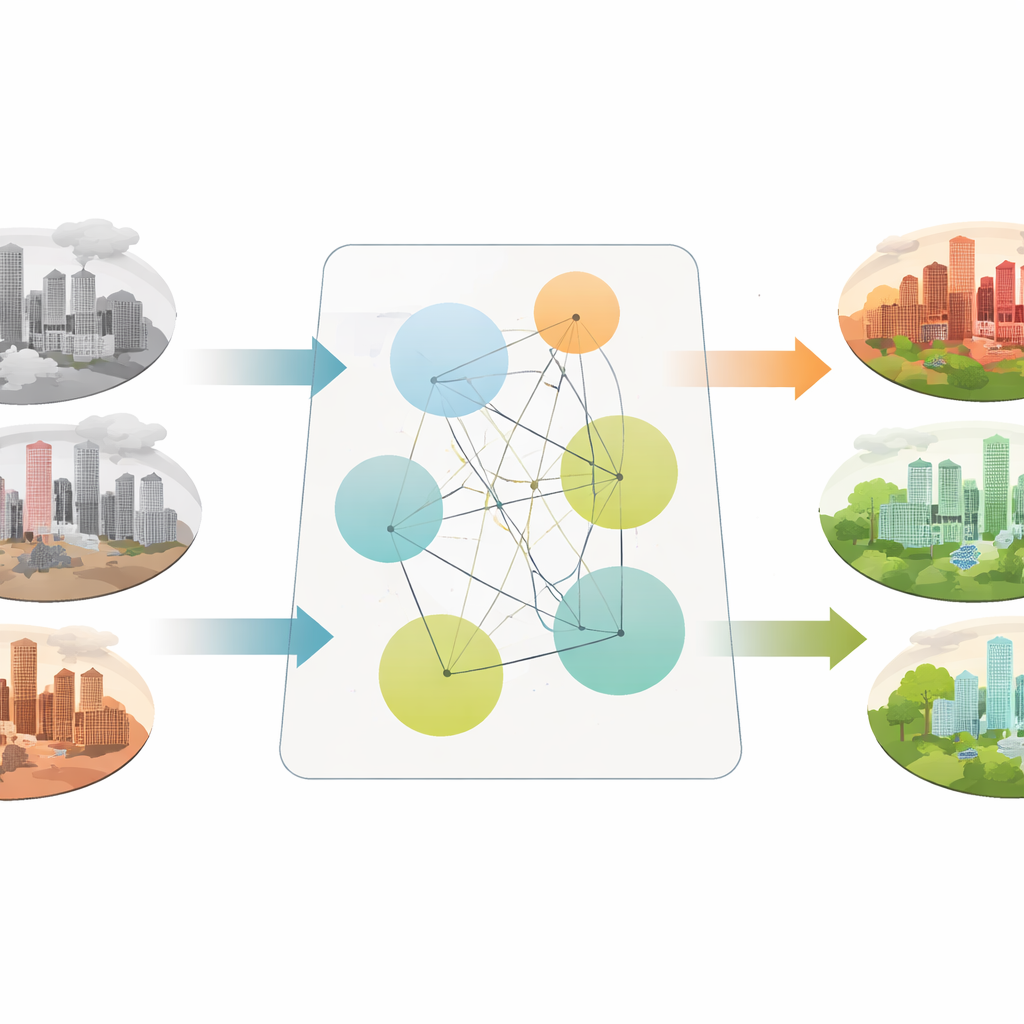
Looking at City Clusters as Living Systems
The study focuses on nineteen major urban agglomerations across China—large networks of cities that share people, industries, roads, and pollution. Rather than treating "urbanization" and "pollution control" as vague ideas, the authors break them into concrete pieces. Urbanization is described through four sides of city life: how many people are moving in and finding jobs, how strong the local economy is, how well social services such as health and education are provided, and how fast the built‑up area spreads. Pollution control is described through three angles: the pressure created by energy use and waste, the state of the environment, and the responses taken by governments, such as treatment plants and green spaces. This allows a more realistic picture of how growth and cleanup advance—or clash—inside each city cluster.
Measuring Balance Between Growth and Cleanup
To compare very different cities on the same scale, the authors use a data‑driven scoring method that blends dozens of statistics into two main indices: one for urbanization and one for pollution control. They then calculate how tightly these two indices move together, a measure they call the “coordination degree.” A high value means that better urban development comes hand‑in‑hand with cleaner air and water; a low value means that progress on one side tends to undermine the other. Cities are grouped into types, ranging from severely out of balance to highly coordinated, and maps are used to track how these types shift from 2010 to 2019 across the entire country.
Uneven Progress and Stubborn Gaps
The results show that most Chinese cities sit in the middle of the pack for both urbanization and pollution control, with very few achieving truly top‑tier performance. Within nearly every urban agglomeration, core cities such as provincial capitals pull ahead, while surrounding smaller cities fall behind, creating a clear center–edge divide. Coastal regions like the Yangtze River Delta and the Pearl River Delta are the most successful at combining strong growth with improving environmental protection, but even there, many neighboring cities remain stuck in basic maladjustment. Over time, extremely poor situations become less common, and some core cities shift into a more balanced state. Yet improvements spread only slowly outward, so nationwide averages rise while regional inequality in coordination persists.
Finding the Real Bottlenecks Inside the System
One of the paper’s key insights is that weak coordination is usually not because everything is doing poorly, but because one or two pieces of the system act as bottlenecks. For example, population urbanization—bringing more people into cities with better jobs and services—often helps coordination by building a stronger tax base and demand for cleaner living. In contrast, the way land is developed tends to work against coordination: sprawling construction and low‑density expansion raise energy use and pollution faster than they improve quality of life. On the environmental side, the sheer scale of emissions and the lingering impact of past pollution drag down coordination, while government actions such as better waste treatment and higher green spending help but rarely compensate fully. Each urban agglomeration shows its own mix of helping and hindering subsystems, which the authors translate into tailored suggestions: some regions need to curb energy‑intensive heavy industry, others to rethink land use, and still others to strengthen public services so growth does not rely on polluting sectors.
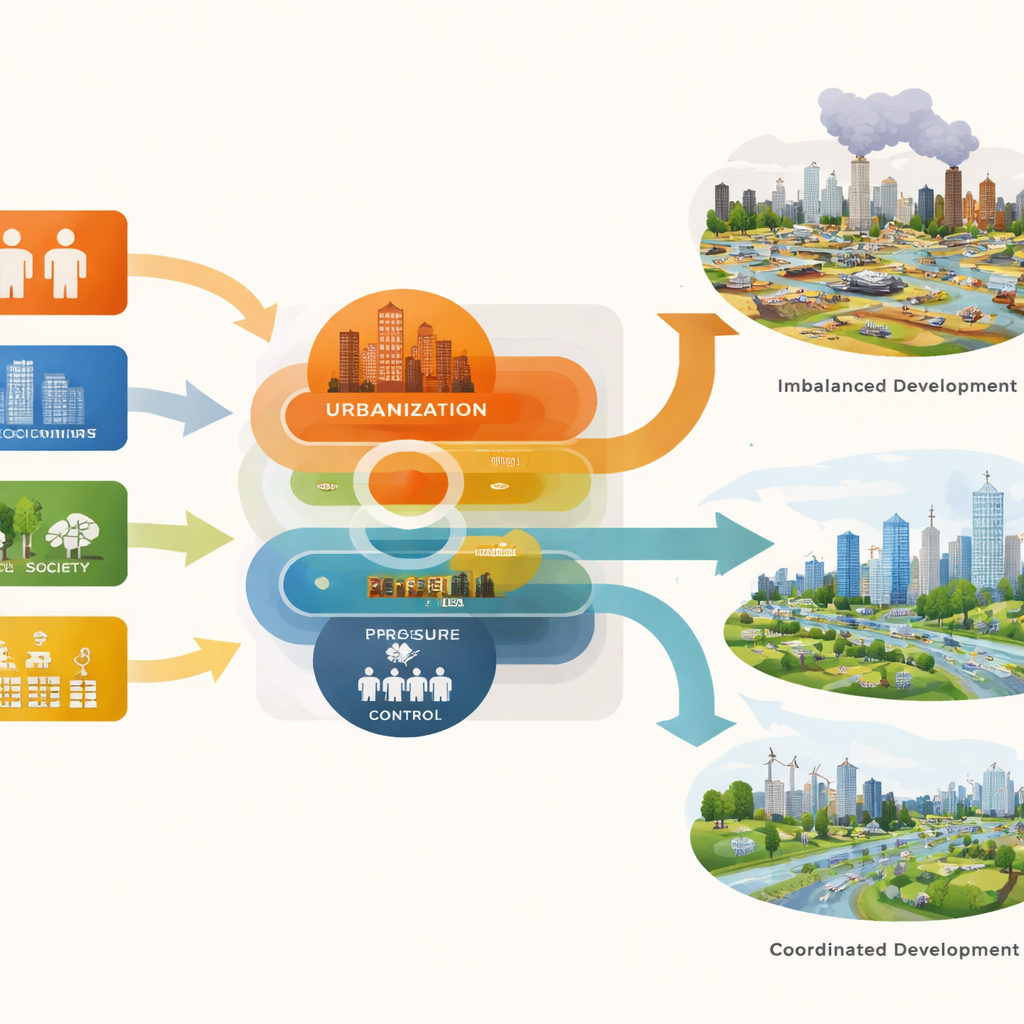
What This Means for Future City Living
For a lay reader, the main takeaway is that greener cities are not just about more parks or stricter factory rules. They depend on many moving parts of urban life working in step—where people live and work, how fast land expands, what kinds of industries dominate, and how seriously local leaders treat pollution. This study shows that China’s city clusters have begun to shift toward better balance between growth and cleanup, but that progress remains fragile and uneven. By pinpointing which parts of each region are out of sync, the framework gives planners and policymakers a practical roadmap: target the true bottlenecks, rather than applying one-size-fits-all policies, to move entire city networks onto a path of cleaner, fairer, and more sustainable development.
Citation: Qin, Y., Li, H. Types identification, patterns characterize and pathway optimization of synergistic development between urbanization and pollution control in Chinese urban agglomerations. Sci Rep 16, 11587 (2026). https://doi.org/10.1038/s41598-026-41820-9
Keywords: urban agglomerations, pollution control, low-carbon transition, China urbanization, sustainable city planning