Clear Sky Science · en
A low-magnitude high-frequency vibrator utilizing a specific amplitude and frequency for bone remodeling conducive to orthodontic tooth movement
Why a gentler buzz could shorten braces time
For many people, the worst part of getting braces is not the metal on their teeth but how long treatment takes and the side effects that can follow. This study explores whether a very gentle, rapid vibration applied to teeth can speed up movement while helping the surrounding bone stay strong, using a tiny mechanical device and a key pressure-sensing protein in the tissues around the teeth.
How tooth movement and bone work together
When an orthodontist moves teeth, the bone that holds them must constantly be broken down in some spots and rebuilt in others. If this process is too slow, treatment drags on; if it is too aggressive, tooth roots and jawbone can be damaged. The tissues that connect teeth to bone, known as the periodontal ligament, sense mechanical forces and relay signals that tell bone cells when to remove old bone and when to lay down new bone. Scientists have identified a pressure-sensitive channel called Piezo1 in these tissues that helps convert physical force into biological responses, making it a promising target for safer ways to speed tooth movement.
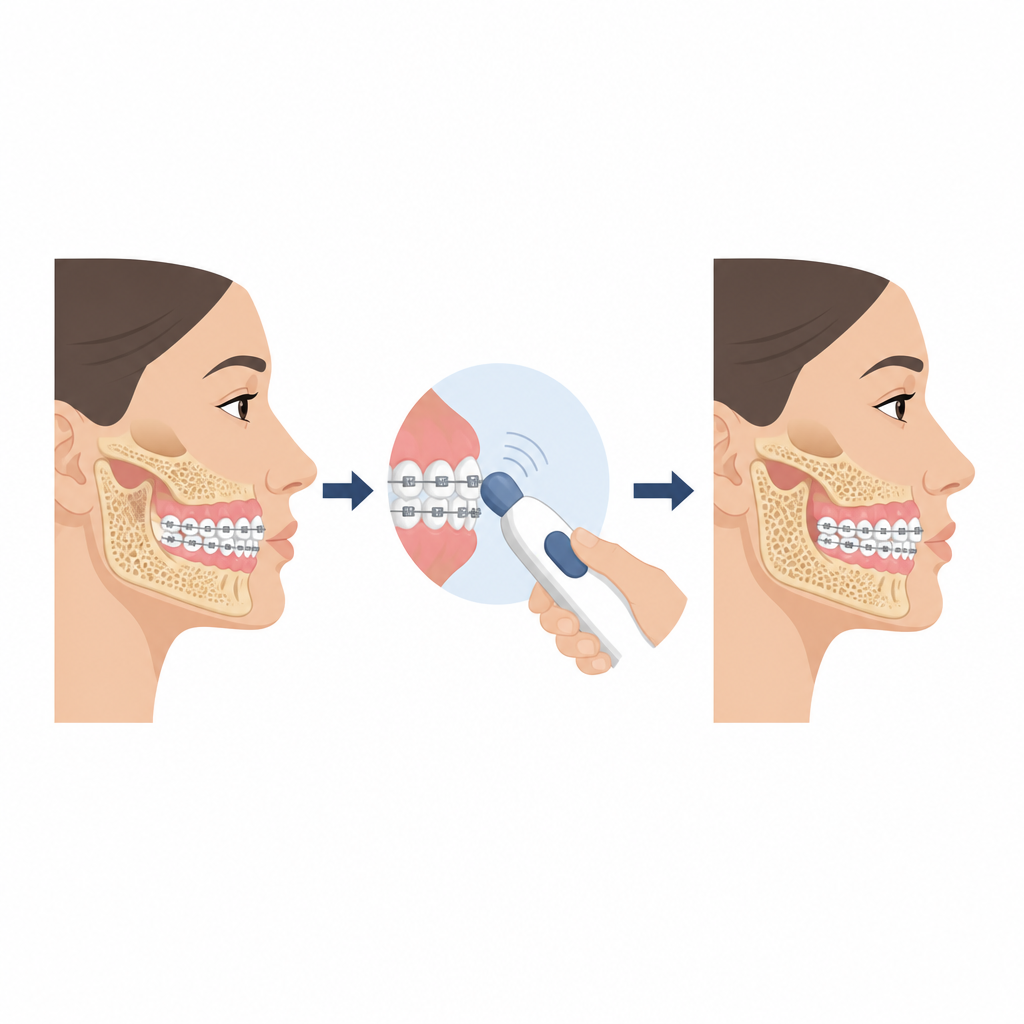
A tiny vibrator with carefully tuned settings
The researchers built a small device that produces low-strength but high-speed vibrations, with adjustable frequency and amplitude. They tested it in a rat model of orthodontic tooth movement by attaching a spring to move an upper molar and then applying vibrations at five different frequencies, from none at all up to 100 cycles per second. Each rat received 15 minutes of vibration per day. After two weeks, the team examined the jawbone using detailed X ray scans and tissue staining to see how much bone had formed, how dense it was, and how far the teeth had moved.
Finding the “sweet spot” for vibration
The results showed that vibration did not help equally at all settings. Around 75 cycles per second, the bone around the moving tooth became denser and its internal structure thickened, while the tooth itself moved farther in the same amount of time compared with teeth that received no vibration. At 100 cycles per second, the tissues formed more fibers, but signs of root damage increased and bone density did not improve. These findings suggest that there is a sweet spot where the vibration is strong enough to encourage healthy rebuilding of bone without adding harmful stress.
A pressure sensor at the heart of the response
To understand why 75 cycles per second worked best, the team focused on the Piezo1 channel in the periodontal ligament. They stained the tissues to see how much Piezo1 was present and found that its levels rose with increasing vibration, peaking near 75 cycles per second. They then used two drugs: one that nudges Piezo1 to open more often, and another that blocks it. When vibration at 75 cycles per second was paired with the activator drug, bone density and thickness increased even more, and Piezo1 staining grew darker. When the blocker was used instead, both Piezo1 staining and bone measures dropped, even though vibration continued, pointing to Piezo1 as a central player in how these gentle forces shape the bone.
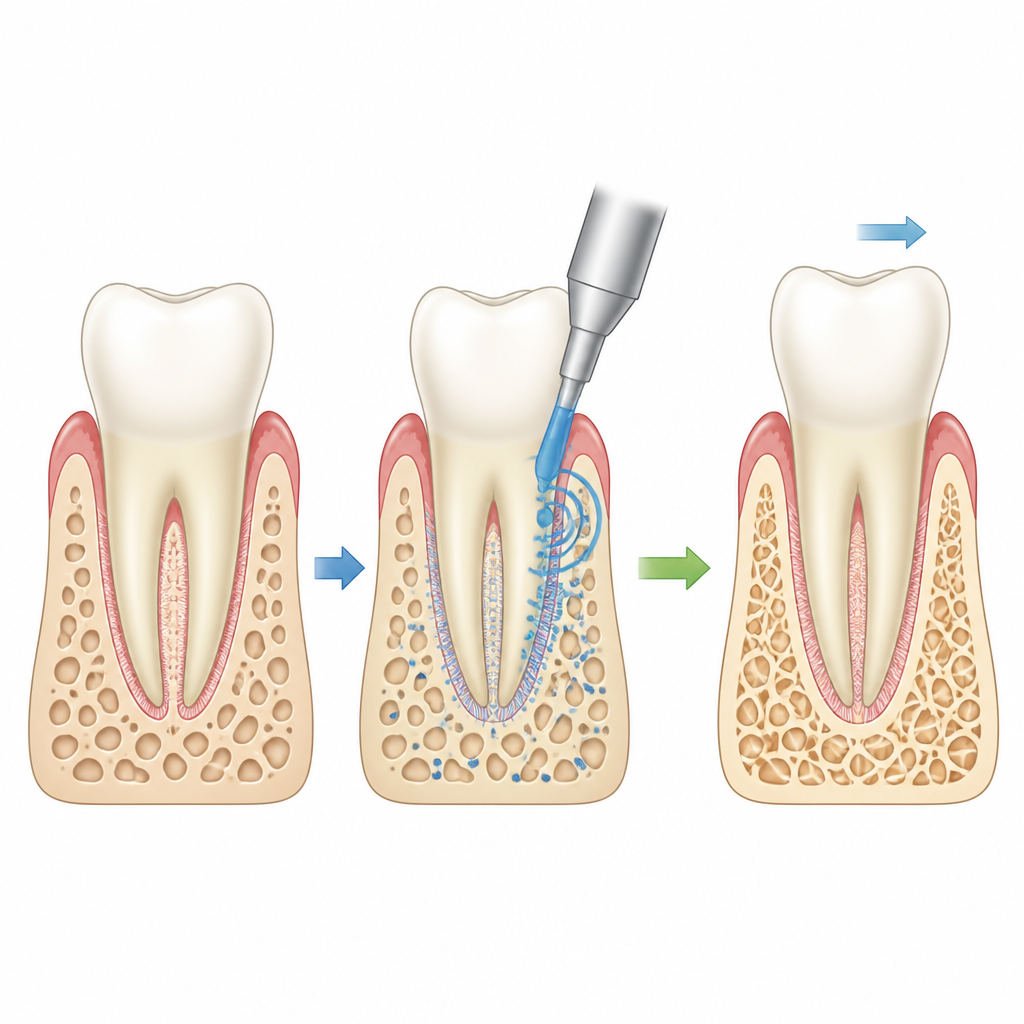
What this could mean for future orthodontic care
In simple terms, the study suggests that a mild buzz at just the right speed can tell the tissues around a tooth to build stronger bone while letting the tooth slide into place faster, and that a specific pressure sensor molecule helps drive this response. Although these tests were done in rats and over a short period, the work raises the possibility that small, carefully tuned vibrators could one day be used alongside braces to shorten treatment and support healthier bone, provided that the settings are chosen to help and not harm the teeth and their roots.
Citation: Wu, Z., Jiang, Q., Chen, Y. et al. A low-magnitude high-frequency vibrator utilizing a specific amplitude and frequency for bone remodeling conducive to orthodontic tooth movement. Sci Rep 16, 15775 (2026). https://doi.org/10.1038/s41598-026-41804-9
Keywords: orthodontic vibration, tooth movement, alveolar bone, Piezo1, braces treatment time