Clear Sky Science · en
Drift and dispersion of silver carp (Hypophthalmichthys molitrix) eggs and larvae for hypothetical spawning scenarios in the Upper Mississippi River
Why this river story matters
Much of the wildlife, fishing, and recreation on the Upper Mississippi River is threatened by invasive carp, fast‑growing fish that can crowd out native species. Managers know adult carp are showing up farther and farther upstream, but they still do not know exactly where these fish could successfully reproduce. This study uses a computer model to follow virtual silver carp eggs and larvae as they drift down the Upper Mississippi, revealing where young carp are most likely to survive—and where the river itself may help stop them.
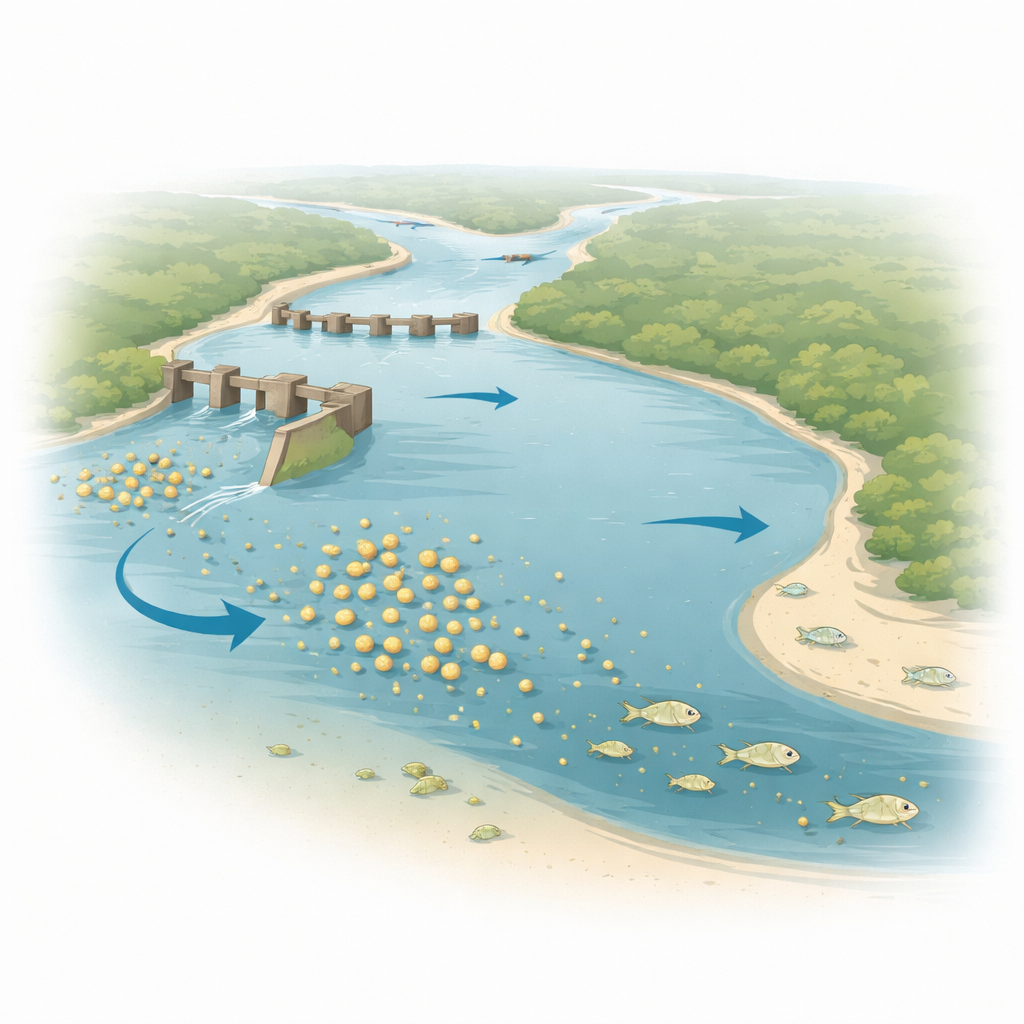
Unwanted travelers on a great river
Four species of invasive carp, including silver carp, were brought to North America decades ago and have since spread throughout much of the Mississippi River Basin. They eat huge amounts of plankton, compete with native fish, and can disrupt both ecosystems and local economies. While self‑sustaining populations are firmly established farther downstream, reproduction has not yet been confirmed in the northern pools of the Upper Mississippi, from the Twin Cities area down to just below Lock and Dam 10. Knowing whether this reach can support successful spawning and growth of young carp is crucial for deciding where to concentrate monitoring and control efforts.
Following eggs on a digital river
Silver carp release thousands of tiny eggs into fast‑moving water, usually below dams or at river bends where currents are strong. These eggs and the fragile larvae that hatch from them drift with the flow for days before the young fish can swim well enough to seek out quiet nursery areas. The research team used a tool called the Fluvial Egg Drift Simulator to mimic this journey in Pools 1–10 of the Upper Mississippi. They ran 450 different scenarios, combining five water temperatures, nine flow levels, and ten spawning spots below major dams, then tracked where model eggs would be at hatching and where larvae would be when they first inflate their gas bladders and become active swimmers.
The surprising role of a natural lake
One feature stood out as a powerful gatekeeper: Lake Pepin, a broad, slow‑moving natural lake along the river. Simulations showed that when eggs are released upstream of Lake Pepin, the sluggish currents in the lake tend to let them sink toward the bottom before they hatch. That settling likely increases mortality, as eggs resting on or bouncing along the bed may be damaged or smothered by sediment. Only eggs that stay suspended long enough to drift through the lake can hatch and continue downstream. In contrast, when spawning is simulated downstream of Lake Pepin, eggs and larvae remain in faster‑moving channels where they stay afloat more easily but are swept much farther along the system.
Where young carp could take hold
The team also looked at how temperature and flow shape risk. Warmer water speeds development, shortening the distance eggs and larvae drift before they can swim, while higher flows push them farther downstream. For spawning upstream of Lake Pepin, most successful hatching and early development still occur within the study reach—but only if eggs avoid settling in the lake. For spawning downstream of Lake Pepin, larvae in most scenarios drift beyond the lower end of the study area before reaching the stage when they would turn into active, feeding juveniles. Only under relatively warm, low‑flow conditions do some larvae remain within Pools 1–10 long enough to find nursery habitat, meaning recruitment risk there is highest for specific combinations of temperature, flow, and upstream spawning locations.
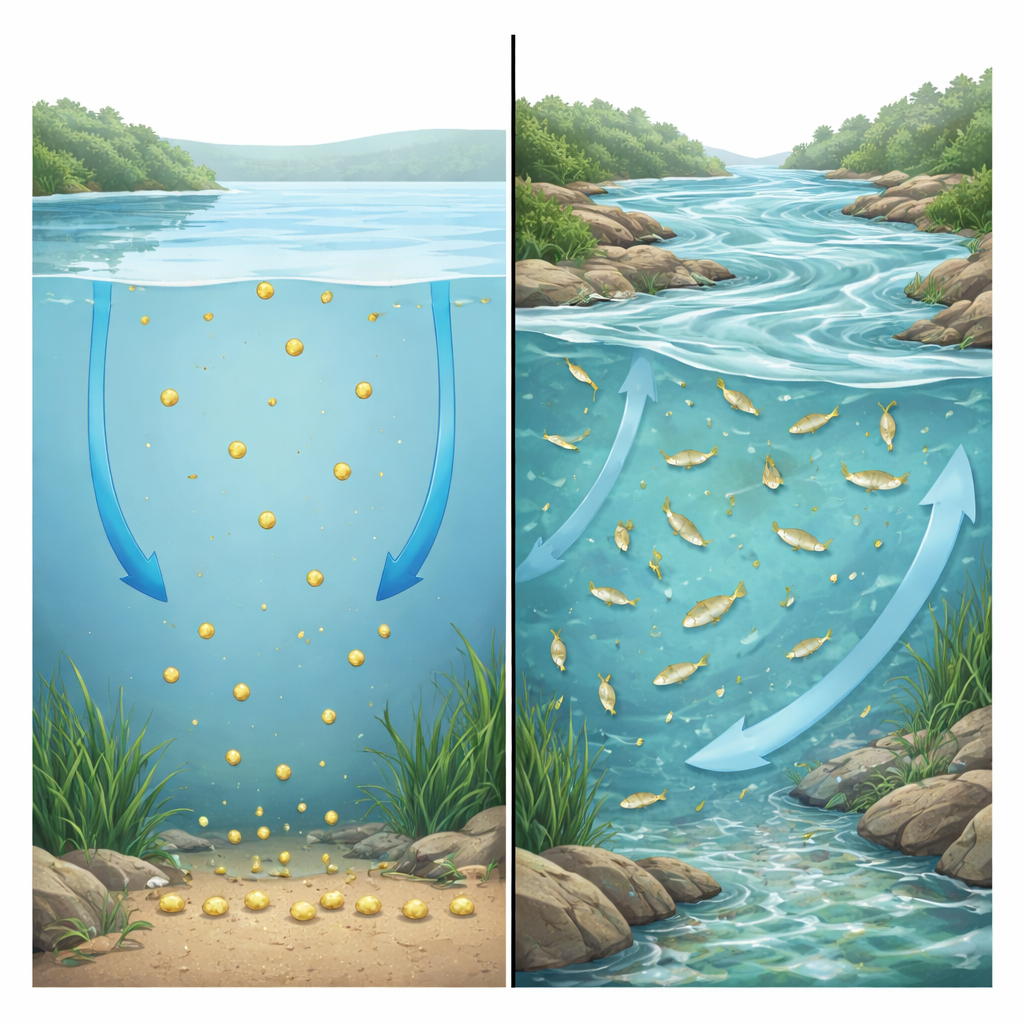
Turning model insights into action
By tracing these virtual eggs and larvae, the study shows that the geography and hydraulics of the Upper Mississippi strongly shape where invasive carp could gain a foothold. Lake Pepin often acts as a natural filter that causes many upstream‑spawned eggs to settle before hatching, while downstream reaches tend to carry larvae out of the area entirely. Only in a subset of warm, moderate‑flow conditions, and with spawning far enough upstream, do young carp linger in Pools 1–10 long enough to potentially survive. Managers can use these insights to place sampling gear where eggs or larvae are most likely to appear and to focus removal efforts on areas most likely to support new generations, buying time to protect native fish and the river communities that depend on them.
Citation: LeRoy, J.Z., Loppnow, G.L., Jackson, P.R. et al. Drift and dispersion of silver carp (Hypophthalmichthys molitrix) eggs and larvae for hypothetical spawning scenarios in the Upper Mississippi River. Sci Rep 16, 14421 (2026). https://doi.org/10.1038/s41598-026-41803-w
Keywords: invasive carp, silver carp, Upper Mississippi River, egg drift modeling, aquatic invasive species