Clear Sky Science · en
Electron bunch optimization in laser wakefield acceleration through temporally asymmetric pulse shaping in ionization injection regime
Smaller particle machines with big potential
Modern particle accelerators stretch for kilometers and cost billions, but a newer approach called laser wakefield acceleration offers a way to shrink these machines to laboratory size. This paper explores how reshaping the brief flash of a powerful laser in time can fine tune the tiny bursts of electrons it produces, opening paths toward compact sources for research, imaging, and industry. 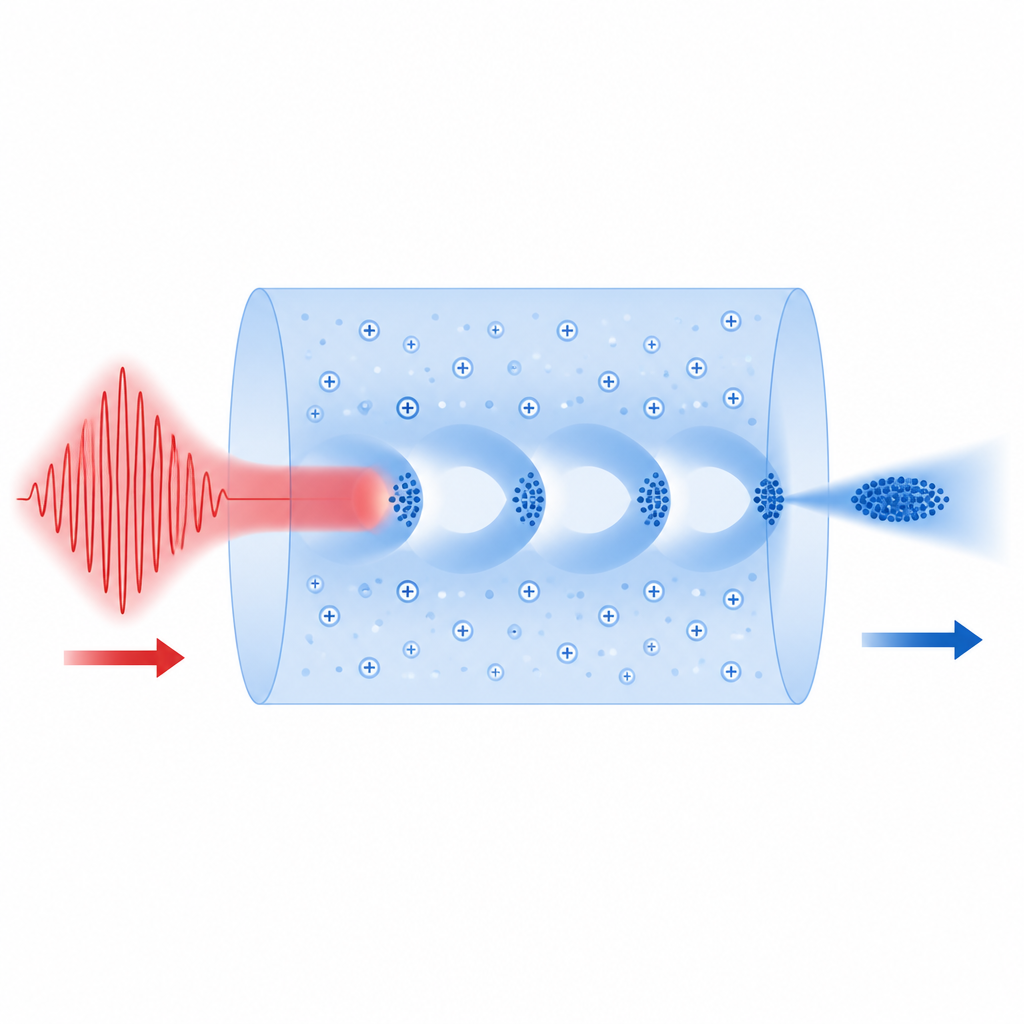
Riding a wave of light in a tiny gas cloud
In laser wakefield acceleration, an intense laser pulse flies through a thin gas that has been turned into plasma, pushing electrons aside and leaving a trailing wave, much like a speedboat crossing a lake. Electrons that fall into just the right part of this wave can be swept up and rapidly accelerated to high energy over only a few millimeters. A long standing challenge has been to control exactly when and how many electrons join this ride, because that timing strongly affects their energy, spread, and how tightly they are packed.
Shaping the laser flash like a tailored heartbeat
The researchers focus on a scheme called ionization injection, where a gas mixture of light atoms and a small amount of heavier atoms is used. The laser is strong enough to strip tightly bound electrons from the heavier atoms right inside the plasma wave; these freshly freed electrons can then be trapped and accelerated. Instead of using the usual symmetric laser flash, the team studies pulses whose brightness grows and fades at different rates in time. By changing this temporal asymmetry, they can alter the structure of the wake and the moments when new electrons are released into it.
Short bursts versus heavier loads
Using detailed computer simulations, the authors compare two main types of shaped pulses: one with a fast trailing edge and one with a slow trailing edge. Fast trailing pulses generate a sharper and stronger wakefield, which captures electrons over a brief region and accelerates them over a longer distance. This produces compact electron bunches with relatively low charge but higher maximum energies, reaching around 450 million electron volts in their model. In contrast, slow trailing pulses keep the injection going for longer, leading to broader bunches that carry more charge but reach lower energies because the wave is more heavily loaded.
Balancing beam sharpness and beam strength
The simulations also reveal how pulse shape influences the transverse spread and pointing of the beam. Pulses that favor prolonged injection tend to produce bunches with higher charge and, in the two dimensional studies, a trend toward reduced sideways spread of the electrons. Pulses that favor brief injection create more energetic but less heavily loaded beams with somewhat larger transverse spread. By examining phase space maps and a simple theoretical model, the authors show that pulse asymmetry changes the depth and shape of the potential wells that trap electrons, effectively tuning who gets caught and how they move. 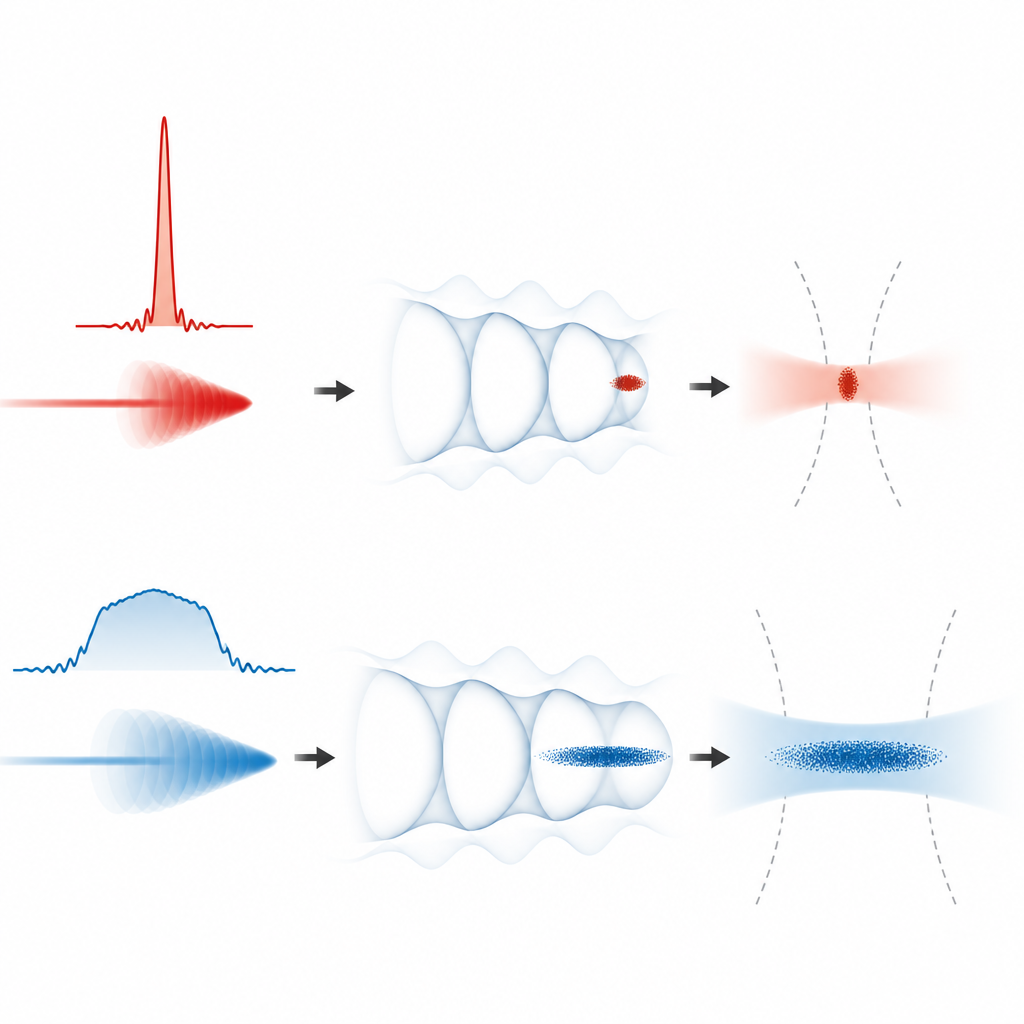
A tunable knob for future compact accelerators
For a general reader, the key message is that the shape of a laser flash in time can act like a control knob for compact particle accelerators. By choosing the right form of asymmetry, experimenters can trade between higher energy, higher charge, and tighter beam quality without changing the gas or plasma density. This flexible control could help tailor small, lab scale accelerators for different uses, from high energy physics experiments to new X ray sources and advanced imaging tools.
Citation: Ravina, Kim, S., Gupta, D.N. et al. Electron bunch optimization in laser wakefield acceleration through temporally asymmetric pulse shaping in ionization injection regime. Sci Rep 16, 15019 (2026). https://doi.org/10.1038/s41598-026-41795-7
Keywords: laser wakefield acceleration, electron bunches, pulse shaping, plasma accelerator, ionization injection