Clear Sky Science · en
Analysis of chemiluminescence and liquid chromatography-mass spectrometry in 25-hydroxyvitamin D detection using fuzzy logic
Why vitamin D tests don’t always agree
Vitamin D has become a household name, linked to strong bones, immune defense, and protection against diseases like diabetes and heart problems. Doctors usually check a form in the blood called 25-hydroxyvitamin D to see whether someone is getting enough. But there is a catch: different laboratory tests can give slightly different answers on the same blood sample. This study explores why two common testing methods disagree, and how an artificial intelligence approach called fuzzy logic can uncover hidden patterns in these differences.
Two ways to measure the same sunshine vitamin
Hospitals typically use a fast, automated method called chemiluminescence immunoassay, which works a bit like a lock-and-key reaction between vitamin D in the blood and special antibodies. A more advanced and precise method, liquid chromatography–tandem mass spectrometry, separates and weighs vitamin D molecules and is often treated as the “gold standard.” The researchers analyzed 138 blood samples that were tested by both methods on the same day in a large Chinese hospital. They found that the mass spectrometry method consistently reported slightly higher vitamin D levels than the immunoassay, with an average difference of about 1.3 units on the measurement scale. 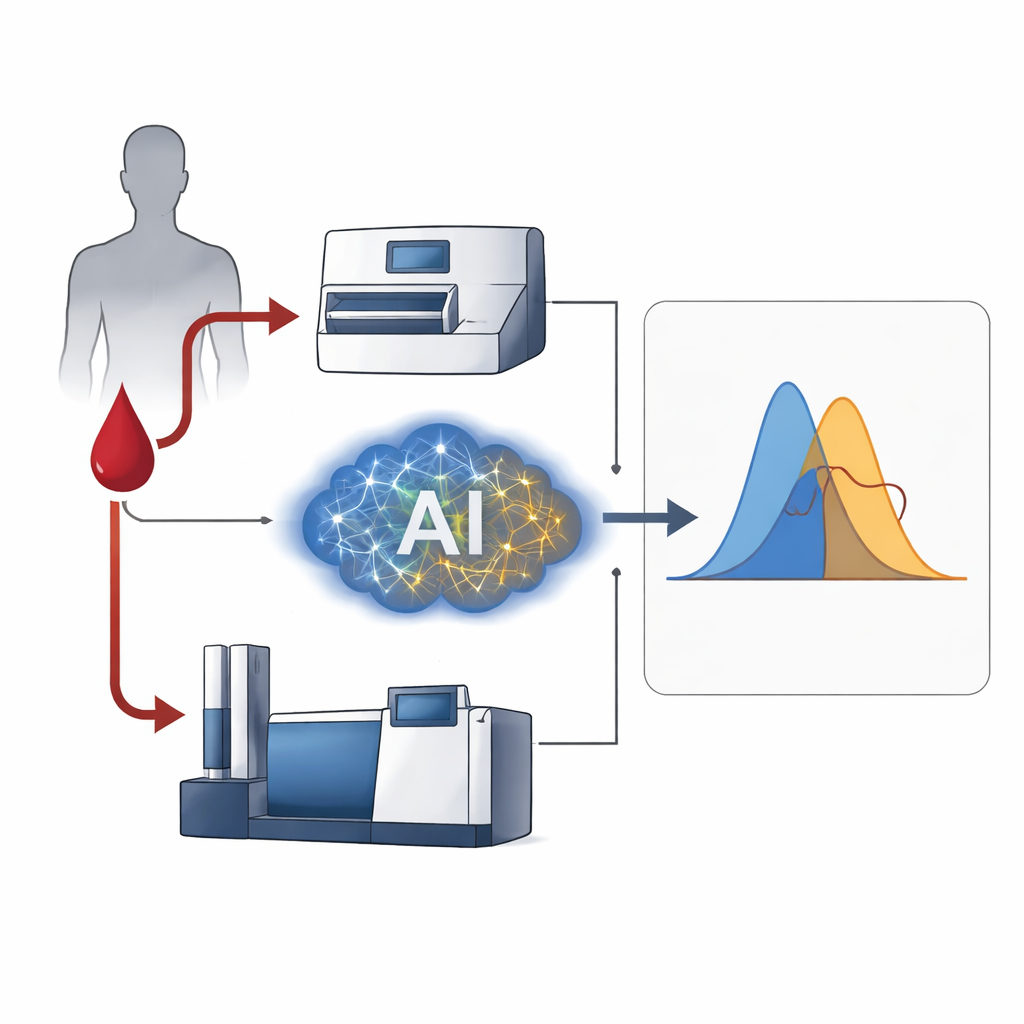
Small gaps that matter near the cutoff
Although the two methods agreed more than 90 percent of the time, the remaining disagreements were not trivial. Around one in eleven people would be placed in a different category—such as “deficient” versus “sufficient”—depending on which test was used, especially near common clinical cutoffs of 20 or 30 units. For individuals just on the border, that could mean the difference between being told they need supplements or being reassured that their levels are fine. The study also highlighted that average vitamin D levels in this sample, taken from a relatively well-off region, were below 30 units, suggesting that even in higher-income areas of Asia, vitamin D status may be suboptimal and deserves continued monitoring.
Letting AI handle shades of gray
Traditional statistics often assume clear, straight-line relationships, but real biology is messier. To better understand why the two tests sometimes diverge, the team turned to fuzzy logic, a branch of artificial intelligence designed to handle “in-between” situations rather than simple yes-or-no answers. They fed a generative fuzzy inference system with four pieces of information for each person: the result from each test, age, and sex, and asked it to learn rules that explain how differences between methods arise. Instead of rigid categories, fuzzy logic assigns each data point partial membership in overlapping groups—such as low, medium, and high—allowing subtle trends to emerge that might be missed by conventional tools. 
A surprising signal in women in mid-adulthood
The fuzzy logic model uncovered an intriguing pattern: women in their thirties showed the largest gaps between the two testing methods, especially when vitamin D levels were above the lowest threshold. To check whether this was a fluke, the researchers examined an additional 59 samples. When they compared women aged 30 to 40 with everyone else, the midlife female group was more than three times as likely to show a large difference between methods. The authors suggest that hormonal changes and related proteins that carry vitamin D in the blood may contribute, although the study did not directly measure these factors. The sample also included more women than men, which may have amplified the pattern.
What this means for everyday health decisions
For most people, both vitamin D tests give broadly similar answers, and either can be useful for routine care. However, this work shows that method choice and patient characteristics, such as age and sex, can subtly shift measured values and even tip borderline results into a different category. By combining modern laboratory technology with fuzzy logic, the researchers provide a more nuanced picture of how and when these differences arise. Their findings support ongoing efforts to standardize vitamin D testing worldwide and suggest that doctors should be cautious when interpreting results near decision thresholds, particularly for women in mid-adulthood, where discrepancies between methods may be greatest.
Citation: Liu, H., Li, S., Wong, K.W. et al. Analysis of chemiluminescence and liquid chromatography-mass spectrometry in 25-hydroxyvitamin D detection using fuzzy logic. Sci Rep 16, 11886 (2026). https://doi.org/10.1038/s41598-026-41793-9
Keywords: vitamin D testing, laboratory methods, fuzzy logic, clinical diagnostics, women’s health